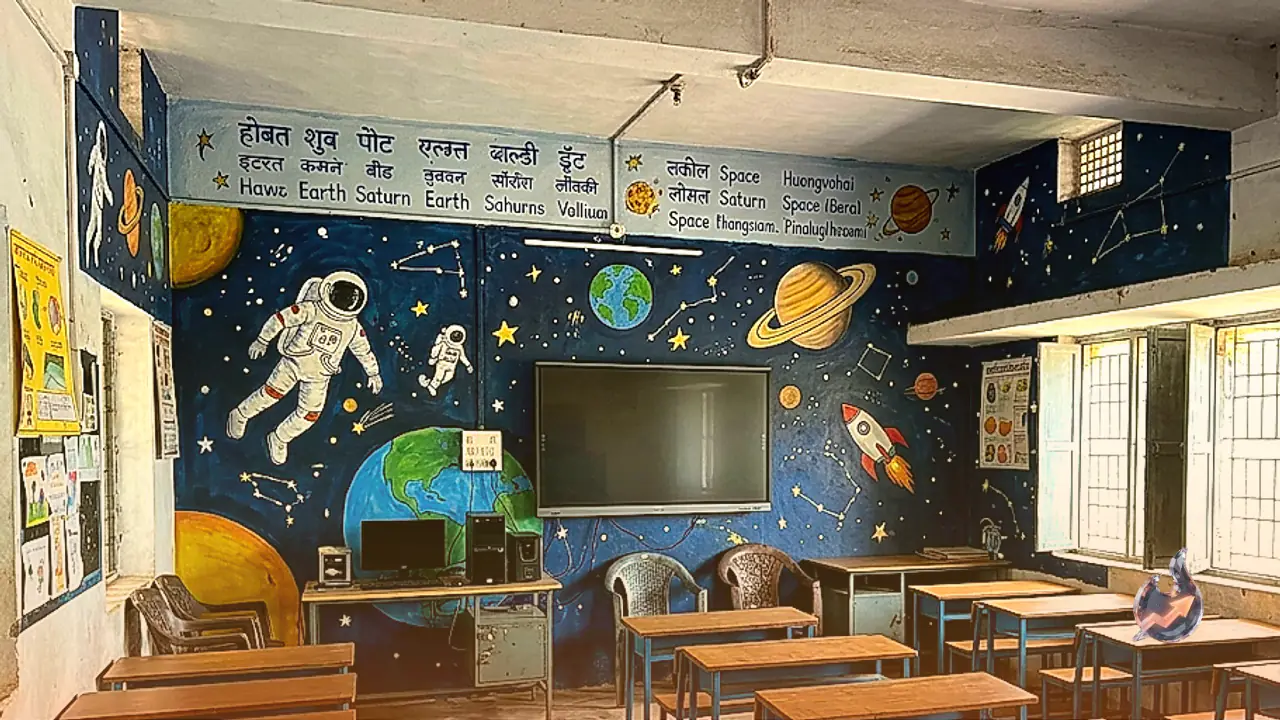

In an inspiring development from rural Chhattisgarh, a government middle school situated in Baigavahapara within Surguja district has undergone a dramatic transformation. What was once a struggling rural institution marked by low student engagement has now evolved into a dynamic learning space comparable to modern private institutions. Prior to the pandemic and during the intermittent disruptions of recent years, teachers routinely marked their attendance, but pupils showed little enthusiasm or responsiveness in the classroom. Recognizing that routine instruction was failing to ignite curiosity, the entire teaching faculty joined forces to reinvent the institution, making sure children would eagerly walk through the school gates every single day.
Transformative Leadership under the Headmistress
The campaign to uplift the institution began under the close guidance and direction of Headmistress Suruchi Khalkho. The leadership firmly believed that cosmetic upgrades alone would be meaningless unless accompanied by a noticeable rise in academic proficiency. Teacher Kamlesh Singh, who also shoulders the administrative responsibility of cluster coordinator, pointed out that the educational foundation of many students suffered a setback in the wake of the pandemic closures. Prolonged absence from structured learning created substantial learning gaps among children in the village. To reverse this setback, the faculty resolved to rebuild basic competencies while introducing engaging tools that could make standard subjects accessible and fun.
Educators Fund Tech Upgrades from Their Own Pockets
Instead of waiting indefinitely for departmental funds or external grants, the educators decided to pool their personal financial resources. Understanding that modern education requires digital literacy, the teachers purchased computers and a television set out of their own personal savings. Furthermore, to provide a clean and dignified physical setting, the school staff spent roughly sixty thousand rupees from their personal funds on wall putty work, plaster repairs, and fresh paint. Kamlesh Singh explained that this financial contribution stemmed from a shared vision to ensure that students from modest backgrounds enjoy the same modern educational advantages as their urban counterparts, enabling full all-round growth.
Transforming Blank Walls into Cosmic Learning Centers
The physical layout of the school was reimagined to serve as an active teaching instrument. Instead of plain or neglected surfaces, the walls now feature detailed illustrations of the solar system, deep space, and the planetary orbits. Alongside these astronomical visuals stands a portrait of pioneer astronaut Kalpana Chawla, placed intentionally to inspire students through her extraordinary life journey and scientific achievements. Learning here is no longer restricted to traditional textbooks. Teachers consistently use educational games and interactive group activities to teach the updated curriculum across Hindi, mathematics, English, and social science.
Students Envision Careers in Public Service and Teaching
The addition of technological tools and interactive pedagogy has generated palpable enthusiasm among the student body. Eighth grade student Ankit Yadav mentioned that access to television sets, computers, school gardening, and organized sports has made attending classes an enjoyable daily routine. Ankit explained that teachers provide dedicated attention to each lesson, motivating him to work hard toward his ambition of joining the police department. Another classmate shared an equally ambitious dream of becoming a teacher to educate future generations of rural children.
Inspiring Young Girls to Reach for the Stars
Female students in the upper primary grades are showing a marked rise in self-assurance and ambition. Eighth-grade student Gudiya spoke passionately about Kalpana Chawla, noting how the astronaut undertook an extraordinary journey into space despite immense hurdles. Another student, Kumari Prince Yadav, articulated her firm desire to become a police officer in the future. The girls recalled that when they studied in lower grades, the school lacked such educational infrastructure. However, once they entered the sixth grade, the entire learning environment shifted for the better. The students credited teacher Kamlesh Singh and the broader faculty for investing time and care into creating a modern educational atmosphere.
Rural Learners Compare Their Campus to Private Academies
The extensive structural and teaching reforms have completely reshaped how students perceive their campus. When asked whether their institution feels like a conventional government setup or an upscale private facility, the children enthusiastically stated that it matches the quality of a private school. With digital screens, computer hands-on sessions, active gardening clubs, and lively sports periods, the campus has become a welcoming hub. The educators of Baigavahapara have proven that dedicated public school teachers can create transformative learning environments through collective willpower and personal initiative.