






















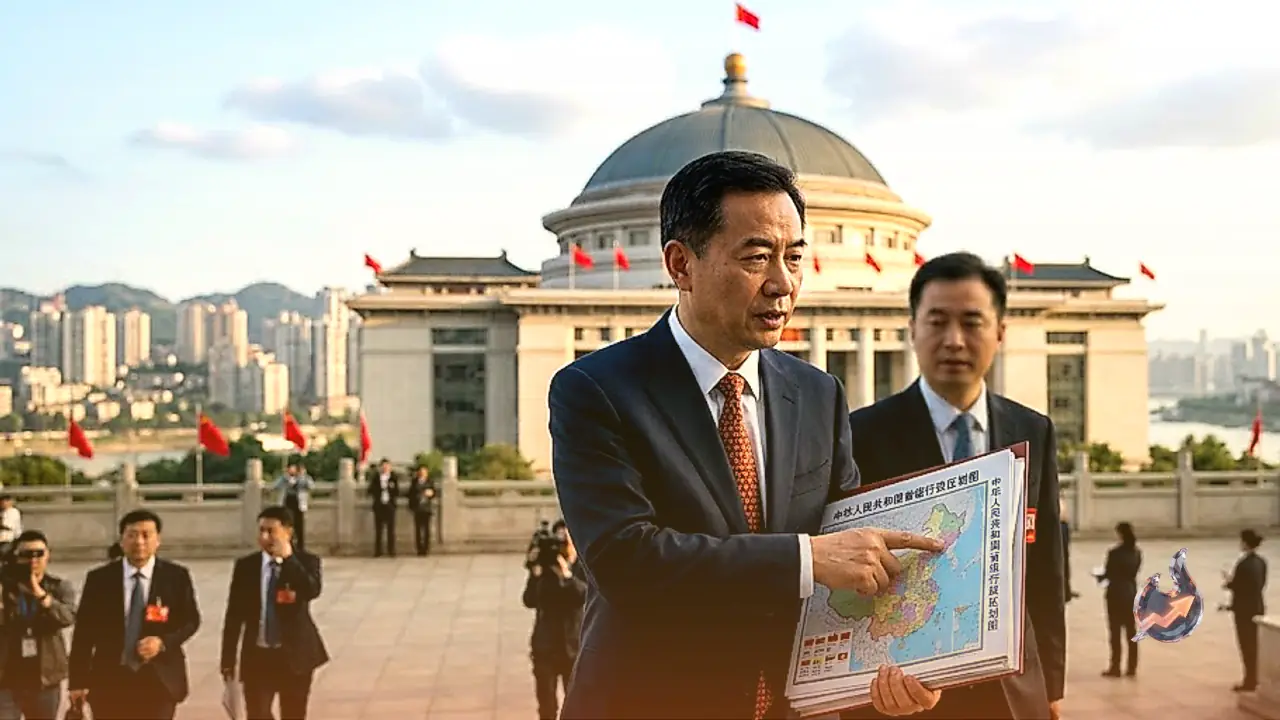

When analyzing the governance frameworks of major global powers, most people naturally picture a federal setup similar to India or the United States, where power is divided between a central government and individual states. However, China, despite being the world's fourth-largest country by land area and the second-largest economy, operates on an entirely different administrative philosophy. China does not possess traditional states or provinces with independent constitutional autonomy. Instead, the nation is administered as a unitary state through a structure known as Provincial-Level Administrative Divisions (PLADs).
The Breakdown of China's 34 Provincial-Level Entities
To systematically manage its massive geographic footprint and population, Beijing has organized its primary tier of governance into 34 Provincial-Level Administrative Divisions. Rather than giving every region the same political legal standing, China groups four distinct categories of governance under this single top-level umbrella
- 23 Provinces: This official count includes Taiwan, over which Beijing claims sovereignty.
- 5 Autonomous Regions: Territory designated for significant ethnic minority populations with limited localized administration.
- 4 Direct-Controlled Municipalities: Major metropolitan cities that fall under the direct jurisdiction of the central government.
- 2 Special Administrative Regions (SARs): Hong Kong and Macao, governed under specific constitutional frameworks.
The 23 Mainstream Provinces: China's Economic Engine
China officially recognizes 23 provinces as the core of its administrative framework. Key powerhouses among these include Guangdong, Zhejiang, Jiangsu, Sichuan, Henan, Hubei, Fujian, and Shandong. These provincial territories accommodate the vast majority of China's population, housing the heavy industrial centers, technology hubs, and manufacturing facilities that drive global supply chains. Although Beijing includes Taiwan in its official count of 23 provinces, the island maintains its own democratic government and is not under direct mainland administrative control.
The 5 Autonomous Regions and Their Historical Background
To manage regions with dense ethnic minority populations, China established 5 Autonomous Regions. While these units are granted specific localized policy latitude regarding cultural affairs, all ultimate executive authority remains tightly controlled by the central government in Beijing and the Chinese Communist Party (CCP). Their historical timelines developed as follows
- Inner Mongolia: The CCP established control over this region on May 1, 1947, during the Chinese Civil War, two full years before the formal founding of the People's Republic of China (PRC) in 1949.
- Xinjiang: Following the surrender of Republic of China (ROC) government officials in 1949, the territory came under CCP authority. Initially designated as a standard province, it was re-established as the Xinjiang Uygur Autonomous Region on October 1, 1955.
- Tibet: The People's Liberation Army (PLA) expanded its presence into Tibet in 1950, leading to Beijing establishing administrative control under the Seventeen Point Agreement in 1951. Following the 1959 Tibetan uprising, central control was fortified, culminating in the creation of the Tibet Autonomous Region (TAR) on September 1, 1965.
- Guangxi: Integrated into the PRC as Guangxi Province in 1949, it was reorganized into the Guangxi Zhuang Autonomous Region on March 15, 1958, to accommodate its large Zhuang ethnic population.
- Ningxia: Originally designated as Ningxia Province upon the founding of the PRC in 1949, it was officially declared the Ningxia Hui Autonomous Region on October 25, 1958, recognizing its significant Hui Muslim demographic.
Direct-Controlled Municipalities and Special Administrative Regions
China elevates four major urban centers out of provincial jurisdictions altogether: Beijing, Shanghai, Tianjin, and Chongqing. These direct-controlled municipalities hold an administrative rank equal to that of a full province and report directly to the central power structure.
Furthermore, Hong Kong and Macao operate as Special Administrative Regions (SARs). Integrated under the 'One Country, Two Systems' principle, both territories were allowed to maintain separate legal, monetary, and economic structures for extended periods following their handovers, though Beijing's central authority over both regions has deepened substantially in recent years.
Comparing Unitary China with Federal Systems
The fundamental distinction between China and federal systems like India lies in where sovereign power resides. In a federal nation like India, constitutional authority is explicitly divided between the union government and state governments, granting states independent legislative domain.
In contrast, China operates a strictly unitary system. All legislative and administrative power emanates from the central government and the Communist Party of China (CPC). Local and provincial administrators do not enjoy independent constitutional mandates; instead, their primary mandate is executing policy directives handed down from Beijing.