






















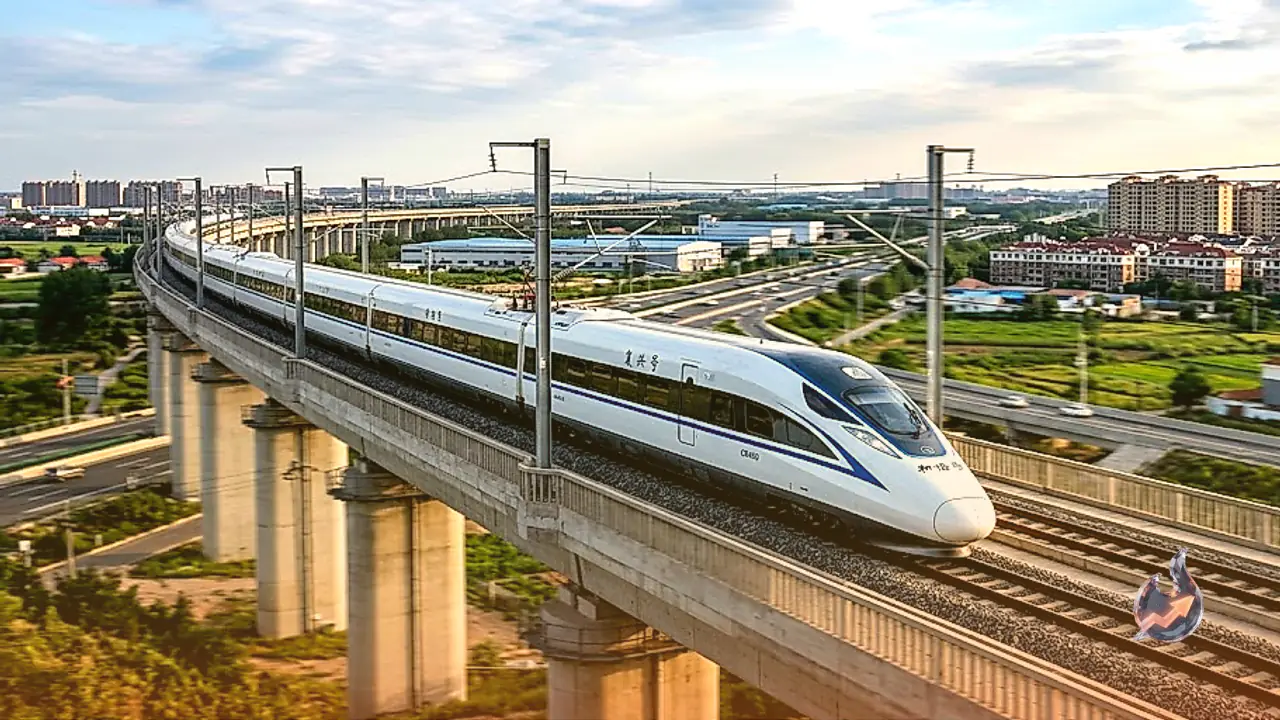

China's next-generation CR450 high-speed train has officially completed its extensive pre-service testing programme, clearing a critical hurdle on its path to commercial deployment. Designed to sustain a passenger operating speed of 400 kilometres per hour, the train accumulated over 600,000 kilometres during its trials. That cumulative testing distance equals approximately 15 complete circumnavigations of the Earth's equator, underscoring the scale of evaluation conducted before welcoming the travelling public onboard.
A Mandatory 600,000-Kilometre Safety Hurdle
Under national railway regulations in China, no new high-speed passenger train may enter commercial service without first logging 600,000 kilometres in rigorous trial runs. The mandate exists to eliminate vulnerabilities and safeguard passenger wellbeing under sustained operating stress. Over the course of the trials, engineers subjected the train to demanding environmental extremes, including sub-zero winter temperatures, intense summer heat, and severe rainstorms across diverse track layouts.
Throughout this exhaustive evaluation, monitoring systems gathered granular performance metrics on every core component. Specialists tracked the operating temperatures of the traction motors, measured mechanical friction at the wheel-rail interface, analysed aerodynamic drag and air pressure, and recorded interior sound levels. The train earned operational clearance only after consistently satisfying all safety and engineering criteria across each stage of testing.
Carbon-Fibre Construction and Efficiency Gains
China's commercial high-speed railway corridors currently rely on Fuxing CR400 trainsets, which operate at a maximum service speed of 350 kilometres per hour. The CR450 represents a major evolutionary jump in operational capacity. While its revenue-earning service will be capped at 400 kilometres per hour, the experimental platforms attained even higher velocity marks during closed-track technical evaluations.
The engineering team achieved these gains through advanced aerodynamic shaping and lightweight structural materials. Significant portions of the train body utilise carbon fibre and resilient composite materials, keeping aggregate mass down while maintaining structural rigidity. This lower weight profile allows the trainset to accelerate far more rapidly. Aerodynamic refinement and reduced weight together yield an estimated 12 to 15 percent drop in electricity consumption compared to predecessor rolling stock, alongside superior acoustic insulation that keeps interior cabin noise low.
Sensor Integration and Emergency Braking Architecture
Operating passenger equipment at 400 kilometres per hour presents formidable deceleration demands, particularly during unforeseen emergencies. To address this operational risk, engineers developed a dedicated deceleration system designed to yield a markedly reduced braking distance. In situations where emergency braking must be engaged, the mechanism brings the trainset to a stable halt across a short stopping distance without severe mechanical jolting.
The train's defensive architecture also relies on integrated AI monitoring algorithms and automated sensor arrays. These instruments continuously survey the physical state of the track, trackbed alignment, downstream weather patterns, and onboard machinery health. Should the monitoring hardware identify an anomaly, structural flaw, or external hazard along the rail alignment, the control system initiates prompt and automated speed reductions to neutralise the hazard.
Compressing Intercity Transit Timelines
The operational entry of the CR450 will substantially alter point-to-point transit times between China's primary economic hubs. On the heavily travelled 1,300-kilometre corridor connecting Beijing and Shanghai, existing high-speed trains require between 4 and 4.5 hours. Deploying the CR450 is projected to shorten that journey to roughly 2.5 to 3 hours, bringing substantial efficiency to business and regional travel.
Cabin interiors are outfitted with contemporary passenger amenities to sustain comfort at elevated speeds. Travellers will have access to high-speed 5G connectivity, smart digital displays, wireless charging pads, and generous legroom. Furthermore, window assemblies and cabin pressure seals are calibrated to regulate atmospheric pressure shifts when passing through tunnels or crossing other trains, preventing passenger ear discomfort throughout high-velocity transits.