
























Privacy-centric cryptocurrency Monero trades steadily around $564 on Tuesday, cementing gains of nearly 3% logged during the previous session. Backed by key infrastructural progress on its next-generation privacy protocols and an increase in speculative positioning across derivatives exchanges, the token is maintaining its footing comfortably above the $560 threshold. Market participants are monitoring technical formations and on-chain indicators as price action approaches key resistance levels.
Beta Stressnet v3.0 Introduces FCMP++ and Scaled Anonymity
Monero rolled out the v3.0 beta stressnet release for its Full-Chain Membership Proofs (FCMP++) upgrade along with its new CARROT addressing protocol. The major objective of this technical milestone is to significantly harden the network against traceability and upgrade underlying wallet functionalities. The implementation places strong emphasis on seamless support across both hot and cold wallet environments.
A central pillar of the FCMP++ upgrade is the expansion of transaction anonymity sets. Moving past the legacy structure of 16 decoys, the protocol scales the anonymity pool to more than 100 million decoys, creating a mathematically formidable layer of financial privacy for individual transfers. Furthermore, the overhaul facilitates the integration of Layer-2 network protocols, opening the door for accelerated block confirmation times and virtually instantaneous, consecutive payments across the Monero ecosystem.
Derivatives Markets Point to Growing Long Positioning
Data from CoinGlass reveals that retail interest in XMR derivatives has expanded notably alongside spot gains. Monero futures Open Interest (OI) climbed by more than 4% over the last 24 hours to reach $263.33 million. This expansion reflects an uptick in the total notional value of active contracts as traders deploy fresh capital into the market.
Trading volume surged by 56% over the same timeframe to hit $132.89 million, illustrating heightened turnover and active engagement from market participants. Simultaneously, the funding rate moved up from 0.0104% on the previous day to 0.0347%, indicating that buyers holding perpetual long contracts are paying higher premiums to keep their positions open, a dynamic characteristic of bullish positioning.
Technical Outlook: Symmetrical Triangle Tests Resistance
On the four-hour timeframe, Monero continues to demonstrate constructive price structure, holding positions above its key moving averages. The asset trades comfortably above the 50-period, 100-period, and 200-period Exponential Moving Averages (EMAs), which are plotted at $548, $545, and $525, respectively.
Price action highlights a rebound unfolding within a symmetrical triangle structure governed by two converging trendlines. The upper resistance trendline sits in the vicinity of $565, while the lower boundary provides dynamic support near $537. Adding technical weight to this barrier, the 50% retracement level measured from the swing high of $609 down to the trough of $518 aligns at $563, reinforcing the supply overhead. A decisive breakout above the $565 resistance zone could pave the way for a retest of the $609 swing high if momentum persists.
Technical indicators reinforce this upward bias. The Relative Strength Index (RSI) fluctuates near 64, well within bullish territory without signaling an immediate overbought extreme. Concurrently, the Moving Average Convergence Divergence (MACD) remains positioned above its signal line, demonstrating sustained buyer control. Should the token face downward pressure, initial support rests at the 50-period EMA at $548, with further cushions identified at the 100-period EMA at $545, the ascending trendline around $536, and the 200-period EMA at $525.
Broader Regulatory Landscape and Peer Performance
In regulatory developments, Michael Selig, Chairman of the Commodity Futures Trading Commission (CFTC), stated that the agency will move forward with establishing regulations for the digital asset market after legislative efforts in the United States Congress failed to produce a comprehensive federal framework.
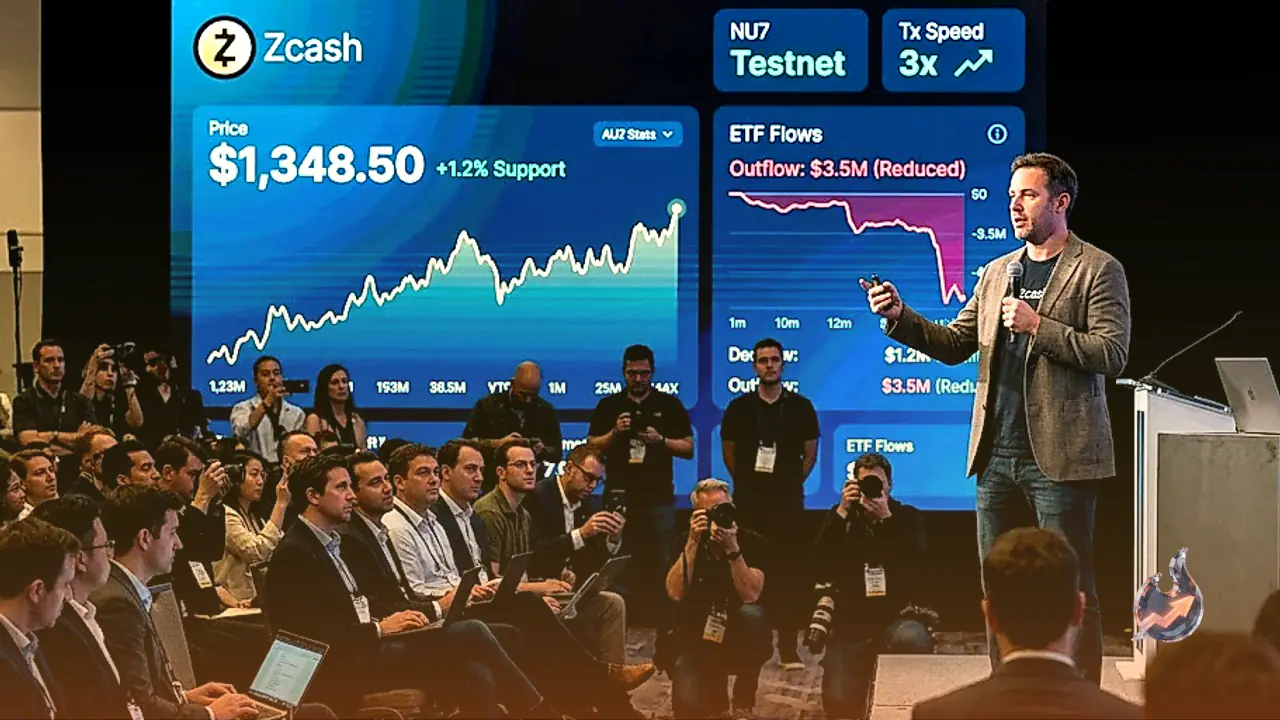
Across the wider cryptocurrency market, Ripple and Stellar faced downward pressure, slipping below $1.499 and $0.220, respectively, amid early-week corrections. Weakening derivatives metrics and fading bullish momentum indicate ongoing caution among XRP and XLM traders. In contrast, Zcash maintained a steady stance near $1,348 following mild weekend gains. The network saw its NU7 upgrade go live on Monday, accelerating transaction speeds and directing 60% of network fees into future development incentives. Institutional outflows from Zcash also moderated sharply, dropping to approximately $3.50 million on Monday from $93.56 million recorded during the previous week.