
















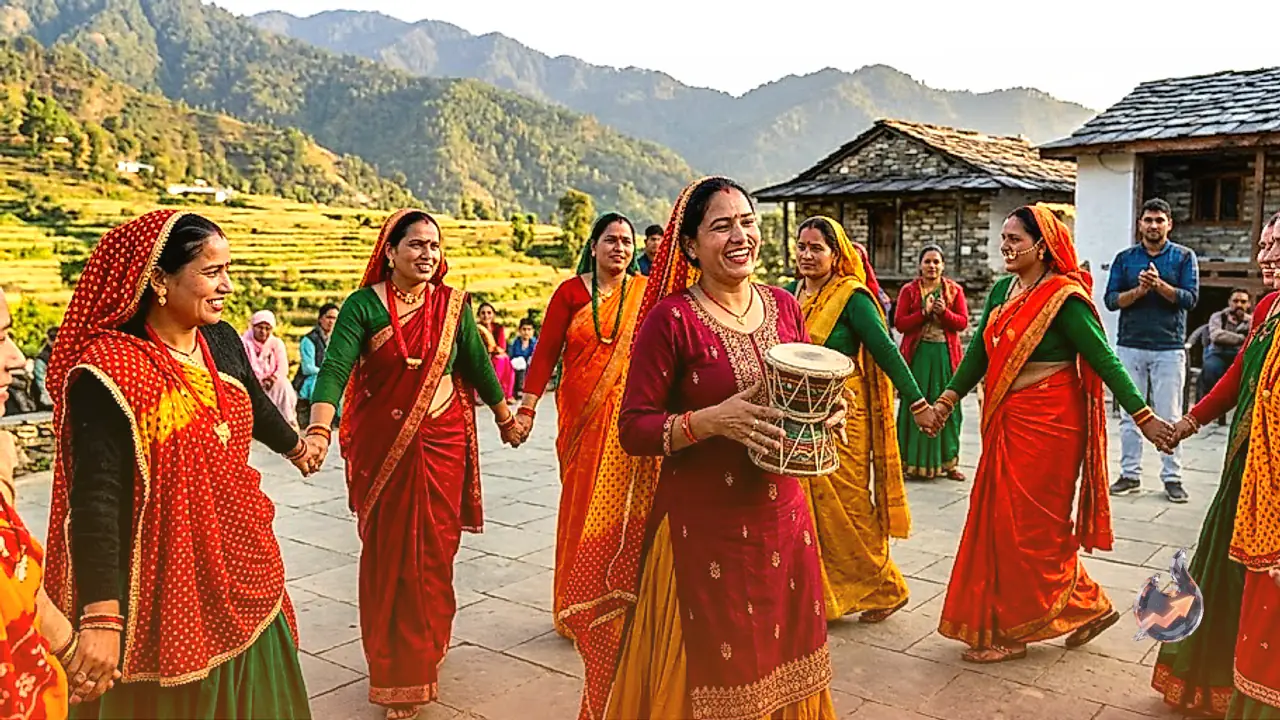

In the remote and picturesque Danpur region of Bageshwar district in Uttarakhand, the centuries-old hill tradition of Jhoda and Chanchari folk music and collective dance remains vibrantly alive. Despite the rapid spread of modern digital entertainment and changing lifestyle trends, local residents continue to celebrate their heritage with unmatched enthusiasm. During regional fairs, sacred religious rituals, and social gatherings, women dressed in traditional Kumaoni attire assemble in large groups to perform these ancient folk forms. Standing in circular or semi-circular formations with arms rested over each other's shoulders or waists, the dancers step in precise synchronization to the beats of traditional percussion instruments. This artistic spectacle is far more than mere entertainment; it embodies the spirit of community cohesion, mutual affection, and the simplistic lifestyle of the Himalayan hills.
The Rhythmic Pulse of the Hudka and Lead Vocalist
At the center of every Jhoda-Chanchari gathering is the powerful resonance of the Hudka, a traditional hour-glass-shaped drum native to the region. As soon as the first rhythmic beats of the Hudka echo through the air, an invigorating energy sweeps across the gathering. According to local cultural observer Prema Koranga, the musical arrangement follows a structured and disciplined pattern. The main lead singer initiates the performance by rendering the opening poetic verse. Immediately following this lead call, the surrounding chorus of men and women repeats the line in harmonious unison. As the tempo of the Hudka accelerates, the steps of the dancers quicken accordingly until the entire group moves as one unified body. The choreography showcased by the women of Danpur is celebrated for its graceful body flexibility and effortless coordination.
Circle Formation and Synchronized Group Choreography
The defining hallmark of Jhoda and Chanchari is its thoroughly collective and democratic nature. Unlike performance styles that feature solo artists or individual spotlights, this folk tradition relies entirely on group harmony. Dancers arrange themselves in a semicircle or complete circle, interlocking hands behind one another's shoulders or waists. Guided by the rhythm of the music, the dancers move forward, backward, left, and right in fluid, rhythmic unison. This synchronized movement creates a visually captivating spectacle where individual identities dissolve into a single artistic expression, demonstrating how collective cooperation produces enduring beauty.
Themes of Hill Life, Devotion, and Romance in Folk Lyrics
The verses of Chanchari folk songs offer a vivid reflection of daily life, emotions, and cultural values in the Kumaon region. Written in the local Kumaoni dialect, the lyrics span a wide spectrum of human experience, including innocent romance, romantic longing, devotion to local deities, and the warmth of family relationships. The songs capture the quiet beauty and daily perseverance required in mountain villages. Hearing these hauntingly beautiful melodies echoes through the hills invokes deep nostalgia among listeners, connecting them to their ancestral villages, families, and childhood memories. Beyond musical enjoyment, Chanchari serves as an oral vessel that transmits historical narratives and folk values across generations.
The Highlight of Religious Fairs and Village Festivals
In Danpur, local religious festivals, shrine rituals, and seasonal fairs gain their distinctive charm from the Jhoda-Chanchari performances. Women participating in these festivities often wear ornate traditional Kumaoni jewelry and colorful attire, instantly elevating the celebratory atmosphere. The seamless alignment of footsteps, the chorus of melodic voices, and the rhythmic thump of the Hudka create an intoxicating ambiance that draws onlookers directly into the dance circle. These cultural showcases highlight the vital role women play as custodians of Himalayan heritage.
Bridging Generations in the Modern Digital Era
Even as modern technology, television, and social media capture the attention of younger audiences, the tradition of Jhoda-Chanchari has lost none of its relevance in Danpur. Community elders and veteran artists actively dedicate time to train the younger generation in song lyrics, Hudka rhythm patterns, and traditional choreography steps. Children and young adults learn by observing these performances at local melas and community gatherings, absorbing the techniques under adult mentorship. As a result, these folk songs and dances remain a thriving, lived tradition rather than a forgotten relic of history. Collective village celebrations continue to serve as the backbone of cultural preservation.
Preserving Kumaoni Identity and Community Bond
Jhoda-Chanchari is not merely a combination of music and dance; it represents the living soul and cultural identity of the Kumaon region. In the hills of Danpur, this enduring tradition keeps people deeply connected to their roots. The echo of the Hudka drum, the communal chorus, and the synchronized footwork reflect the humility, warmth, and solidarity of mountain living. In an era dominated by fast-paced contemporary trends, such community traditions stand as a bulwark against cultural erosion, ensuring that the legacy of Devbhoomi Uttarakhand continues to shine for generations to come.