


















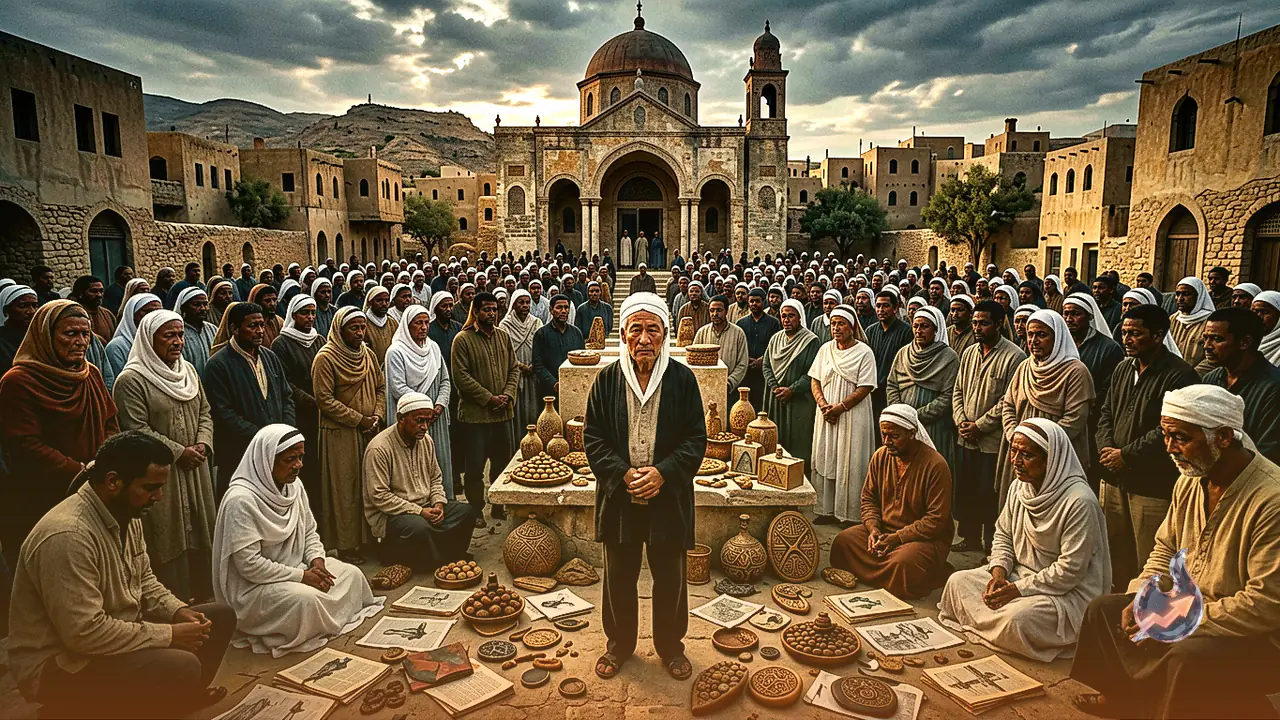

A packed church in the West Bank town of Birzeit, located near Ramallah, hosted solemn funeral services for the celebrated Palestinian artist Sliman Mansour following his death at the age of 79. Cultural figures, community leaders, and admirers gathered to pay their respects to a painter whose work became synonymous with Palestinian national identity, resistance, and connection to the homeland.
Mansour was widely recognized for his vivid canvas portrayals of rural Palestinian life, featuring olive groves, citrus orchards, and traditional heritage. Through his distinct visual language, he provided a powerful narrative of resilience and rootedness that resonated with Palestinians both in their homeland and across the global diaspora.
Translating Struggle and Heritage onto Canvas
Among Sliman Mansour's most enduring works is his iconic 1973 painting Camel of Hardship. The artwork depicts an elderly porter carrying Jerusalem and the gilded Dome of the Rock on his back, symbolising the emotional and historical weight carried by displaced Palestinians. Another signature piece, Woman From Bethlehem painted in 1987, offers a poignant portrait of his wife dressed in traditional attire, reflecting cultural pride amidst political turmoil.
His 2014 triptych titled Orange Fields further emphasized these themes by showcasing Palestinian women harvesting citrus fruits against the backdrop of the Jaffa coastline. The work pays homage to agricultural traditions while evoking memories of historic landscapes cherished by generations.
Reflecting on his artistic legacy, fellow artist and friend Vera Tamari noted, "He was actually the main Palestinian artist, the best known locally and internationally." Tamari stressed that Mansour dedicated his life to asserting Palestinian roots through art, often highlighting women clad in hand-embroidered thobes to anchor cultural identity in the soil.
Emerging from the 1947 Nakba to Form an Art Movement
Born in 1947 in the village of Birzeit during the British Mandate, Mansour arrived just prior to the founding of Israel and the subsequent 1948 Arab-Israeli war. That conflict resulted in the expulsion or displacement of over 700,000 Palestinians in what is remembered as the Nakba, or Catastrophe. These formative events deeply shaped his artistic consciousness.
Mansour went on to study fine arts in Jerusalem, where he recognized that Palestinian artists were existing inside a cultural ghetto. Drawing inspiration from a book detailing the murals of Mexican painter Diego Rivera, he sought to create art that connected directly with working-class people and broader society.
Over the decades, Mansour became a driving force behind Palestine's modern art movement. He co-founded the League of Palestinian Artists and the International Academy of Art, while aiding in the establishment of regional art galleries. Beyond easel painting, he illustrated children's literature, created political cartoons, authored books, and mentored scores of aspiring artists.
Defying Israeli Censorship with Earth and Clay
Due to the nationalist themes embedded in Palestinian art, practitioners frequently faced scrutiny from Israeli military authorities occupying the West Bank. During the 1970s and 1980s, soldiers regularly confiscated art postcards and prints, arresting merchants who sold them. When Gallery 79 opened in Ramallah, troops frequently raided exhibitions to remove works they deemed provocative.
In response, Mansour and his peers devised subtle symbolic codes within their art to convey political resistance without triggering military intervention. With the outbreak of the First Intifada in 1987, Mansour co-founded the New Vision collective alongside Tamari and other creators.
The group initiated a boycott of Israeli commercial art supplies, including synthetic acrylics and oil paints. Instead, they turned to local organic substances such as mud, straw, and henna. Mansour pioneered a technique utilizing mud mixed with straw on wooden panels, creating cracked, textured surfaces that evoked historic connection, passage of time, and deep roots in the earth.
Global Acclaim and a Modest Legacy
While Mansour's original canvases eventually commanded prices in the hundreds of thousands of dollars at international auctions, he remained committed to making his work accessible. He advocated for reproducing his paintings as inexpensive mass prints, allowing ordinary families and refugees to display his imagery in their homes.
Amer Shomali, a visual artist and director general of the Palestinian Museum, captured Mansour's impact by stating, "He was the mastermind of creating a Palestine that unifies us all as Palestinians, something that we long for and we work to live in." Shomali recalled growing up in a Syrian refugee camp with two of Mansour's posters pinned to his wall.
Mansour's masterpieces are now housed in premier global cultural institutions, including Abu Dhabi's Guggenheim Museum, Doha's Mathaf: Arab Museum of Modern Art, Paris's Institut du Monde Arabe, and London's British Museum. Despite his international stature, Mansour maintained legendary humility. Upon completing a grand mural for the Palestinian Museum, he famously declined a monetary fee, asking only that a fig tree be planted in the museum garden in his honor.