



















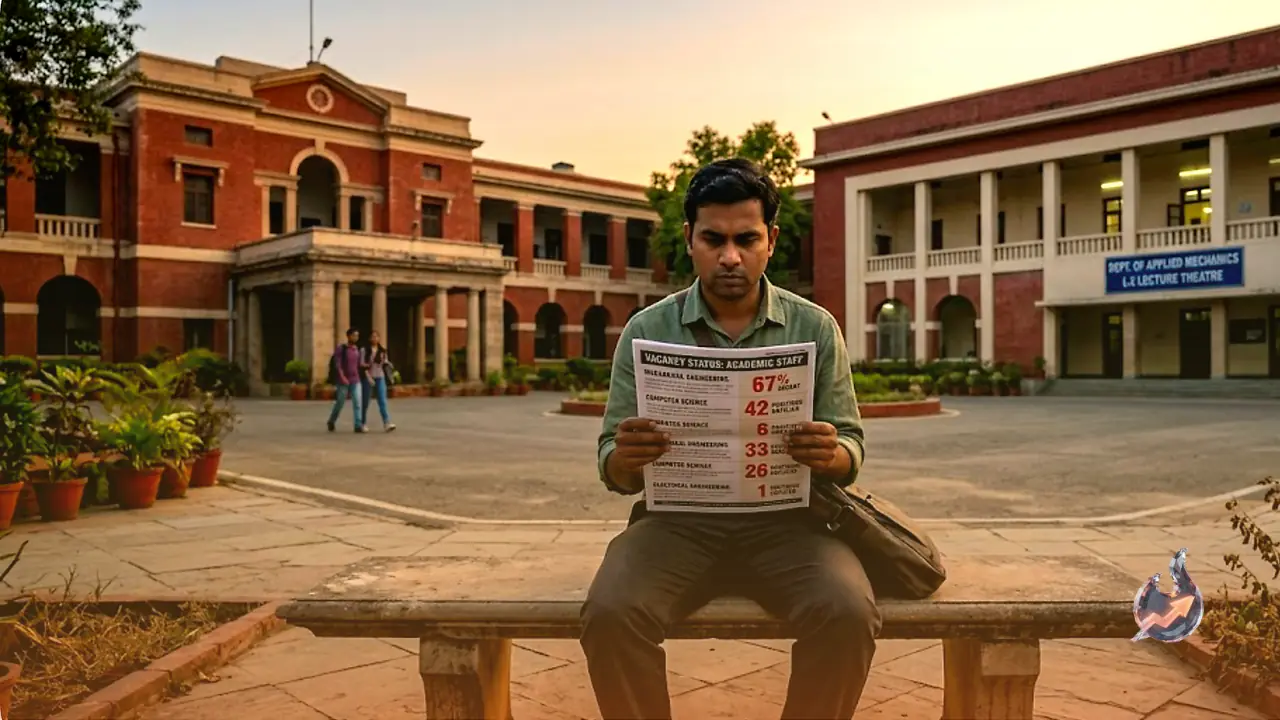

India's premier technical institutes are grappling with a serious faculty shortage that cuts across the entire system. IIT Council data and government records show that across the country's 23 IITs, 4,804 of the 12,498 sanctioned faculty positions currently lie vacant, amounting to roughly 38 percent of all approved posts. Put simply, two out of every five teaching chairs are empty. The situation is particularly pressing because these same institutions are simultaneously expanding their campuses, launching new courses, and admitting larger student cohorts, even as the faculty gap continues to widen.
Which IIT Has the Worst Shortage
IIT Patna carries the heaviest burden, with 54.6 percent of its sanctioned posts still unfilled. IIT Kharagpur follows at 51.3 percent. Across the broader system, the numbers tell a consistently worrying story:
- IIT Dhanbad: 48.4%
- IIT Goa: 45.8%
- IIT Guwahati: 42.2%
- IIT Mandi: 39.9%
- IIT Kanpur: 39%
- IIT Bombay: 38.4%
- IIT Delhi: 38.3%
Two institutions stand apart as relative bright spots. IIT Dharwad has kept its vacancy rate to just 1 percent, while IIT Palakkad stands at 5 percent, making them the best-staffed IITs in the country.
Teaching Quality and Research Output Under Pressure
With more than 1.35 lakh students currently enrolled across all IITs, the faculty deficit has begun to take a measurable toll on both instructional quality and the volume of research output. IIT directors point to fierce global competition for top PhD holders. Foreign universities, large multinationals, research laboratories, and deep-tech startups are offering these individuals attractive positions and compensation packages, making an IIT faculty role a harder sell for many qualified candidates who prefer these alternatives.
The selection bar at IITs is also notably rigorous, which means posts are deliberately held vacant until a suitably qualified candidate is identified rather than being filled with less capable applicants. The problem is especially acute in fast-emerging disciplines such as AI, semiconductors, and quantum technology, fields that have expanded rapidly but where the pool of educators with genuine, deep expertise remains thin.
Recruitment Campaigns Gain Pace
Several IITs have responded by adopting rolling advertisements, special recruitment drives, and mission-mode hiring campaigns to close the gap more quickly. IIT Kharagpur has completed over 215 faculty selections since October 2025. IIT Madras, which has 411 vacancies out of 1,100 sanctioned posts, is currently bridging the shortfall with visiting and adjunct faculty while full-time hiring continues.
The Ministry of Education has stated that vacancies are an inherent and continuous phenomenon driven by retirements, resignations, and promotions, and has directed all institutions to maintain active recruitment processes throughout the year. However, the written reply to a question raised in Parliament on this subject did not include an institution-wise breakdown of the figures.
Reserved Category Posts Also Face a Deep Deficit
Nine IITs provided caste-based vacancy data. Of the 1,501 total vacancies across SC, ST, and OBC posts in these nine institutions, approximately 60 percent fall under reserved categories. OBC posts account for the largest share, with 477 positions unfilled, the highest among all reserved categories.
The stakes are amplified by a plan to expand IIT seat capacity by 6,500 by 2028-29. If the current faculty deficit is not addressed, experts warn it could undermine both the expansion plan and the research output these institutions are expected to generate. A prolonged shortage at this scale risks having lasting consequences for the quality of technical education and the pace of innovation coming out of India's top engineering schools.
IIT Directors Speak Out
Prof. Suman Chakravarty, Director of IIT Kharagpur, framed the core challenge this way: "The question is not whether India can attract world-class talent, but whether we can create the world's most exciting environment for talent." Prof. Manindra Agrawal, Director of IIT Kanpur, acknowledged that this is not a new problem but stressed that the shortage of high-quality PhD candidates remains a persistent and unresolved challenge. IITs are intensifying their hiring efforts, yet filling all sanctioned positions while maintaining the characteristically high selection standards will still require considerable time.