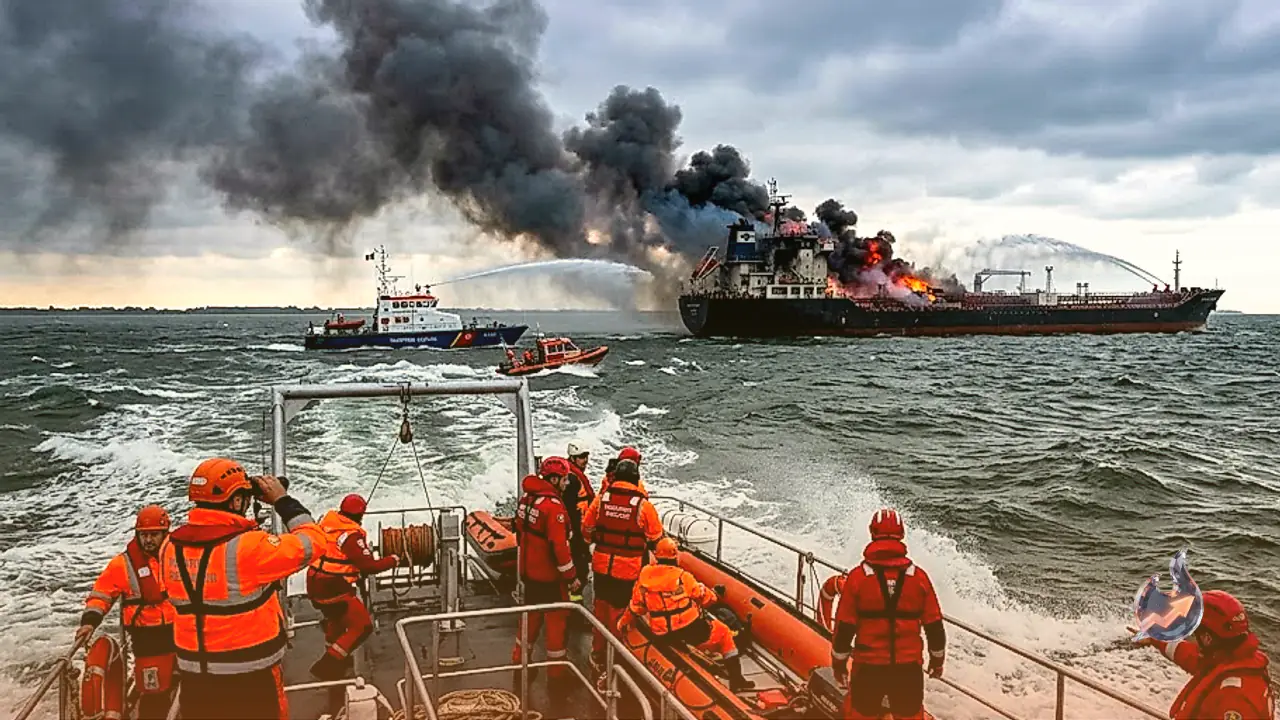

A commercial oil tanker was struck in an apparent drone attack in the western Black Sea near the Romanian coastline on Thursday morning, triggering explosions and a devastating onboard blaze. Naval and emergency authorities in Romania confirmed that 8 of the 12 crew members aboard the vessel are missing, prompting an extensive search and rescue operation in severe maritime conditions.
Explosions Reported Near Sulina Danube Mouth
The tanker, identified as the San Marino-flagged Wine Trader, was en route from Tunisia to Romania when disaster struck. Positioned roughly 13 nautical miles (24 kilometres) east of the mouth of the River Danube at Sulina, the vessel reported multiple loud detonations at approximately 07:00 local time (05:00 GMT). Heavy fire immediately broke out across the ship.
Romanian President Nicușor Dan later formally confirmed that the vessel was hit by aerial drones. Crew members operating on vessels in the immediate vicinity stated that two drones directly struck the Wine Trader, sparking chain reactions and fierce flames across critical compartments of the commercial carrier.
Challenging Rescue Operation in High Waves
In response to the emergency, Romanian authorities quickly mobilized specialized maritime rescue resources. Two Black Hawk helicopters and two rescue boats were dispatched to the burning vessel. Romania's interior ministry also distributed video footage documenting one of the military helicopters hovering over the stricken tanker amidst the response.
Rescue personnel are confronting very high waves and choppy seas, complicating every phase of the intervention. Officials highlighted that the immediate operational priority is reaching the four crew members who are confirmed to be alive on board, while balancing the physical safety of rescue teams battling the elements to locate the eight missing seafarers.
NATO Consultations and Article 4 Discussions
The violent incident right at the maritime doorstep of an alliance member has triggered urgent security discussions. Leadership in Romania and Bulgaria are set to confer shortly on whether to officially invoke Article 4 of the NATO treaty. Under Article 4, any allied member state may formalize consultations whenever its territorial integrity, political sovereignty, or baseline national security is perceived to be endangered.
Romanian President Nicușor Dan stressed the gravity of the event, stating that while authorities seek full clarity on the circumstances, there will be a definitive response from the Romanian state. President Dan is scheduled to travel to Brussels to meet NATO Secretary General Mark Rutte, accompanied by Bulgarian Prime Minister Rumen Radev, to assess the worsening danger in Black Sea navigation corridors. Discussions are expected to center on specific operational requirements, particularly securing supplementary defense equipment to safeguard commercial shipping lanes.
Escalating Maritime Hostilities in the Black Sea
The strike on the Wine Trader represents the latest chapter in a sharp escalation of drone activity along the western Black Sea shelf. Overnight, a swarm of Russian drones had been tracked operating nearby, in the vicinity of Ukraine's Snake Island. Concurrently, Moscow stated that two cargo vessels transporting military supplies toward Ukraine's port of Odesa were struck during their passage, though Russian authorities did not identify the names of the targeted ships.
Regional maritime incidents have surged this week. On Tuesday, two commercial vessels were hit by drones farther south off the coast of neighboring Bulgaria. One of those ships sank entirely, resulting in 11 missing crew members. Following that sink, Bulgarian officials voiced strong suspicions of Russian involvement and formally summoned Moscow's diplomatic envoy. Earlier, another pair of vessels was attacked near Bulgaria, matching the day Ukraine struck an oil tanker berthed at the Russian Black Sea port of Sochi.
Diplomatic Repercussions and Commercial Threats
Kyiv has directly accused Russia of systematically targeting civilian maritime traffic along the western corridor, which serves as an indispensable trade artery for Ukrainian trade. Following Tuesday's coastal attacks, European Commission President Ursula von der Leyen publicly condemned the violence, observing that the Black Sea was turning into an unacceptable new front in the widening conflict.
Moscow has consistently defended its intensified strikes by asserting that its military exclusively engages vessels ferrying weaponry and dual-use equipment destined for Ukrainian terminals. Conversely, Ukrainian authorities and European allies argue that ordinary merchant carriers moving grain and civilian provisions are being recklessly endangered.
Global Grain Trade Under Pressure
Both Russia and Ukraine rank among the planet's largest grain exporters, making safe passage through Black Sea lanes essential for global agricultural stability. In light of the spiraling violence, Turkey has issued urgent appeals to both belligerents, calling for an immediate cessation of hostile actions across the basin.
Western powers, including the United States and European partners, have repeatedly urged a comprehensive naval ceasefire in Black Sea waters. However, Moscow has continually rebuffed these proposals, pointing to Ukrainian operations against Russian merchant shipping as justification for maintaining its offensive posture. Since Russian President Vladimir Putin initiated the full-scale invasion of Ukraine in 2022, Moscow has seized control over approximately 20% of Ukrainian territory, with naval confrontations increasingly spilling into international and allied maritime corridors.