






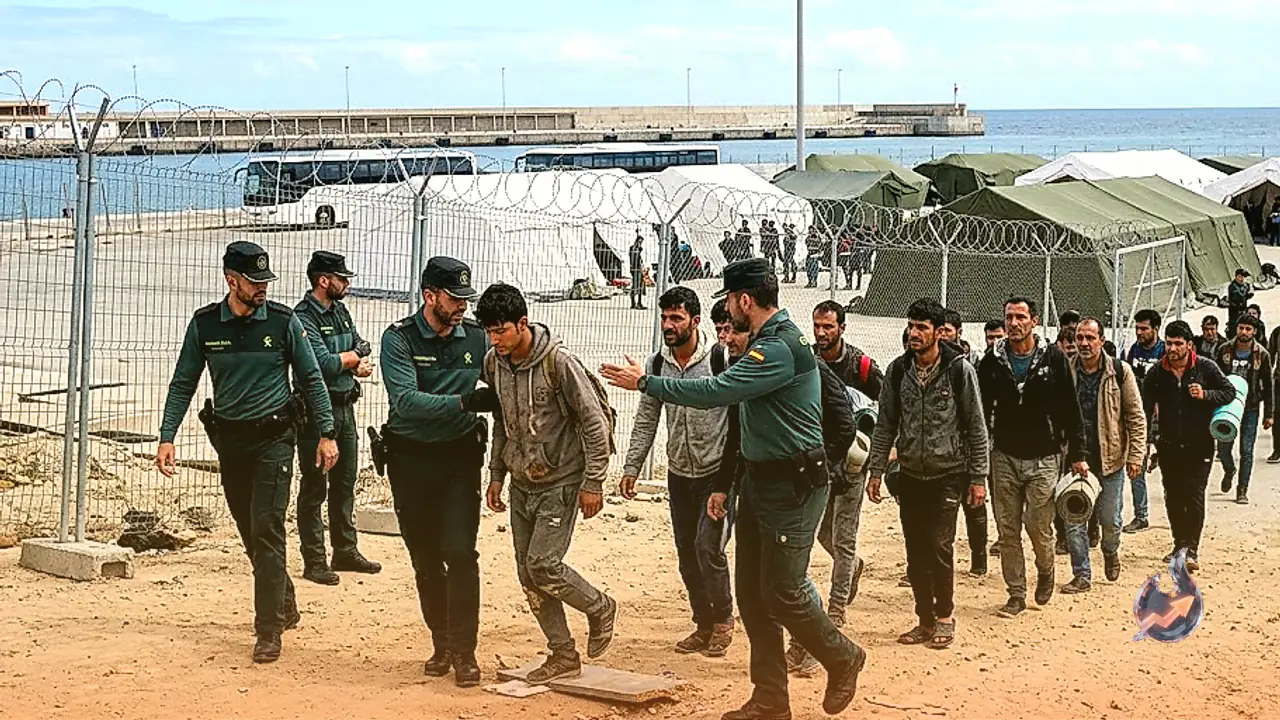
















Law enforcement authorities in the Spanish north African enclave of Ceuta have initiated a major operation to clear hundreds of migrants from open coastlines and transfer them to a newly established tented compound in the port district. The coordinated move commenced around 07:00 local time (05:00 GMT) on Friday, as officers faced intense jostling from crowds desperate to secure shelter after enduring weeks of harsh conditions on the beaches. Amid the disorderly rush, tensions boiled over into confrontations with members of the Spanish Civil Guard, and gunfire rang out as security personnel discharged rounds into the air to halt the surge.
Deployment at the Port Compound and Security Measures
The designated tent facility at the harbour was constructed to accommodate up to 1,700 individuals. Several hundred migrants have already been brought onto the grounds, marking the first phase of an operation designed to eventually relocate more than 3,000 people. The transit process involved escorting groups along a designated 2-kilometre (1.2-mile) corridor linking the shoreline to the harbour. During the operation, multiple groups broke through the police perimeter under the cover of darkness, prompting officers to scramble to maintain order. More than 170 police personnel, backed by specialised drone operators, were deployed to monitor and secure the area. The situation was subsequently brought under control quickly, allowing the logistical transfer to proceed.
Identification Protocols and Administrative Reviews
Government officials have framed the port operation as an urgent measure to centralise the scattered migrant population within a manageable environment. Under the open-air conditions along the coast, providing adequate medical assistance and basic necessities proved difficult. By gathering the migrants inside the structured compound, authorities aim to deliver essential humanitarian aid while systematically verifying individual identities. The facility will serve as an operational base to assess each person's administrative standing on a case-by-case basis and determine the corresponding legal pathways available under Spanish law.
The Scale of the July Crossings and Lingering Population
The current humanitarian and logistical strain follows a massive wave of crossings in late July, when an estimated 72,000 migrants crossed over the Moroccan boundary into the Spanish territory. Although the vast majority of those who entered have since returned across the border, an estimated population of more than 13,000 individuals remains within the enclave. Accommodating thousands of displaced people within a compact territory spanning just 18.5 square kilometres (7.2 square miles) has pushed local infrastructure and municipal capacity to severe extremes.
Community Unrest and Mounting Civic Anxieties
The protracted presence of thousands of unhoused migrants has heightened safety fears among the long-time inhabitants of the small enclave. Discontent has occasionally manifested in direct confrontations, with several residents dismantling makeshift shelters and physically intercepting aid consignments intended for those stranded on the beaches. The sudden demographic surge within an exceptionally confined geographical space has created deep frictions between the settled population and the displaced arrivals.
Political Backlash Against Pedro Sánchez in Madrid
The unrest in Ceuta has reverberated across Spain's national political arena, intensifying scrutiny of Prime Minister Pedro Sánchez and his cabinet's management of the enclave's borders. Ceuta Mayor Juan Jesus Vivas addressed members of the European Parliament earlier this month, characterizing the territory as having become a pressure cooker under the weight of the emergency. The conservative mayor stated that the city was completely different from what it was before the surge, adding that local citizens had lost their joy and seen their daily routines entirely upended.
National opposition politicians have seized on the border disorder to level direct accusations against Madrid. Ester Muñoz of the conservative People's Party asserted that the administration bore direct responsibility for the arrival of migrants in Ceuta as well as for the individuals who lost their lives in the attempt. Prime Minister Pedro Sánchez has faced persistent criticism regarding immigration enforcement and diplomatic preparedness, though he has denied possessing advance intelligence regarding the mass rush toward the border.
Judicial Rulings, Online Deception, and Fatal Maritime Crossings
The crisis gained momentum following an intervention by Spain's Supreme Court, which issued a ruling establishing that migrants intercepted at sea while attempting to reach Ceuta could not be subjected to summary returns to Morocco. The verdict dismantled previous expedited return mechanisms and altered border enforcement procedures. In the wake of that legal determination, social media networks saw a proliferation of misleading claims, with predatory accounts demanding hundreds of pounds under the pretext of facilitating unauthorized entry into Spanish territory.
Misled by false assurances, thousands converged on the boundary infrastructure, scaling perimeter fencing and attempting perilous swims around maritime seawalls. The resulting chaos carried a heavy human toll, with local authorities confirming that at least 100 people perished while attempting the treacherous sea and land crossings. The ongoing presence of thousands of survivors continues to pose formidable administrative, security, and foreign policy dilemmas for the Spanish administration.