



















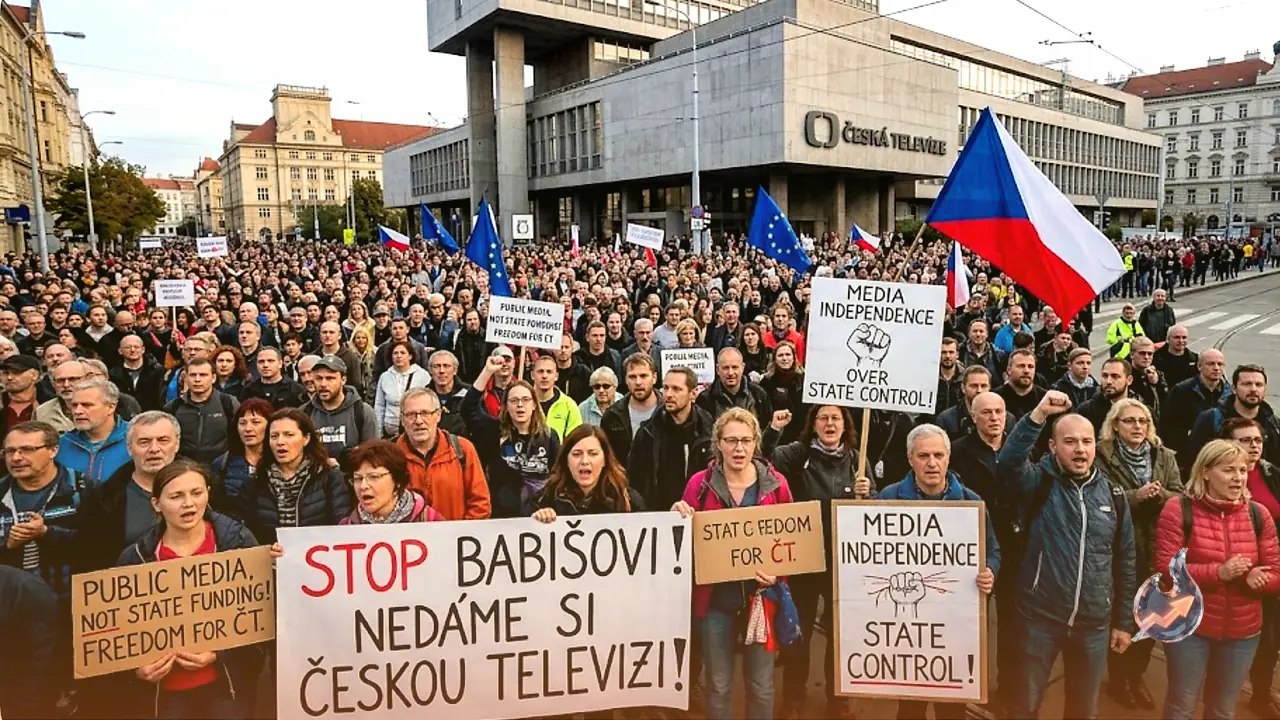

On Sunday, thousands of people filled the streets of Prague outside Czech public television offices, turning out in protest against a government proposal that would fundamentally alter how the country's public broadcasters are financed. Organisers framed the gathering not as an industry dispute but as a matter of direct public interest, arguing that what happens to Czech Radio and Television ultimately affects every citizen.
The Plan and Why It Worries Critics
The cabinet led by Prime Minister Andrej Babiš approved the plan on Monday. Under it, public radio and television would receive their operating budgets directly from the state from next year onward, scrapping the existing arrangement in which individuals, households and businesses pay dedicated licence fees. Opponents argued that making broadcaster income subject to annual political decisions about the state budget creates a structural opening for editorial pressure that the old fee system had avoided.
A 15 Per Cent Cut with No Long-Term Protection
International media organisations added their criticism to those already voiced domestically. The plan would deliver roughly 15 per cent less money than public broadcasters received during the current year, opponents noted, and it included no long-term guarantees about future budget levels. The directors of both public radio and public television warned that these constraints would force significant cost reductions. They said the funding drop could lead to hundreds of job losses, with the cuts rippling through both day-to-day operations and programming output across public services.
Babiš countered that public media organisations should bring their spending down. Supporters of the existing model responded that stable, predictable funding is precisely what allows editorial independence to function in practice.
The Slovak and Hungarian Warning
Protesters and their leaders repeatedly drew comparisons to neighbouring countries where populist-leaning governments have moved to reshape public media. They cited Slovakia under Prime Minister Robert Fico and Hungary under former Prime Minister Viktor Orbán as examples of how budget leverage can translate into editorial leverage, warning that the three-party coalition could follow the same path. Critics also pointed to a pattern of repeated attacks on public and other mainstream media by Babiš himself, by cabinet members and by loyalist lawmakers, arguing that the funding proposal did not arise in a vacuum.
A Strike Coming Monday and a Wider Political Picture
The Sunday protest came just one day before broadcast staff had planned a warning strike for Monday. Protest marches had already been held in Prague and in several regional capitals in the preceding period. Organisers were clear that the funding fight could not be separated from the coalition's broader political direction, which included moving the country away from support for Ukraine and pushing back against certain key European Union policies, raising fresh questions about the balance of power between the government and independent institutions.
The Protesters Put It Simply
Mikuláš Minář, a main organiser from the Million Moments for Democracy group, made the central argument as directly as possible:
The media dont belong to politicians. They belong to us all and we wont allow them to be stolen from us.
That statement captured the core of what the crowd had come to say. For those gathered, public broadcasters are a civic asset held in common, and any funding arrangement that hands politicians structural influence over their budgets is, in effect, a transfer of that asset from the public to those in power.