





















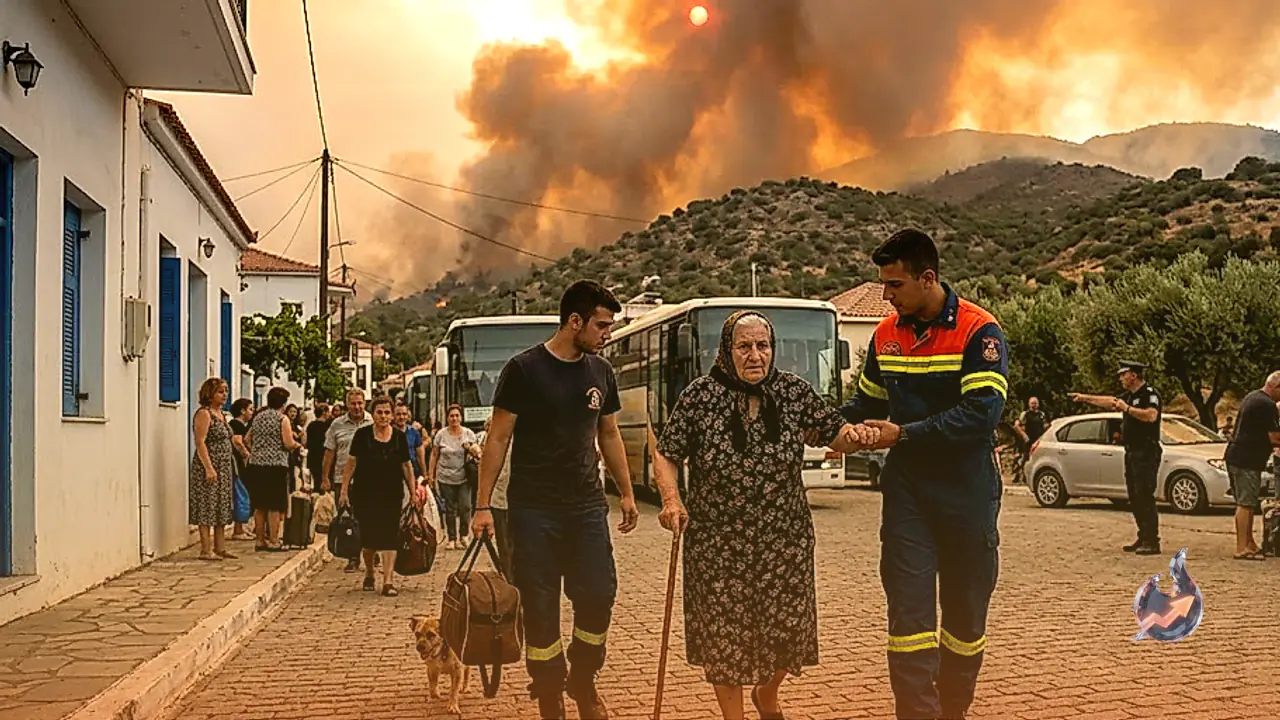

Devastating wildfires driven by intense heatwaves and fierce gale-force winds continue to sweep across multiple Southern European nations, causing widespread displacement and destruction. The Greek island of Crete, along with affected zones in Spain, France, and Portugal, is enduring an unprecedented wildfire season. In the Rethymno region of Crete, rapidly moving flames have threatened coastal resorts, agricultural lands, and residential villages, claiming the lives of three brave firefighters during containment operations. Emergency services across the Mediterranean basin remain on high alert as extreme weather conditions hamper firefighting efforts.
Lethal Wildfires and Mass Evacuations Strike Crete
A massive blaze erupted near the village of Krya Vrysi in Crete's Rethymno district on Wednesday, escalating rapidly due to severe atmospheric conditions. Overnight wind gusts on the island surged to 125 km/h (77 mph), driving flames directly toward populated areas and forcing the immediate evacuation of approximately 8,000 residents and tourists. Although many evacuees were eventually permitted to return as conditions temporarily stabilized, the fire continues to burn out of control across rugged terrain.
The disaster comes during the peak of Crete's summer tourist season, complicating emergency responses. Temporary shelters have been established across Rethymno to accommodate residents and stranded holidaymakers. British tourist Peter Wood described the intense panic at one evacuation shelter, explaining that visible flames atop nearby hills prompted police and rescue personnel to order immediate evacuations of entire communities.
Firefighter Casualties and Escalating Wind Conditions in Greece
The firefighting effort in Greece turned tragic on Wednesday when two firefighters were trapped and killed while combating the inferno near Krya Vrysi in Rethymno. Theodoros Vagias, chief of the Hellenic Fire Service, confirmed the fatalities and identified the deceased personnel as Emmanouil Stratidakis, aged 58, and Pantelis Diamantakis, aged 25. Both firefighters will be laid to rest on Thursday. Additionally, a third firefighter lost his life on the Greek mainland near the port town of Gytheio in the Peloponnese region while tackling a separate blaze.
Rethymno's deputy regional governor, Maria Lioni, described Wednesday as a dark day for the island. She noted that overnight wind forces reached up to 11 on the Beaufort scale, a intensity classified as violent, which severely hampered containment operations and accelerated flame propagation. Lioni emphasized that assessing structural damage remains secondary to securing human safety and establishing containment perimeters around active fire fronts.
Record Destructive Blazes and Emergency Status in Spain
Spain is simultaneously battling severe wildfire outbreaks amid its fourth major summer heatwave. In the northwestern provinces of Zamora and León near the border with Portugal, freshly sparked fires led to the evacuation of more than 1,000 residents. Meanwhile, Spanish Prime Minister Pedro Sánchez officially announced the termination of the national emergency status for wildfires in the Ávila and Madrid regions, though he urged citizens to exercise extreme caution as elevated temperatures persist.
The wildfire in Ávila has burned through more than 43,000 hectares of land over the past week, making it officially the largest recorded wildfire in Spanish history. Across 2026 so far, more than 200,000 hectares of land have been destroyed by fires in Spain, a figure roughly five times higher than the seasonal average. Firefighting crews continue to deploy heavy ground equipment and aerial water bombers to prevent secondary reignitions.
Gironde Fire Struggles and Mass Relocation Across France
In south-western France, a major wildfire in the Gironde region destroyed 240 homes and burned an area larger than the US city of Detroit. However, light rainfall near Bordeaux on Thursday offered crucial relief to containment crews, halting the fire's expansion. The regional fire service expressed reasonable optimism that the containment perimeter would hold, noting that the burn footprint had not grown since the weekend.
Of the 220,000 residents displaced by the Gironde emergency, approximately 84,000 were cleared to return to their residences on Thursday. Data from the European Forest Fire Information Service reveals that more than 90,000 hectares of land have burned across France this year, marking the highest annual total on record for the country.
Injuries and Evacuations Across Portugal and Turkey
In eastern Portugal, a wildfire near the town of Valpaços resulted in five injuries according to local reporting, with Portugal's total burned acreage for July significantly surpassing historical norms. Further east in Turkey, fires broke out across several southern coastal provinces, prompting the evacuation of hundreds of homes. Turkish emergency authorities confirmed that the majority of these blazes have now been brought under control following intensive aerial and ground interventions.
Environmental Drivers, Climate Factors, and Forest Management Deficits
Meteorologists warn that the European wildfire season, which typically extends into August and September, is likely to worsen as high temperatures shift toward central Europe. Environmental scientists point out that last winter was unusually mild and wet, stimulating dense vegetation growth across the Mediterranean basin. Subsequent successive heatwaves dried out this biomass, converting it into tinder-dry fuel easily ignited by human activity or lightning.
Experts also highlight deficiencies in forest and scrubland management across Southern Europe as a critical vulnerability factor. Unmanaged vegetation accumulation provides abundant fuel loads for wildland fires. Combined with climate change, which intensifies hot, dry, and windy conditions, ordinary ignitions rapidly turn into uncontrollable environmental disasters across the continent.