






















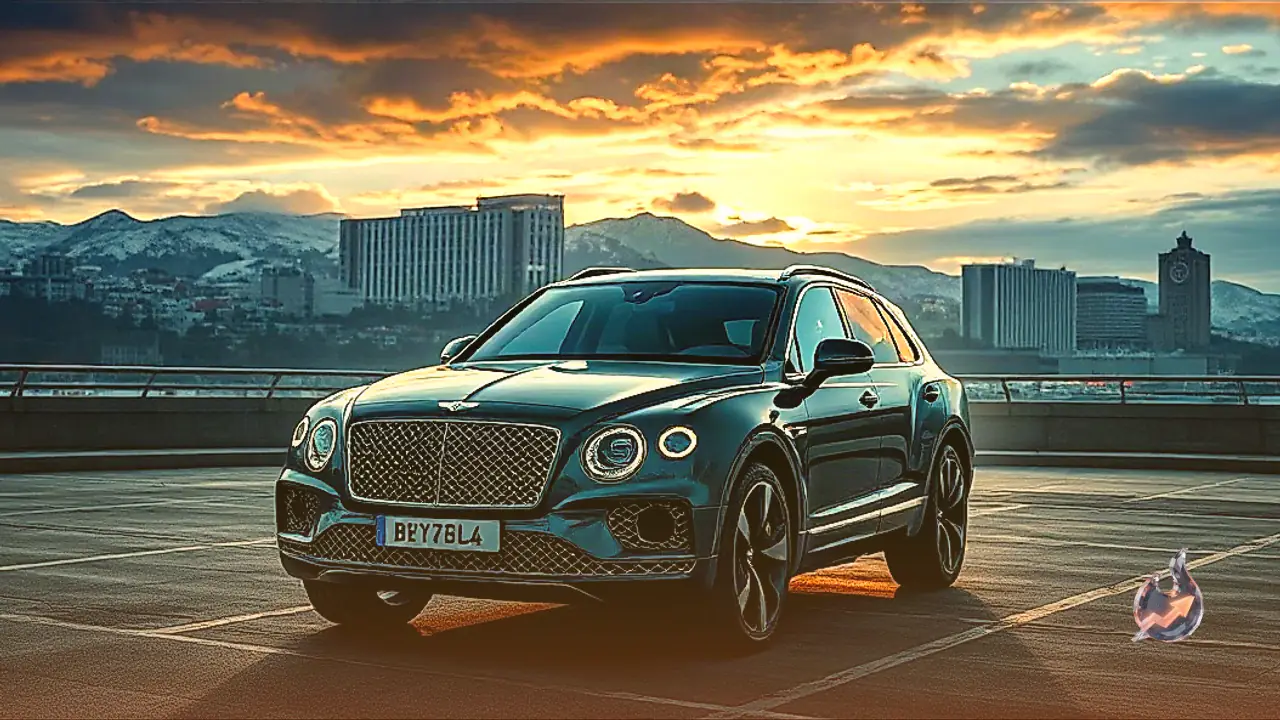

Bentley has officially taken the wraps off its first-ever battery electric vehicle, the Torcal SUV, delivering a driving range of up to 375 miles under the European WLTP testing cycle, with an anticipated EPA rating of approximately 330 miles in the United States. Capable of supporting ultra-rapid 400-kilowatt direct-current charging, the luxury electric vehicle can replenish its battery pack from 10 to 80 percent in just 16 minutes. Positioned as a more compact and urban-friendly alternative compared to the larger Bentayga, the five-seat SUV represents the historic British marque's crucial transition toward zero-emission mobility.
High-Output Dual-Motor Powertrain and Acceleration Benchmarks
Powering the Torcal is a dual-motor electric drivetrain featuring a dedicated motor on each axle for permanent all-wheel-drive traction. In the performance-oriented S specification, the powertrain churns out a massive 888 metric horsepower (PS) and 1,350 Newton-meters (Nm) of instantaneous torque. This substantial output propels the SUV from a dead stop to 60 mph in a blistering 2.9 seconds, eventually reaching an unrestricted top speed of 162 mph.
For buyers selecting the standard Core model, the powertrain is tuned to deliver 821 PS alongside 1,194 Nm of torque. This configuration allows the SUV to sprint from 0 to 60 mph in 3.4 seconds while topping out at 155 mph, providing substantial straight-line performance across both trim levels.
Navigating Market Headwinds in the Ultra-Luxury Electric Segment
The transition toward battery electric drivetrains has proven fraught for ultra-luxury automotive manufacturers, who often find that their loyal demographic is reluctant to abandon internal combustion engines. Ferrari and other high-end competitors have been approaching the shift with significant caution. Bentley is rolling out the Torcal into an exceptionally hesitant luxury marketplace where peers have already encountered sharp headwinds. Lamborghini famously shelved the production plans for its Lanzador electric grand tourer after CEO Stephan Winkelmann acknowledged that customer demand had dropped nearly to zero.
Other established luxury manufacturers are facing similar setbacks. Mercedes-Benz managed to deliver only 1,450 units of its fully electric G-Class across Europe through April 2025. Concurrently, registrations for the Rolls-Royce Spectre electric coupe plunged by roughly 50 percent, prompting the brand to plan an early mid-cycle refresh to reignite buyer interest. Against this backdrop, Bentley is heavily anchoring its sales pitch to brand heritage and bespoke hand craftsmanship, emphasizing in its launch materials that the Torcal remains fundamentally a Bentley above all else and will serve as an engineering and aesthetic blueprint for future models regardless of their powertrain.
Pricing Strategy and Direct Rivalry With Range Rover Electric
The Torcal has been positioned to capture buyers at the very top of the premium automotive market. The entry-level Core variant carries a base price of $218,000 (£173,300), while the higher-tier First Edition S pushes the sticker price to $258,200 (£199,300). While the upcoming Range Rover Electric starts substantially lower at $138,000 in the American market with comparable range figures, the Torcal directly targets the top-tier Range Rover Electric Autobiography trim, which carries an MSRP of $208,000.
This pricing alignment indicates that Bentley is aiming directly at Jaguar Land Rover's high-end market share. The proposition presented to prospective luxury buyers is clear: for an incremental premium of approximately $10,000 over the flagship Range Rover, customers can step up into the bespoke tier of a Bentley badge.
Exterior Proportions, Aerodynamic Profiling, and the Crystal Grille
In terms of exterior dimensions, the Torcal measures 4,983 millimeters in overall length, which is 161 millimeters shorter than the flagship Bentayga, and spans 2,016 millimeters in width. While its footprint is broadly similar to the Range Rover Electric, the two vehicles diverge dramatically in vertical profile. The Range Rover Electric stands nearly 20 centimeters taller than the low-slung Torcal. Although Bentley maintains that the Torcal possesses genuine all-terrain capability, the taller architecture and traditional chassis geometry of the Range Rover Electric will likely give it the decisive edge during serious off-road excursions.
To enhance exterior efficiency, the Torcal incorporates a tapered roofline that slopes downward toward the rear, minimizing aerodynamic drag. The rear fascia displays completely redesigned light clusters, and the roof features an electrochromic switchable glass panoramic sunroof. Up front, the lack of an internal combustion engine eliminated the requirement for conventional radiator cooling ducts. In place of a conventional mesh intake, Bentley fitted a solid, upright front panel constructed from illuminated acrylic crystals that cast a vivid glow upon approach, creating a deliberate visual statement on highways and mountain passes rather than blending into understated quiet luxury.
Interior Appointments, Sustainable Materials, and Acoustic Craftsmanship
Inside the cabin, the Torcal reinforces Bentley's focus on bespoke craftsmanship blended with modern technology. Fully automated power doors open into an interior trimmed in a combination of high-resolution OLED displays and tactile physical switchgear. The central infotainment display features an elegant downward curve reminiscent of modern Porsche Cayenne cockpits, though Bentley deliberately excluded an auxiliary display screen for the front passenger.
To emphasize sustainability without sacrificing luxury, Bentley partnered with textile specialist Fox Brothers to engineer a specialized, durable woven wool upholstery suitable for interior door panels, marking an automotive industry first. Furthermore, interior veneers feature a newly developed sustainable wood finish formed by compressing 1,000 layers of walnut off-cuts and recycled paper together, which are then sliced into thin veneers measuring less than one millimeter in thickness. Ergonomics are handled by multi-mode massage and power-folding seats, complemented by an optional 1,780-watt Naim audio system that channels sound through 28 speakers, including seat shakers, integrated headrest speakers, and Dolby Atmos 7.1 spatial audio processing.
Visual Artistry and Natural Acoustic Feedback
Bentley took an unusual, artisanal route to develop both the interior visual animations and artificial driving acoustics. When software engineers initially attempted to create on-screen graphic animations depicting light refracting through cut glass, the digital modeling appeared overly sterile because computer rendering failed to capture the organic microscopic flaws of real cut crystal. To resolve this, Bentley physically filmed real crystal under moving light to produce the animations now seen across the driver instrument binnacle and central console.
A similar analog philosophy was applied to vehicle sound design. Rather than synthesizing a digital approximation of an engine roar through mathematical sound waves, acoustic designers recorded real musical instruments, including live drums, viola, and electric bass guitar, to recreate the rhythmic, uneven cadence of a classic Bentley V8 engine. For drivers seeking silence, this acoustic track can be deactivated completely. Even secondary system alerts were sourced from physical objects: the turn indicator tone was recorded from a hammer gently striking a piece of leather, while the digital voice assistant's wake chime was captured from the ringing resonance of a finger gliding around the rim of a crystal glass.
Assisted Driving Hardware and Automated Narrow-Road Reversal
The Torcal incorporates a broad suite of modern convenience and active safety electronics, including an augmented reality head-up display, facial recognition sensors that automatically calibrate the cabin environment to pre-stored driver profiles, smartphone digital keys, and a dedicated 'Refresh' cabin climate mode that adjusts lighting and air delivery to invigorate the driver. Active driver assist systems are powered by a network of 25 individual radar sensors, optical cameras, and ultrasonic sensors.
Among the electronic features is an intelligent space detection program. When traveling along narrow country lanes or tight passages, if the vehicle encounters oncoming traffic without adequate passing room, the Torcal can autonomously reverse along its exact path back to a previously identified passing cutout to allow the approaching vehicle to proceed safely.
Rising Pressure From Asian Competitors and the Defense of Heritage
These advanced vehicle technologies are arriving at a moment when traditional luxury manufacturers face intense competitive pressure from Chinese automakers. Asian brands are aggressively expanding into the high-end SUV landscape with high-specification vehicles offered at significantly lower price points. Xiaomi's upcoming SkyNomad SUV lineup, scheduled to arrive in European showrooms next year, is designed to heavily undercut the pricing structures of both Bentley and Range Rover while offering longer ranges, interior entertainment projectors, modular multi-configuration seating, and heated floor surfaces.
This competitive expansion coincides with substantial financial restructuring at Bentley's parent company, Volkswagen Group, which is currently eliminating 50,000 jobs across its wider operations, even as Bentley itself maintains profitability. Bentley management, led by Walliser, maintains that the primary strategic moat against Asian market disruption remains the company's continuous manufacturing heritage dating back to 1919. Whether century-old prestige and bespoke craftsmanship will prove sufficient to overcome slowing ultra-luxury EV adoption remains the central question facing the brand's electric transition.