























Anyone who has watched a toddler methodically empty a drawer or stack plastic containers knows that children are natural engineers. Their innate curiosity drives them to explore how the physical world fits together. For parents and educators, the challenge lies in nurturing this creative drive and steering it toward constructive learning without losing the element of fun. STEM toys, which cover Science, Technology, Engineering, and Math, serve as the perfect bridge, transforming abstract logical concepts into tangible, tactile play. Extensive assessments conducted in both home environments and active school classrooms have highlighted some of the most engaging and educational toys currently available. These playthings go beyond simple entertainment, encouraging problem-solving, logical deduction, and spatial awareness. Let us look at the standout choices that have proven highly effective at capturing young minds and maintaining their interest over hours of exploration.
Plus-Plus Building Blocks: Simplifying Tactile Construction
Many construction toys rely on a massive variety of specialized shapes, which often leads to children spending more time searching for a specific piece than actually building. Plus-Plus building blocks completely bypass this frustration by utilizing a single, universal shape. These Danish-designed pieces resemble two connected plus signs and are crafted from a slightly flexible, squishy plastic. This unique material makes them incredibly satisfying to press together and pull apart. Available in a wide spectrum of vibrant colors, these blocks allow children to focus entirely on their designs.
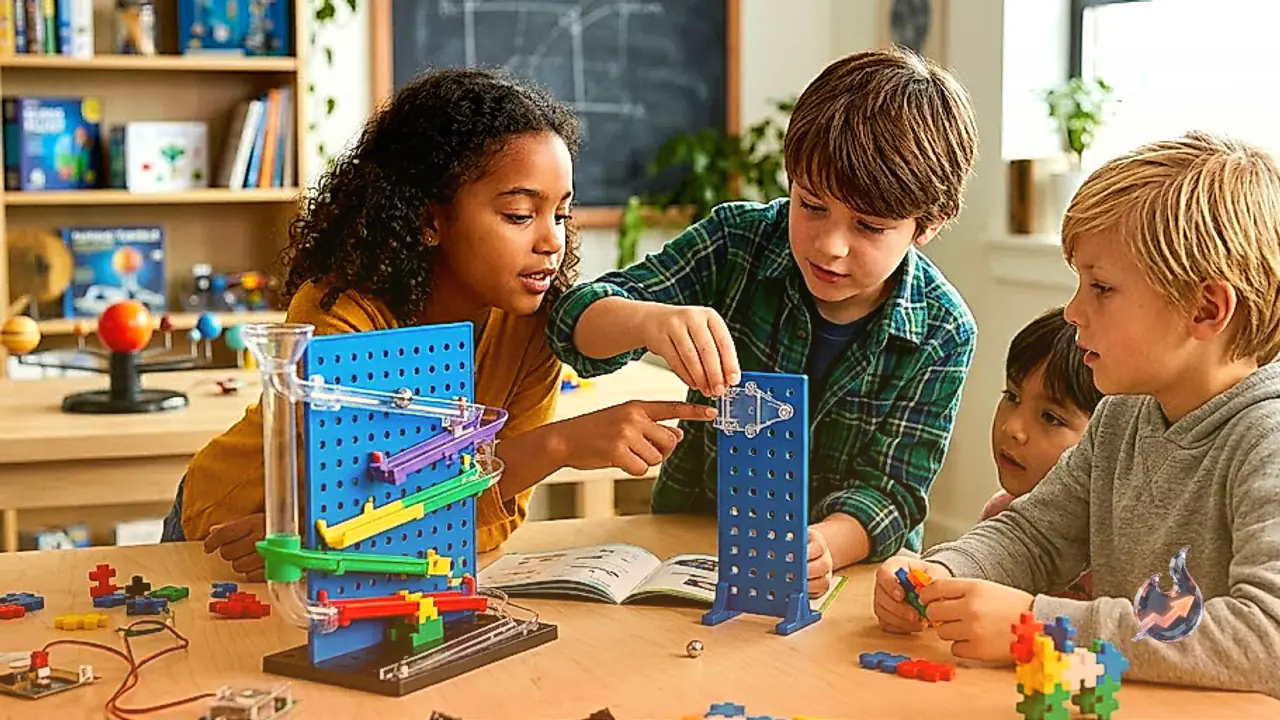
During classroom sessions with seven and eight-year-old students, these blocks emerged as an absolute favorite. The open-ended nature of the toy accommodates different learning styles. Some children preferred spontaneous play, building without any premeditated plan, while others meticulously mapped out elaborate scenes to test their engineering skills. The blocks are versatile enough to create two-dimensional mosaics, wearable items like bracelets and headbands, or complex three-dimensional structures like robots and sturdy bridges. Each set also includes helpful guidebooks with creative suggestions, making them an excellent tool for developing fine motor skills and spatial reasoning.
Turing Tumble: Learning to Code Without a Screen
Teaching children the fundamentals of programming can be difficult, especially when trying to limit their screen time. Turing Tumble, developed by Upper Story, offers an ingenious solution by representing computer logic through a fully mechanical, marble-powered system. Priced at seventy-seven dollars, which is approximately seventy-two pounds, this high-quality kit combines the excitement of a marble run with a captivating, illustrated science-fiction comic book. The narrative follows an astronaut stranded on a distant planet, and children must solve increasingly difficult logic puzzles to help her escape.
The primary board resembles a traditional pachinko machine. To solve each challenge, players must strategically slot various plastic pieces, such as ramps, crossovers, and interceptors, onto the board. These pieces redirect the path of red and blue marbles as they cascade down. By arranging the components correctly, children generate specific patterns of balls at the bottom, mimicking how binary switches operate inside a real computer microprocessor. This hands-on computer has kept nine-year-olds engaged for hours. As the puzzles become more complex, they naturally invite collaboration, encouraging the entire family to sit down and debug the physical code together. It is an exceptionally rewarding experience for children aged eight and older.
Let's Start Coding Ultimate Kit: Direct Exposure to C++ and Hardware
A common criticism of children's programming kits is that they often oversimplify coding, using block-based drag-and-drop interfaces that do not translate well to real-world software engineering. The kits from Let's Start Coding take a refreshingly direct path. Instead of hiding the code, they introduce kids straight to the syntax of C++, one of the most widely used programming languages in the world. The Ultimate Kit provides a comprehensive hands-on experience by pairing this programming language with genuine electronic components.
The kit features twenty-three distinct hardware parts, including a fully functional LCD screen, a speaker, an LED light strip, and various environmental sensors. Children connect these components to a micro-computer board and write actual code to control them. With over one hundred unique projects to choose from, learners can build practical gadgets like digital thermometers, musical instruments, and interactive light displays. The product provides example code that kids can modify, allowing them to see the immediate physical impact of changing a line of text. This trial-and-error process is supported by detailed walkthrough videos. While the instructional videos are highly technical and dry, they offer invaluable, step-by-step guidance for young coders ready to tackle real hardware and software integration.
OffBits: Industrial Hardware Reimagined for Creative Assembly
For children who love tinkering with real tools, OffBits kits offer a brilliant blend of custom plastic components and standard industrial hardware. Instead of delicate toy parts, these kits feature actual metal nuts, bolts, screws, and springs, similar to what you might find in a home toolbox. Every kit comes with a proprietary, multi-functional assembly tool and instructions to build a specific character, vehicle, or creature, such as the colorful UnicornBit.
These toys encourage children to think outside the box, inviting them to modify the official designs using spare hardware found around the house. This open-ended approach fosters genuine engineering ingenuity. However, parents should note that some connections can be physically demanding. Certain screws require significant hand strength to tighten, which may necessitate some adult assistance. Additionally, a few parts might feel slightly loose depending on how they are configured. Given the small size of the hardware pieces and the intricate nature of the assembly, these kits are best suited for children aged six and up, and adult supervision is highly recommended to ensure a frustration-free building experience.
Science Can Solar System: Interactive Exploration of the Cosmos
Space exploration is a common passion for young minds, and the Science Can Solar System model is an exceptional way to fuel that fascination. This interactive planetarium features rotating model planets arranged in their correct orbital order based on their actual distance from the sun. The system is powered by three AA batteries housed in the sturdy base. Children can activate educational audio descriptions for each planet simply by touching the corresponding illustrations on the base plate.
In addition to the audio facts, the top of the sun contains a built-in projector that casts vivid, space-themed images directly onto the ceiling of a darkened room. The kit includes three projector discs containing a total of twenty-four slides. These slides display breathtaking images of distant galaxies, nebulae, astronauts, and advanced spacecraft. A major advantage of this toy is its language versatility. A simple toggle switch on the underside of the base allows users to alternate between English and Spanish audio. This feature makes the model not only a great science tool but also a helpful resource for kids practicing a second language through auditory exposure.
Holographic Magnetic Cube: Spatial Reasoning and Shape-Shifting Fun
This geometric puzzle is composed of twelve unique magnetic pieces that can be manipulated and folded into an astonishing array of shapes. The exterior of the cube is covered in striking holographic stickers that capture and reflect light as it is rotated. It also features a spinner accessory that adds another layer of sensory engagement. While there is a companion mobile application that offers digital building suggestions, children often find that they do not need it, preferring to explore the tactile possibilities of the cube entirely on their own.
This magnetic toy has proven to be an immense success in primary school classrooms, particularly with children aged seven and eight. Fidgeting with the shifting shapes helps develop spatial intelligence as children learn how three-dimensional geometries fold and lock together. The satisfying tactile feedback of the magnets clicking into place makes it a calming and engaging focus tool, proving that sometimes the simplest, screen-free concepts can deliver the deepest educational value.