






















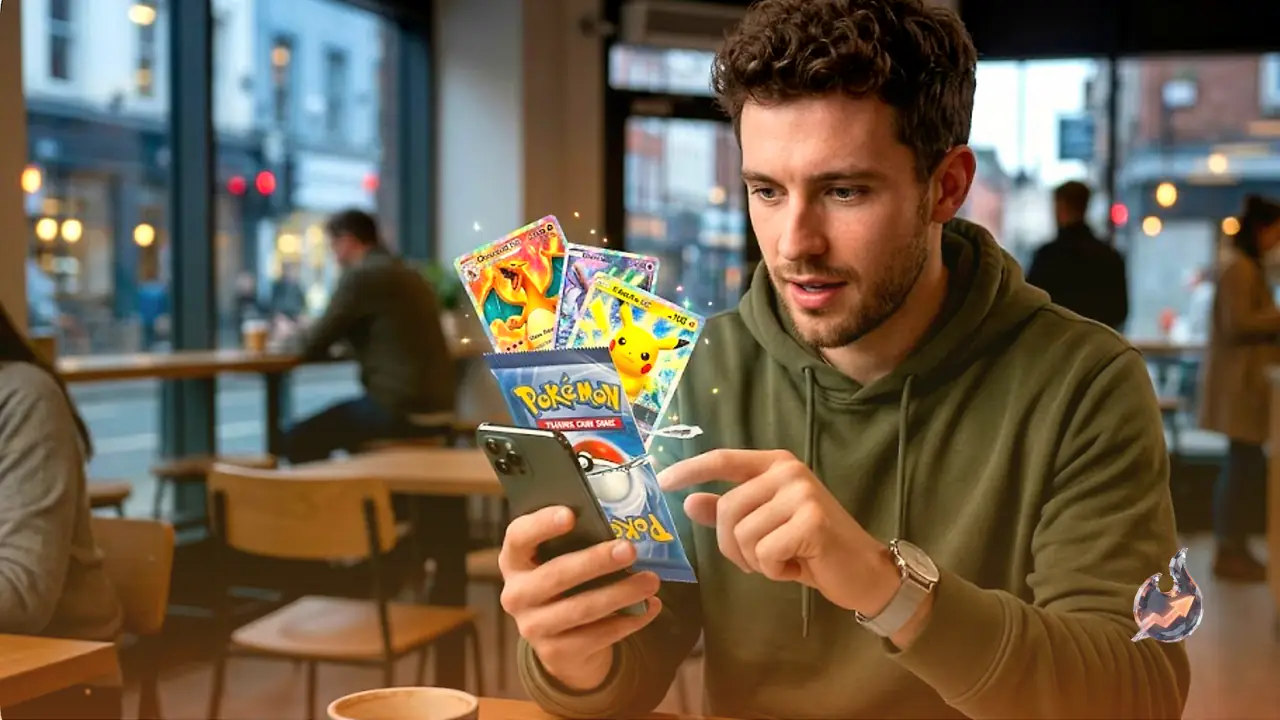

These digital card packs, designed for rapid opening and even faster financial feedback, are experiencing a massive surge in online popularity. Since its debut in October 2025, the Rips application has accumulated over 6 million downloads, with fully half of those installations occurring in just the past two months, according to analytics from Apptopia. The premise is straightforward yet highly engaging: users pay real money to open digital packs and win physical trading cards, but they are also presented with the instantaneous choice to sell those assets back to the platform for cash.
Rips serves as a prime example of the current digital landscape, where smartphone users are continuously targeted by sophisticated and novel ways to risk their money online. From modern sports betting services to decentralized prediction markets, the device in everyone's pocket has transformed into a virtual casino floor where users chase rapid financial wins, often resulting in swift losses. Rips has not commented publicly on these concerns.
Even before downloading the app, many users are already deeply familiar with the platform through relentless advertising campaigns on TikTok. Other prominent applications have adopted a nearly identical format, such as RipIt, a platform associated with online personality Logan Paul. These digital environments directly monetize the massive, long-standing cultural phenomenon of opening physical trading card packs, particularly Pokémon cards, in search of exceptionally rare collectibles that command premium prices on the secondary market. To participate in this digital marketplace, users must be at least 18 years of age.
Because Rips provides an immediate buyback valuation for every single card pulled, active users theoretically have the opportunity to walk away with thousands of dollars more than their initial starting capital. However, the mathematical reality for the vast majority of participants is far less lucrative, frequently resulting in rapid financial depletion with absolutely no physical cards or cash to show for it.
The Mechanics of the Digital Vending Machine
Upon launching Rips, users are greeted by an aesthetic that resembles an AI-generated image of a glowing, neon-drenched vending machine. This virtual machine, packed with various card designs, stands in dramatic, cinematic lighting within a dark and industrial warehouse space. The app's official designation is Rips by Triumph. The parent entity, Triumph, is already well-known in the mobile software ecosystem for operating an interactive gaming platform where players pay to compete in classic arcade challenges for real money prizes.
The fundamental loop of the Rips application centers on opening glossy, single-card digital envelopes. Players can choose from three main product categories: Pokémon, Basketball, or One Piece collectibles. Entry points vary wildly, beginning with a modest $1 Pokémon Starter Pack and scaling all the way up to the premium Pokémon Diamond Pack, which demands a staggering $2,500 payment for a single digital opening. Furthermore, users can adjust a specific volatility level within the application's configuration settings for many of these card packs. Selecting a higher volatility level mathematically skews the potential outcomes, significantly increasing the probability of landing either an extremely valuable card or a virtually worthless one, while simultaneously reducing the chances of obtaining a mid-tier asset.
To put the economics into perspective, opening a basic $1 pack yields a minimum card value of 10 cents and a maximum potential value of $20. On the high-stakes end of the spectrum, the premium $2,500 packs guarantee the user a card worth at least $850, while the absolute luckiest outcome can yield a single card valued at an astonishing $82,166.
The Showroom and Asset Retention Policies
The application prominently features a digital Showroom on its main interface, which showcases the most coveted and ultra-rare cards that users can theoretically obtain across the various purchasing tiers. For instance, the app displays a rare holographic Japanese Pikachu card from the year 2005, valued at $43,450, subtly encouraging players to continue purchasing packs in the hope of striking gold through sheer luck.
Any card that a user decides to keep, rather than instantly liquidating back to the platform for an immediate account credit, is temporarily transferred to their digital collection. However, this storage is strictly time-limited. If the user does not explicitly request the physical card to be mailed directly to their home address, Rips automatically executes a forced sale of the card back to the system after exactly seven days have elapsed.
Anatomy of a Fast-Paced Loss
In a simulated test to understand the user journey, a $20 balance was loaded into a newly registered Rips account. The initial interface interactions proved surprisingly satisfying. The sensation of dragging a fingertip across the screen to slice open the digital envelopes, followed by the immediate liquidation of the virtual Pokémon cards, created an absorbing flow. The glittering, high-fidelity visual design makes the app feel like a stylized slot machine themed around the villainous Team Rocket group, with anticipation deliberately engineered into every single swipe gesture. It is worth noting that Nintendo has no corporate association or involvement with the Rips application.
The physical sensation of this high-stakes loop can quickly become intense. In a fast-paced session lasting just under 15 minutes, a total of 56 packs were opened, representing an aggregate transaction volume of $892. The process began with a single $1 starter pack. After tapping the purchase button, a rotating, illuminated carousel of card packs materialized on the screen. Slicing the virtual seal triggered a burst of digital glitter as a rotating, color-shifting card emerged. Once the visual sequence concluded, the card's secondary market value was revealed: a common Dunsparce card worth a mere 30 cents.
By the fifth consecutive opening, the account balance had actually risen above the initial deposit, prompting a transition to a higher-stakes $20 pack. After adjusting the settings to maximum volatility, the expectation was a complete loss that would terminate the session. Instead, the screen revealed a rare Psyduck card valued at $71. This unexpected success triggered a powerful physical reaction, including an elevated heart rate and a profound dopamine rush, despite the net win being only about $50.
This pivotal moment of success catalyzed a period of rapid, high-frequency pack opening. The strategy shifted to purchasing the absolute most expensive packs the fluctuating account balance could sustain. While some openings yielded minimal returns, subsequent pulls would occasionally double the remaining capital. Riding this intense emotional wave of rapid wins and losses, the virtual account balance eventually peaked at a high of $101.
At this juncture, the decision was made to commit $100 to a single Pokémon Gold Pack. After the complex, highly polished opening animations concluded, the result was a disappointing trainer card valued at just $31. The sudden transition from excitement to frustration prompted further rapid purchases in an attempt to recoup the lost funds, quickly draining the remaining balance to less than one dollar.
The Discord Mirage and Social Media Amplification
This reality of rapid financial loss stands in stark contrast to the promotional content distributed across TikTok and the app's official Discord server. In the Discord community, users continuously share recordings of extraordinary wins, which are routinely celebrated by other members using fire emoji reactions. One shared clip depicted a player obtaining a $533 Pokémon card from a $100 pack. Another recording showed a user opening a premium $1,000 pack, pulling a rare asset valued at $5,498, and immediately liquidating it back to Rips for a massive instant profit.
Experts in behavioral psychology and gambling addiction point out that this digital ecosystem represents a fundamental departure from traditional hobbyist collecting. Timothy Fong, an associate clinical professor of psychiatry at UCLA and co-director of the university's gambling studies program, highlights this shift. "As kids, we did not go with $500 or $1,000 into comic book shops. Here, you certainly can, all under the premise that if I keep hanging on, then I'm going to open something that's so valuable it's gonna break the bank," Fong notes. "That's gambling. That's the lure of gambling."
The Illusion of Control and Sensory Engineering
While Rips' corporate terms of service assert that the platform's core experience is distinct from traditional gambling, the company's internal documentation openly addresses the potential psychological risks associated with the software. According to the app's Responsible Purchasing Policy: "Rips acknowledges that the purchase of collectibles (particularly in blind-box form, where the specific contents of a pack are not known at the time of purchase) may, for some individuals, develop into compulsive spending behavior that causes financial, emotional, or interpersonal harm." To mitigate this, the platform offers self-exclusion features, allowing users to contact support to have their accounts permanently blocked from making further purchases, a policy directly mirrored after commercial casino operations.
The highly interactive elements integrated into every phase of the digital opening process are specifically designed to maximize user engagement. For instance, requiring the user to physically swipe their finger to slice the digital seal on a pack creates what Timothy Fong describes as a powerful illusion of control. "When it says 'slice the seal,' there's an illusion of control that you're doing something," Fong explains. "But you're not doing anything." He compares this mechanic to the touchscreen animations featured on modern casino slot machines, which have absolutely no bearing on the mathematically predetermined outcomes of the spin.
The aesthetic architecture of the application also shares profound similarities with the design principles of commercial casino floors. Shane Kraus, a leading expert in gambling-related harms and director of the Behavioral Addictions Lab at the University of Nevada, Las Vegas, immediately recognized these parallels. "It's really attractive looking," Kraus observes. "It immediately reminded me of a slot machine." He notes that the application utilizes color schemes, particularly vibrant orange hues, known to stimulate psychological engagement. "Everything they did was to manipulate you," Kraus states, pointing out that every sensory element of the user interface is calibrated to elicit continuous interaction.
Dopamine Isolation and the Loss of Human Connection
The highly solitary nature of the Rips experience represents another crucial difference from traditional card trading and collecting communities. In conventional markets, acquiring and trading cards historically required face-to-face social negotiation.
Timothy Fong emphasizes the psychological consequences of removing this human element from the equation. "In the old days, I would take that card and sell it to a human behind the counter," Fong says. "He gives me $50 or says no. Gamesmanship is actually the part of collecting that a lot of people like, because there's a human connection. This has zero human connection. There's no one you're talking to. So, that's the gaming and slot-machine-like design to pull you into a world of what I call dopamine isolation."