






















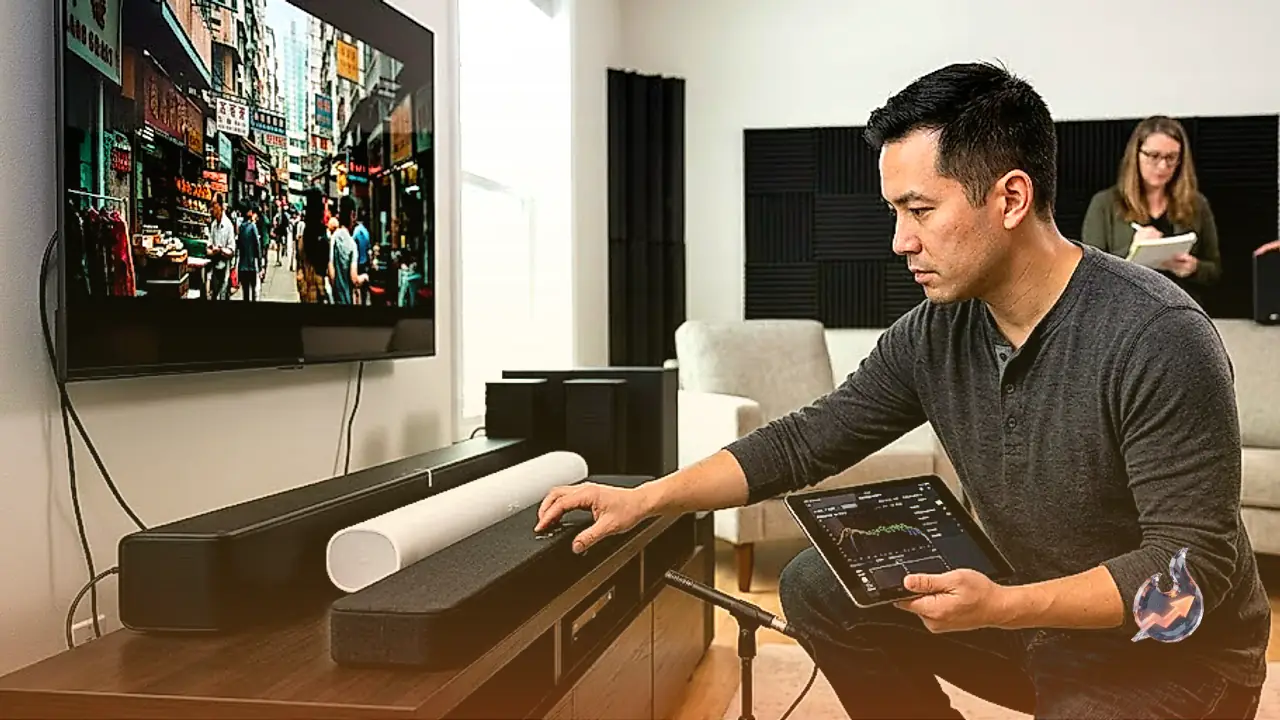

As televisions grow increasingly ultra-thin, the physical space inside them to house competent speakers has essentially vanished. Built-in TV speakers routinely struggle to balance explosive cinematic sound effects with delicate, quiet dialogue, forcing audiences to constantly juggle remote controls or turn on subtitles. A standalone soundbar has consequently transformed from a luxury add-on into an essential component of modern entertainment setups. Whether reproducing the roar of combat aircraft traversing a living room ceiling or resolving the tight rhythmic layers of a bass-heavy studio album, the right sound system completely reinvents home viewing. From space-saving, low-profile designs to expansive multi-speaker ecosystems, modern offerings address diverse acoustic priorities, room dimensions, and budgets.
The Undisputed Benchmark: Sonos Arc Ultra
Among premium all-in-one soundbars, the Sonos Arc Ultra retains its standing as the primary recommendation for gaming, movies, and music reproduction. First introduced in 2024, its refined acoustic architecture delivers pristine clarity without requiring listeners to compromise between sheer power and detail. The hardware utilizes specialized up-firing and side-angled drivers to project Dolby Atmos and DTS:X positional cues across the room. In action set-pieces like Predator: Badlands, subtle environmental details such as clattering spears and directional footsteps reflect accurately across the listening space. Furthermore, modern synth-driven pop and rock tracks, including Maggie Rogers' "Want Want," highlight tight, resonant bass response alongside textured electric guitars.
Room acoustic calibration remains a frequent pain point in high-end home theater setups, but the companion Sonos app automates this environment tuning with minimal input, avoiding tedious manual EQ adjustments. The Arc Ultra is not without minor caveats; power users may miss having an auxiliary HDMI input for routing external media devices, and listeners sensitive to higher frequencies might observe slightly bright treble in specific mixes. Nevertheless, its dependable plug-and-play operation and balanced acoustic profile make it an exceptionally capable centerpiece.
Cinema-Grade Immersion: LG Sound Suite H7
Viewers who place surround immersion above all else will find an unmatched spatial canvas in the LG Sound Suite H7. While impressive as a standalone bar, the system unlocks its true potential when paired with the optional LG W7 wireless subwoofer and LG M7 satellite rear speakers. Although assembling the complete package demands a significant monetary investment, the resulting soundfield wraps listeners in three-dimensional audio. A central technical advantage is its integration of Dolby Atmos FlexConnect, an architecture that permits flexible speaker placement anywhere in the room rather than demanding rigid, symmetrical positioning.
Through the LG ThinQ mobile interface, users link and calibrate the entire ensemble to match the physical geometry of their living space. The practical benefits shine in complex sound designs such as The Last House, where ambient atmospheric cues move precisely through distant corners of the environment. Similarly, during the aerial warfare sequences of Unbroken, the movement of roaring aircraft engines translates with tangible realism. Initial setup requires methodical patience to connect, group, and tune each individual component over a home network. The system does not churn out the bone-crushing low-end punch of dedicated bass-heavy units from Focal or Klipsch, but its spatial steering remains unrivaled.
Compact Solutions for Tight Quarters: TCL A65K and Bose Smart Soundbar
Not every entertainment area accommodates a massive speaker bar spanning several feet. For modest rooms and price-conscious setups, the TCL A65K delivers a noticeable audio upgrade without dominating the media console. Characterized by a slim, short profile, this budget-conscious unit bundles a wireless subwoofer that pairs seamlessly out of the box. Dialogue intelligibility, mid-range punch, and low-end weight see an immediate leap over flat-panel TV speakers. Expectedly, its compact physical cabinet cannot reproduce the vast, panoramic soundstage of flagship alternatives, and the omission of Wi-Fi networking is an unexpected omission. Still, standard connectivity via HDMI eARC and Bluetooth covers conventional streaming needs, while the dedicated TCL smartphone app provides responsive input switching and sound adjustments.
When small physical dimensions must coexist with premium acoustic refinement, the Bose Smart Soundbar stands out as a miniature powerhouse. Measuring just over 27 inches wide, it represents the most compact soundbar in its performance tier while integrating dedicated central, side-firing, and top-firing drivers. This hardware configuration produces wider and more convincing spatial audio than similarly sized alternatives like the Sonos Beam Gen 2. The unit boasts versatile connectivity, accommodating HDMI eARC, optical input, an IR repeater, Wi-Fi, and Bluetooth. Through the Bose Connect mobile software, users can navigate network setup, streaming services, EQ settings, and input selection with ease. While it naturally yields to larger models in outright volume and seismic bass extension, it provides an elegant audio solution where surface space is at a premium.
Low-End Authority and Crisp Speech: Klipsch Flexus Core 300
For listeners who demand physical, room-shaking low frequencies alongside pristine vocal separation, the Klipsch Flexus Core 300 makes a commanding case. Handling intricate cinematic compositions such as the soundtrack to The Odyssey, this unit yields some of the highest volume ceilings and deepest bass profiles available in a standalone bar. Its internal tuning prioritizes center-channel fidelity, keeping spoken dialogue intelligible even during chaotic, explosion-heavy sequences that frequently cause lesser audio equipment to sound muffled.
The ecosystem accommodates physical expansion, allowing listeners to connect up to two subwoofers and additional side-channel speakers over time. Software control via the Klipsch app offers responsive management of audio presets and hardware inputs. Its primary drawback lies in spatial height processing; during high-altitude combat scenes in Unbroken and Masters of the Air, the tracking of aircraft flying overhead and moving from front to rear lacks the definitive three-dimensional trajectory delivered by competing systems. Additionally, completing the physical room calibration requires noticeably more configuration time.
Uncompromising Muscle: Focal Mu-So Hekla
Weighing in at a substantial 34 pounds, the Focal Mu-So Hekla is an acoustic juggernaut built for high-energy blockbusters. Tailored for dynamic, high-impact set pieces such as high-flying stunts and tumbling building sequences, the unit houses 15 internal drivers, including three dedicated woofers that generate thunderous bass on par with the Klipsch Flexus Core 300.
Integrated up-firing drivers project vertical height channels with remarkable force. In scenes like the spear-raising sequence from Predator: Badlands, the resulting metallic resonance rebounds crisply off the ceiling, creating an expansive vertical scale that rivals dedicated ceiling-mounted speakers. For stereo playback, the unit handles classic recordings from Fleetwood Mac at peak volumes without audible distortion or background hiss, while dance-pop tracks like Maggie Rogers' "Want Want" resonate with nightclub-like authority. Input routing and room equalization run smoothly through the Focal app. The major limitation of this heavyweight, high-cost investment is its closed architecture: listeners can add an external subwoofer, but the unit cannot be expanded with modular side or rear surround speakers.
Specialized Flagships and Budget Alternatives
Beyond the primary leaders, several other soundbars fulfill niche acoustic roles, specific price constraints, and brand-specific ecosystems
- Sonos Beam Gen 2 ($499): Serving as a dependable mid-tier option, this compact bar integrates seamlessly with existing Sonos multi-room setups. While it lacks the up-firing drivers found on the Bose Smart Soundbar, the introduction of the newer Sonos Beam Ultra positions the Gen 2 for attractive promotional discounting.
- Sony Bravia Theatre Trio ($2,200): Comprising a main soundbar accompanied by two auxiliary speakers and an optional subwoofer, Sony's flagship trio features stellar center-channel clarity for vocal-heavy content. Although automated room optimization significantly enhances room-filling bass, height cues in atmospheric films like The Last House do not project as vividly from overhead.
- Bluesound Pulse Cinema ($1,499): Measuring 47 inches in length, this system leverages high-resolution audio engineering to excel at music reproduction. Synthesizer-rich tracks like Phoebe Bridgers' "I Will Wait" and Maggie Rogers' "Walk Walk" yield expansive, dimensional stereo separation, though high-end rivals with dedicated upward drivers provide more realistic movie sound effects.
- Polk Audio Signa S4 ($449): Delivering dedicated 3.1.2-channel Dolby Atmos compatibility on a modest budget, this unit features simple setup and accessible presets for movies, music, and late-night listening. It omits Wi-Fi networking and carries a slightly dated physical footprint, but its price-to-performance ratio remains strong.
- KEF XIO ($2,500): Geared squarely toward serious audiophiles, this high-end unit delivers studio-grade balance, tonal transparency, and massive dynamic range across movies and complex musical scores, justifying its substantial price tag through sheer acoustic fidelity.
- Bose Lifestyle Ultra ($1,099): Prioritizing musical immersion, this model excels at enveloping domestic living spaces with rich, warm tonality. It fully supports Dolby Atmos mixes on TIDAL, transforming classic albums like Fleetwood Mac's Rumours into enveloping multi-channel listening sessions.
- Samsung Q990H ($2,000): An evolution of the prior Q990D flagship, this model introduces Sound Elevation technology to virtually lift spoken voices toward the television screen, directly assisting viewers who struggle to decipher hushed film dialogue. Supplementary software updates improve overall sound leveling and refine separation in lower frequencies.