



















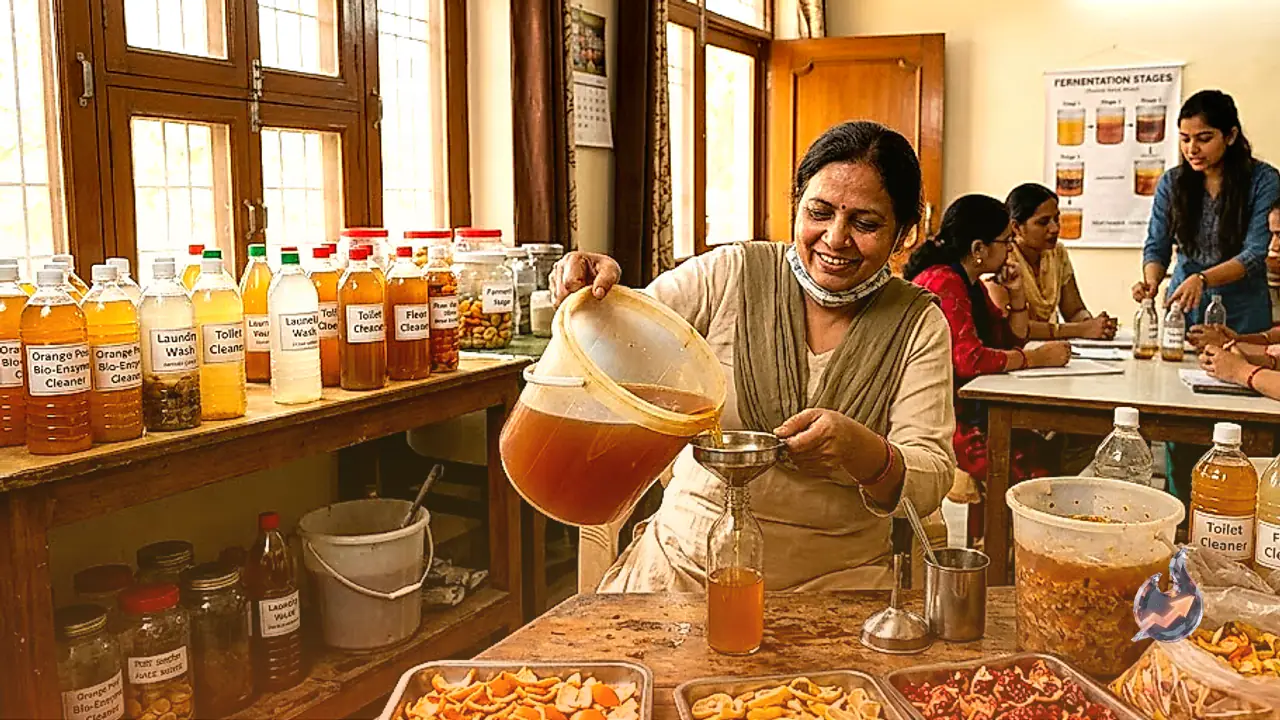

In Faridabad, the orange, lemon, sweet lime, banana and mango peels that pile up in kitchens every single day usually end their journey in the dustbin along with the rest of the household waste, but 54-year-old Suchita Sahu has found a way to turn that same discarded fruit peel into something genuinely useful. She converts the peels into a bio-enzyme, and then uses that liquid as the base for an entire range of home-cleaning products. What began as a personal experiment inside her own kitchen has now grown well beyond her household, with several other people learning the same skill from her and turning it into a source of income for themselves.
How the peels are turned into bio-enzyme
Sahu says the peels she uses do not come only from her own kitchen. Peels collected from nearby juice shops are gathered too, since they would otherwise be thrown away in bulk. To prepare the bio-enzyme, the standard recipe calls for 300 grams of peels, one litre of water and 100 grams of jaggery. For anyone trying it at home using everyday kitchen measures, the same proportion works out to one bowl of jaggery, three bowls of peels and ten bowls of water, which makes it easy to scale up or down depending on how much waste is available.
All three ingredients are mixed together and stored in a sealed plastic jar that is kept in a shaded spot away from direct sunlight. During the first 20 to 25 days, gas builds up inside the jar as the mixture ferments, so the lid has to be loosened slightly every single day to let that gas escape, otherwise the container runs the risk of bursting. After roughly 90 days of this fermentation process, the liquid that has formed inside is strained out, and that finished liquid is the bio-enzyme that is finally ready for use.
A discovery made during a librarian's job
Sahu says her interest in environmental work goes back to her childhood. She used to make compost out of organic kitchen waste at home much earlier in her life, and she still turns her leftover kitchen peels into compost even today. She has also worked as a librarian, and it was during that particular job that she first came across the concept of bio-enzymes. She then took online training from an organisation based in Bengaluru to learn exactly how to prepare it herself.
12 to 13 products, priced from Rs 100
Today, Sahu makes 12 to 13 different cleaning products from this one bio-enzyme base. The range includes a toilet cleaner, a surface cleaner, a glass cleaner and a laundry wash, along with a separate product designed to keep ants, lizards and cockroaches away from the house. She has also prepared a separate liquid that can be sprayed safely around pets. Prices for these products start at Rs 100, while a one-litre bottle of the laundry wash alone sells for Rs 230. Designed for cleaning floors, toilets, glass and other household surfaces, these products effectively replace the chemical cleaners that most households rely on every day, cutting down both the amount of waste generated and the amount of chemicals used at home at the same time.
Over a thousand people trained, a new source of livelihood
Sahu has used thousands of kilograms of fruit peels so far in this process and has personally trained more than a thousand people in the method of making bio-enzyme. She says many of those who have taken her training are now earning their own income from it. According to her, the work was never started with the intention of making money, her original goal was simply to reuse household waste and protect the environment around her. Today, that same effort has quietly turned into a source of livelihood for other people as well. Sahu says age is never really a barrier to starting something new, and if a person genuinely has the will to learn, they can build a fresh identity for themselves through their work at any age.