






















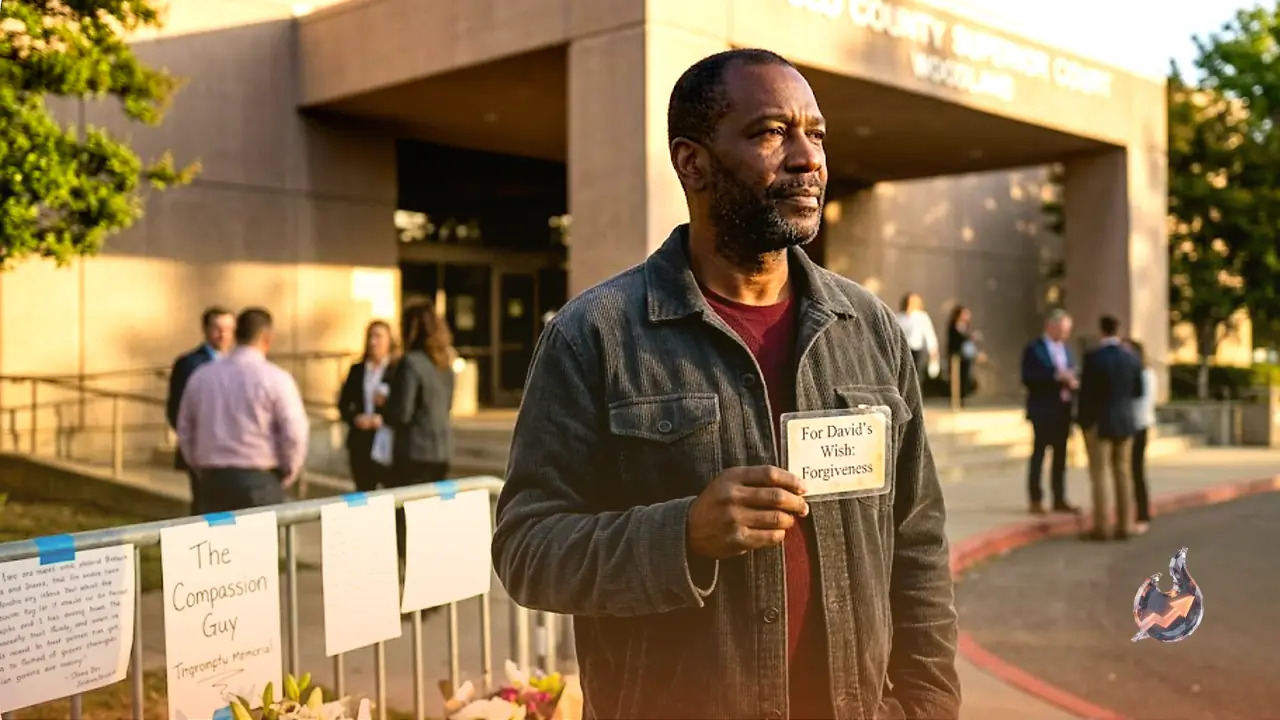

When David Breaux, known across Davis, California as 'the Compassion Guy,' was stabbed to death in April 2023 while sleeping on a bench in the town's Central Park, his sibling faced an impossible test: living up to a note David had written years earlier, asking that whoever harmed him be forgiven.
A Life Devoted to Compassion
David earned his nickname over 14 years of quietly asking strangers in Davis to define the word 'compassion,' recording their answers in a notebook or on video. The project traced back to a personal awakening he experienced in 2009, when he gave away nearly everything he owned to pursue a different kind of life. He chose to live without stable housing, to approach each day without expectation, and to build his existence around simplicity and minimalism.
That someone who had spent well over a decade embodying peace and compassion should die in an act of violence struck his family as a cruel irony. His sibling has described being devastated by the loss. In the early days of grieving, they rediscovered a message David had sent, one he apparently felt compelled to write as he became a more recognisable figure in Davis: 'If I'm ever harmed or unable to speak for myself, forgive the perpetrator and help others forgive that person.'
Sitting Yards From the Man Who Killed Him
Not long afterward, David's sibling found themselves sitting in a courtroom, only yards from the young man accused of taking David's life. The question that followed was blunt: how could anyone live up to David's wish while sitting that close, that early into the grieving process?
The answer, they concluded, was that forgiveness had to be treated as a practice, attempted in real time rather than waited for. It could not be a standard applied to anyone else's grief, only a path walked for themselves.
Studying How Others Learned to Forgive
To build that practice, David's sibling turned to people who had lived through comparable devastation and still found their way to empathy and mercy. They studied the story of Holocaust survivor Eva Kor, who forgave the people responsible for killing her family. They listened to teachings from Jack Kornfield, including his '12 Principles of Forgiveness,' and drew on the work of Fred Luskin, who argued that forgiveness requires learning to 'be at peace with the vulnerability inherent in human life.'
Those lessons were absorbed, then put into practice, though not easily at first. Alongside David's own words, they became a framework. Within that framework, David's sibling also began learning about the young man accused of killing David, and, unexpectedly, started finding common ground with him.
Unexpected Common Ground With the Accused
It can sound absurd that anyone would look for shared humanity with a person accused of killing a family member. Yet that is precisely what David's sibling describes doing over the course of the trial, held in May and June of 2025, of the man accused in David's death, Carlos Reales Dominguez.
The parallels kept surfacing. Their mother had schizophrenia, and so, it turned out, did Carlos, although he had never been diagnosed before a psychiatric evaluation carried out during the trial revealed it. Their mother had come from Jamaica; Carlos had come from El Salvador. Both families carried immigrant roots and had raised their children in lower-middle-class households in dangerous neighborhoods. David, Carlos, and his sibling had all been honors students. In their own ways, all three were survivors. All had been accepted into college, with Carlos and David's sibling both the first in their families to attend.
Recognising how much had been overcome reshaped how David's sibling viewed Carlos, not only through the lens of David's and their own upbringing, but through the experiences of many children they had grown up around, where domestic abuse, sexual abuse, food insecurity, and similar hardships piled up into what public health researchers term adverse childhood experiences. Those experiences, research shows, can raise the likelihood of negative outcomes later in adulthood.
What It Took to Stay Open
Hearing these overlapping stories was deeply moving, but David's sibling also noticed what it actually took to remain open enough to hear them in the first place. It came down, again, to practice: active listening, which the structure of a trial's testimony and evidence arguably demands anyway, alongside mindfulness and sustained self-reflection. Those tools helped in noticing emotions without judgment, recognising personal biases, and listening not just to testimony but to the wider context of suffering behind it.
None of this interrupted the grieving process, nor was that ever the goal. A therapist even told David's sibling that suspending grief in that way would not have been particularly healthy. What the practice did instead was help them heal somewhat faster, grieve somewhat less painfully, and empathise considerably more.
Why Forgiveness Came, and Why It Might for Others
David's sibling acknowledges that everyone carries their own identities, biases, hurts, wants, and needs into painful situations, and that David's explicit request to 'forgive the perpetrator,' the deliberate study of how forgiveness is practiced, and a personal understanding of severe mental illness gained through their mother's experience, likely made forgiveness come more easily than it might for someone else. Still, they believe that given enough time and space, anyone is capable of reaching a similar place of openness and empathy. It may not arrive overnight, but they maintain the possibility exists for anyone willing to look for it.
The Case Continues, and So Does the Healing
The first trial of Carlos Reales Dominguez ended in a hung jury, and a retrial is now underway. David's sibling says they are further along in the grieving process and have started partnering with transformative justice organisations that believe in offering fair chances to people who have committed crimes. They point to a line from civil rights attorney Bryan Stevenson's book Just Mercy: 'Each of us is more than the worst thing we've ever done.'
They describe themselves as being in a good place, still healing and still searching for purpose. Even so, to protect their own wellbeing this time, they are limiting how closely they follow the retrial. Whatever the outcome, they say they intend to approach it with the tools they have built and integrated, and with what they call clear-eyed compassion.