














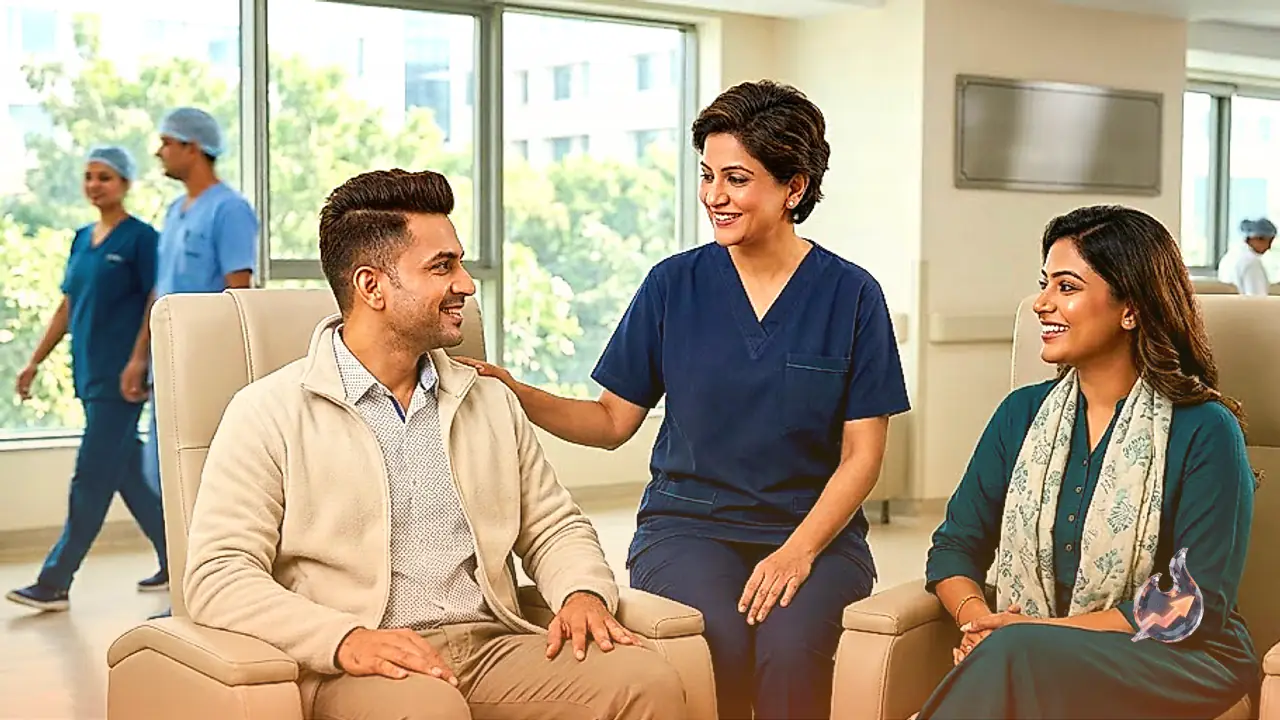

For patients suffering from end-stage renal disease, finding a compatible donor and undergoing a successful transplant operation is often no less demanding than winning a major battle. When a loved one faces a life-threatening illness, family members are usually willing to make any sacrifice to protect them. A deeply moving and extraordinary demonstration of human empathy recently unfolded at Max Super Speciality Hospital in Saket, Delhi. Eight individuals from four completely different corners of India came together to display unparalleled selflessness, mutual trust, and generosity, setting a landmark precedent in medical history while giving four critically ill individuals a fresh lease on life. The entire initiative involved eight participants across four families hailing from Nagaland, Kashmir, Punjab, and Bihar, consisting of four organ donors and four kidney recipients.
Medical Incompatibility Paves the Way for a Unique Solution
The sequence of events began when four separate families arrived at Max Hospital in Saket at different points in time, each seeking treatment for a relative requiring an urgent kidney transplant. In every case, a willing family member had come forward to donate an organ. However, clinical evaluations revealed a major medical barrier: cross-match testing between each patient and their respective relative donor returned positive results. In organ transplantation, a positive cross-match indicates high antibody incompatibility, meaning the recipient's immune system would instantly reject the donor organ, making direct transplantation medically impossible and potentially fatal. Consequently, all four scheduled transplants had to be indefinitely postponed, leaving the families in deep distress.
During this critical period, a visionary doctor at Max Hospital proposed an innovative alternative. The physician suggested cross-matching all four donors against all four recipients simultaneously across the four families. Although the four groups were total strangers belonging to distinct geographical regions, Nagaland, Kashmir, Punjab, and Bihar, every family immediately consented to the comprehensive testing in hopes of saving their loved ones. The cross-match trial yielded astonishingly positive results. Every single donor proved to be a clean, compatible match for a patient from another family. Upon receiving the laboratory confirmation, all four donors and recipients unhesitatingly agreed to proceed with a four-way inter-family organ swap.
Legal Hurdles and the Delhi High Court Verdict
While the clinical obstacles were resolved, a daunting legal hurdle emerged. Regulatory frameworks governing organ transplants under existing law generally recognized paired kidney exchanges involving only two families. The statutory validity of a simultaneous four-way exchange among multiple unrelated families remained legally ambiguous. To overcome this administrative impasse, the donors and recipients jointly filed a writ petition in the Delhi High Court seeking legal authorization for the multi-pair swap.
Recognizing the urgency and humanitarian dimension of the plea, Justice Purushaindra Kumar Kaurav delivered a milestone judgment on May 26, 2026. The High Court clarified that legal phrases such as 'first donor' and 'second donor' within regulatory guidelines were intended merely as illustrative examples rather than a rigid statutory limitation restricting paired swaps to just two couples. Overruling previous restrictive orders, the court directed the relevant authorities to reconsider the four-way exchange proposal expeditiously, provided the transaction was entirely non-commercial and devoid of financial trade. This judicial clearance cleared the final obstacle for the eight participants.
An 11-Hour Marathon Operation Across Five Surgical Theatres
Following the judicial authorization, the medical and administrative teams at Max Hospital mobilized swiftly. On July 13, 2026, all eight individuals were admitted to Max Super Speciality Hospital in Saket, Delhi. Surgical procedures commenced at 7:00 AM across five operation theatres operating in parallel. The complex multi-stage operation was led by Dr. Anant Kumar, with surgical teams coordinated like a disciplined military unit.
Every minute of the procedure required rigorous coordination. As soon as a donor's kidney was retrieved in one operation theatre, it was carefully preserved in a specialized ice container and immediately transferred to an adjacent theatre where the matched recipient was prepped for surgery. The organ was then transplanted without delay. This continuous relay persisted for 11 consecutive hours from 7:00 AM until 6:00 PM, by which time all four organ transfers between the respective families had been successfully completed.
Unwavering Mutual Trust and Successful Recovery
Throughout the extended surgical procedure, the operational stakes remained exceptionally high. Had any single donor withdrawn at the final moment, or had any recipient developed a fever or hyperacute rejection, the entire four-way swap chain would have collapsed, leaving all four families without solutions. Despite these immense pressures, all eight participants maintained profound faith in one another and in the medical team.
When the operation theatre lights were turned off at 6:00 PM and the surgical team confirmed that all four transplants had concluded successfully, emotional scenes of relief unfolded among the families. All four donors emerged from surgery in stable health and good spirits, while all four recipients successfully received functioning kidneys displaying encouraging medical indicators. This achievement stands not only as a clinical triumph but also as a testament to what collective human goodwill and shared trust can accomplish when confronting formidable challenges.