





















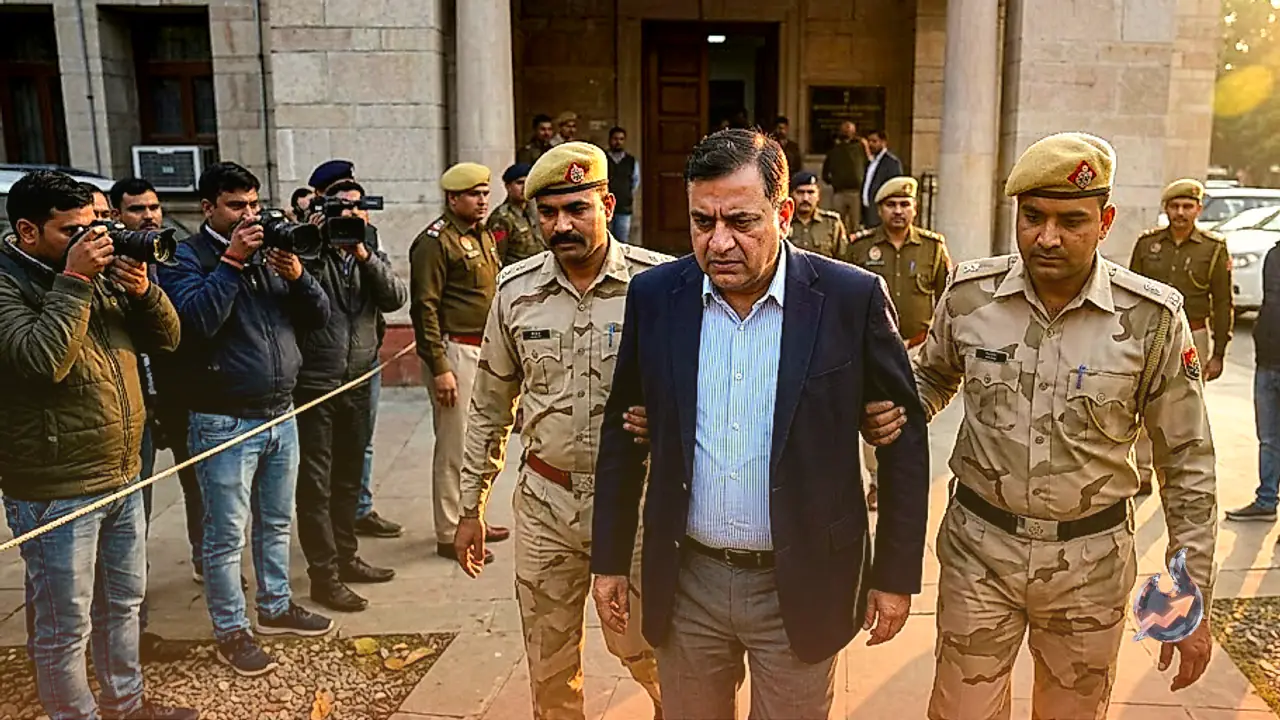

The Supreme Court of India has officially overturned the anticipatory bail previously granted to Rajneesh Bansal, the chairman of the Himalayan Group of Professional Institutions, in connection with a massive financial embezzlement case in Himachal Pradesh. The Enforcement Directorate had approached the apex court to challenge his protection from arrest, arguing that questioning him in custody is absolutely vital to unearth the intricate financial networks involved in the alleged ₹250 crore post-matric scholarship fraud. By accepting the agency's appeal, the top court has paved the way for a deeper federal investigation into the siphoning of government funds.
Court Highlights Need for Effective Interrogation
A two-judge bench comprising Justice M.M. Sundresh and Justice Prasanna B. Varale delivered the ruling, emphasizing the unique nature of large-scale financial crimes. The justices observed that investigating agencies require a completely unimpeded opportunity to conduct a fair and thorough probe into serious economic offenses. According to the bench, tracing the complex route of laundered money demands rigorous examination, which often makes custodial interrogation indispensable. However, the court explicitly clarified that stripping away the pre-arrest bail was purely a measure to facilitate the ongoing investigation and should not be interpreted as a final declaration of the accused's guilt.
Agency Warns of Hindered Investigation
During the hearings, representatives for the Enforcement Directorate detailed the severe implications of the financial irregularities. The agency highlighted that the misappropriated capital was originally earmarked under a post-matric scholarship initiative designed exclusively to support higher education for students belonging to Scheduled Castes, Scheduled Tribes, and Other Backward Classes. The investigators argued that the protection from arrest was actively hindering their progress, making it practically impossible to map the complete money trail or identify the broader network of individuals involved in laundering the illicit wealth without holding the accused in custody.
Mechanics of the Multicrore Embezzlement
The origins of this sprawling controversy trace back to a collaborative welfare initiative funded jointly by the central and state governments. The post-matric scholarship program aimed to provide essential economic assistance to marginalized youth pursuing higher studies. However, a routine internal audit conducted by the state education department in 2018 exposed systemic and widespread discrepancies in how these stipends were being distributed across the region.
Subsequent inquiries revealed a deeply entrenched conspiracy operating between the academic years of 2012 and 2018. Numerous private educational entities allegedly fabricated student enrollment records, generated forged documentation, and manipulated institutional data to fraudulently claim scholarship payouts. Authorities estimate that these deceptive practices drained approximately ₹250 crore from the public exchequer. The preliminary findings ultimately implicated more than two dozen private academic institutions in the coordinated embezzlement scheme.
Federal Interventions and Ongoing Probes
Recognizing the gravity and scale of the fraud, the Himachal Pradesh High Court intervened in 2019, directing the Central Bureau of Investigation to take over the criminal probe. The federal police agency subsequently registered multiple First Information Reports against various institute operators, government officials, and other facilitators for cheating, criminal conspiracy, and corruption. Using the predicate offenses established by these police files, the Enforcement Directorate launched its own parallel investigation under the Prevention of Money Laundering Act to track the diverted assets. The recent apex court decision revoking the education group chairman's bail marks a critical turning point as federal agents intensify their efforts to recover the stolen public money.