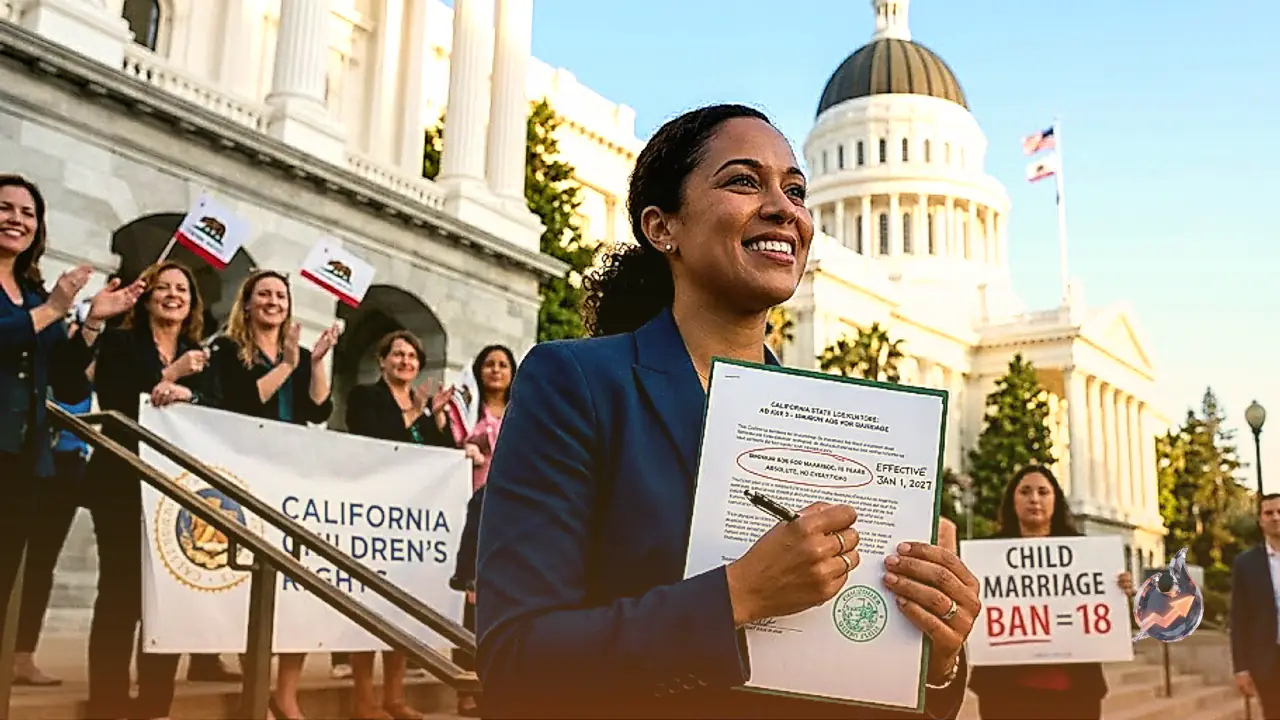
























California has enacted a definitive ban on child marriage, closing a longstanding legal framework that previously allowed minors to wed. Under the newly approved statute, individuals must be at least 18 years old to enter into a marriage or register a domestic partnership, with the mandate taking effect on 1 January 2027. Prior to this reform, the state did not establish a formal statutory minimum age requirement, permitting minors to marry provided they secured parental or guardian consent alongside formal approval from a judge.
The official signing ceremony brought renewed attention to survivor advocacy, featuring Courtney Stodden, who gained widespread public prominence after marrying actor Doug Hutchison at age 16 when he was 51. Stodden subsequently transformed into an outspoken campaigner against early marriages. However, California's legislative milestone applies exclusively within its own jurisdiction, highlighting the fragmented nature of marriage regulations across the United States where no overarching federal standard exists.
The Current Legal Landscape Across the United States
Marriage regulations in the United States operate under state sovereignty rather than federal oversight, creating wide variations in statutory requirements nationwide. Research from Unchained At Last, an organization actively campaigning against child marriage, documents that only 18 US states have enacted comprehensive prohibitions barring individuals under 18 from marrying under any circumstances.
Conversely, 32 US states continue to permit minors to enter into legal unions when specific legal conditions are met. These statutory allowances frequently hinge on exceptions such as parental or guardian permission, formal judicial authorization, pregnancy, emancipation status, or comparable legal exemptions. Consequently, the United States lacks a uniform, nationwide minimum marriage threshold of 18 applying consistently across all 50 states.
Key Factors Behind the Prolonged Reform Process
Efforts to eradicate underage marriage in the United States have confronted decades of resistance tied to localized customs and state-level legislative stagnation. Historical legal frameworks frequently permitted underage girls to marry following pregnancy, including situations originating from sexual assault. The case of Sherry Johnson in Florida stands among the most extensively documented historical examples of these circumstances, alongside the high-profile union between Courtney Stodden and Doug Hutchison.
The numerical reach of the issue remains substantial. Data cited by Unchained At Last indicates that more than 260,000 minors entered legal marriages within the United States between 2000 and 2015. On an international scale, child marriage persists widely, with advocacy groups estimating that roughly 28 girls marry every minute globally. These cumulative records and ongoing survivor testimonies continue to fuel pressure on remaining state legislatures to eliminate statutory exceptions and mandate 18 as an unbending legal requirement.
Documented Consequences for Underage Spouses
Entering marriage as a minor generates profound, long-term harm that extends beyond social implications to alter physical wellbeing, schooling, and personal agency. The World Health Organization documents that adolescent mothers confront substantially elevated dangers regarding pregnancy and delivery complications. Furthermore, infants born to young mothers experience higher risks of low birth weight and premature delivery.
In educational and developmental spheres, UNICEF demonstrates direct correlations between early marriage and heightened school dropout rates, social isolation, curtailed economic prospects, and intensified reliance on spouses. Mental health outcomes reflect similar strain: WHO findings link intimate-partner and sexual violence against young brides to lasting depression, anxiety disorders, and symptoms of post-traumatic stress. These cascading factors reshape an individual's trajectory long after the wedding occurs.
Comparing the Policy Realities of the US and India
A structural contrast exists between how child marriage is addressed in the United States versus India. In the US, the primary legislative battle remains focused on repealing state laws in 32 jurisdictions that still maintain statutory clauses permitting minors to marry under defined exceptions.
In India, child marriage is explicitly prohibited under national legislation. The Prohibition of Child Marriage Act categorizes males under 21 and females under 18 as children, declaring any union involving a minor to be child marriage under the statute. Nevertheless, statutory prohibition has not eradicated the occurrence in practice.
UNICEF data covering 2019 to 2021 indicates that 23% of women aged 20 to 24 in India had entered their first marriage or union before reaching the age of 18. Geographically, more than half of all girls and women in India who married during childhood reside across five states: Uttar Pradesh, Bihar, West Bengal, Maharashtra, and Madhya Pradesh. Thus, while American reformers work to overturn state-level statutes that legally sanction child marriage, India's foremost hurdle lies in enforcing established legislation against deeply rooted practices.