

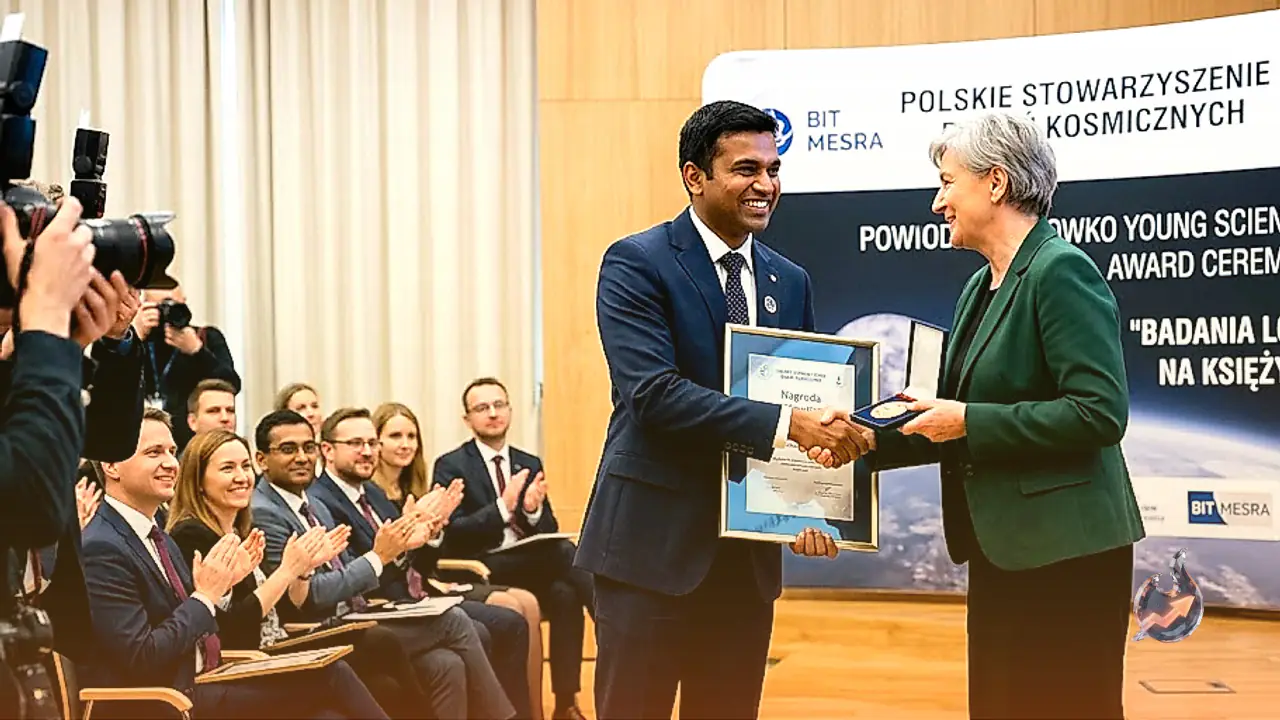

















Indian space research has achieved another milestone on the global stage as Nitish Kumar, a dedicated researcher from BIT Mesra in Ranchi, Jharkhand, was conferred with the prestigious Young Scientist Award in Poland. His award-winning presentation focused on analyzing the potential presence of water ice inside lunar craters situated in the Moon's south polar region, utilizing valuable observations gathered by India's Chandrayaan-2 mission.
Unlocking Lunar Secrets Through Chandrayaan-2 Radar Data
Nitish Kumar received this recognition for his research paper titled Ejecta Characterization of an Icy Crater Using Chandrayaan-2 Dual-Frequency Synthetic Aperture Radar. The investigation delves into the physical and polarimetric properties of crater ejecta, which refers to the material thrown out during impact events in the icy regions near the lunar south pole.
By deploying advanced polarimetric parameters alongside Dual-Frequency Synthetic Aperture Radar (SAR) observations from Chandrayaan-2, the study provides crucial insights into identifying water-ice deposits. The application of sophisticated radar remote sensing techniques allows scientists to map surface and subsurface features of lunar craters with high precision.
Guidance from Senior Scientists and Global Collaboration
The research was conducted under the framework of the Chandrayaan-2 Research Program at BIT Mesra, guided by Principal Investigator Dr. V. S. Rathore and Co-Principal Investigator Dr. A. P. Krishna. Their scientific leadership provided the necessary foundation for completing this complex planetary analysis.
The study also benefited from international collaboration with Dr. Ajit Kumar, a researcher at the RAS Lab within CNIT in Italy. This joint effort underscores the growing importance of global partnerships in processing radar-based remote sensing data for planetary exploration.
From a Small Bihar Village to International Scientific Acclaim
Hailing from Dandwas village in the Kaimur district of Bihar, Nitish Kumar comes from a humble agricultural background. His father works as a farmer, while his mother manages the household as a homemaker. Since his early childhood, Nitish harbored a dream of becoming a scientist and making meaningful contributions to space exploration.
Receiving the award in Poland represents the fulfillment of that lifelong goal. His accomplishment has brought immense pride to his family and village, while inspiring young students across the region to pursue careers in scientific research.