




















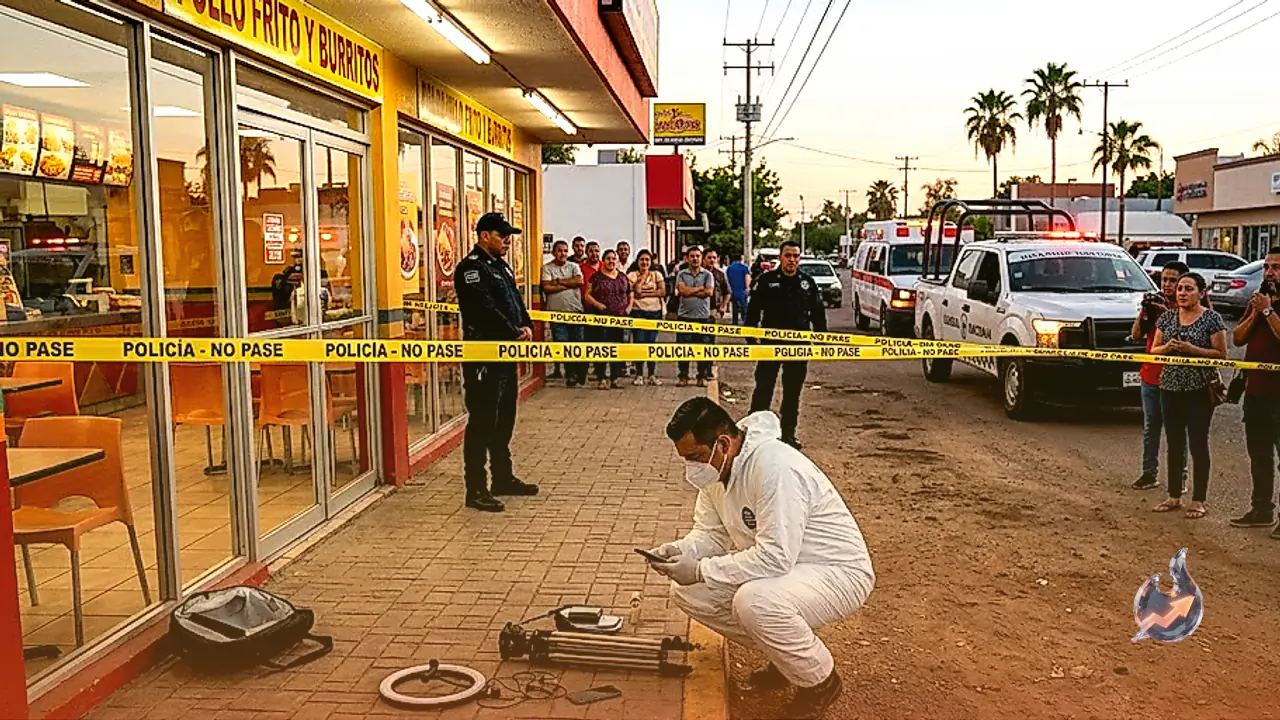

A horrific violent crime captured live on camera has shocked viewers across Mexico, after popular content creator Cesar Gastelum was shot dead while broadcasting live on social media from the city of Culiacan in Sinaloa state. The young digital streamer was conversing with two friends outside a local fast food establishment when two armed assailants riding a motorcycle abruptly approached the group. Within seconds, the passenger on the motorcycle fired a fatal gunshot directly into Gastelum's head at close range before both attackers rapidly sped away from the scene. The tragic murder, witnessed in real time by online followers watching the broadcast, has reignited intense debate regarding the dangerous intersections of social media fame, digital content creation, and powerful drug cartels operating within Sinaloa.
A Sudden Ambush Caught Live on Camera
The sudden attack unfolded in mere seconds during what appeared to be an ordinary evening broadcast. Cesar Gastelum was sitting outdoors with two acquaintances near a fast food restaurant in Culiacan, the capital and largest city of Sinaloa state. As he interacted with his live audience, a motorcycle carrying two unidentified men pulled up alongside the sidewalk where the group had gathered. Without warning or preliminary exchange, the person riding on the back of the vehicle aimed a firearm at Gastelum's head and pulled the trigger at point blank range. As Gastelum collapsed immediately, the perpetrators accelerated their motorcycle and vanished into the surrounding streets. Because the entire sequence was transmitted over an active digital stream, hundreds of viewers experienced the terrifying moment as it occurred, creating immediate panic and outrage across social media platforms.
State Prosecutor Probes Social Media Activity
In the aftermath of the shooting, law enforcement officials and investigators from the Sinaloa state prosecutor's office initiated a comprehensive inquiry into the murder. While initial public statements from prosecutors contained minimal specific operational details regarding suspects or potential motives, official representatives confirmed that investigative tracks are heavily focusing on Gastelum's digital footprint. In particular, investigators are reviewing numerous public videos, photographs, and messages published by Gastelum across his social media channels, noting that several of his posts directly or indirectly reference an active criminal group in the region. At the same time, authorities clarified that Gastelum had never reported receiving threats from organized crime syndicates, nor was he the subject of any ongoing law enforcement investigations regarding alleged criminal associations, a status that contrasts with some other content creators targeted in previous incidents.
Escalating Cartel Warfare and Creator Deaths
The assassination of Cesar Gastelum is not an isolated incident but rather part of a broader pattern of violence targeting digital personalities in northwestern Mexico. Sinaloa has been gripped by intense internal conflict for the past two years, following the outbreak of an all-out territorial war between two rival factions within the Sinaloa cartel: La Mayiza and Los Chapitos. Since this violent internal feud erupted two years ago, at least ten content creators have been murdered across Sinaloa state. The deadly rivalry between these armed factions has turned the region into a high-risk zone for public figures, where online visibility can rapidly translate into physical vulnerability.
The Leaflet Campaign and Alleged Cartel Affiliations
The perilous landscape confronting local influencers was highlighted in January 2025, when an aircraft flew over the city of Culiacan and scattered thousands of paper leaflets onto the public streets below. These dropped pamphlets contained explicit lists accusing twenty-five prominent influencers, content creators, and musicians of possessing direct operational or promotional ties to La Mayiza, the faction engaged in violent conflict against Los Chapitos. The printed notices went so far as to mark four individuals as already eliminated, signifying their prior homicides. Since that aerial pamphlet drop occurred in January 2025, two additional individuals named on the list have been murdered. Although Gastelum's name was not included among the twenty-five individuals listed on the dropped leaflets, local analysts and observers regard his killing as the newest continuation of an alarming trend where digital creators become caught in the crossfire of cartel feuds.
Social Media Algorithms, Narco Culture, and Luxury Displays
To understand why social media creators find themselves exposed to extreme violence, communications expert Claudia Arruñada of Mexico's Iberoamerican University offers critical insights into the structural overlap between digital platforms and organized crime. According to Arruñada, social media algorithms and drug cartels operate on strikingly similar underlying principles, both heavily promoting immediate luxury, ostentatious consumption, and rapid material wealth as the ultimate indicators of personal success. The traditional path of career development, which relies on gradual effort and methodical work over time, has been largely replaced in popular perception by a desire for meteoric, overnight success.
In many instances, content creators explicitly or implicitly promote narco culture by broadcasting lavish lifestyles to millions of followers, creating a direct visual connection between opulent wealth and the illegal activities of cartels. Gastelum frequently uploaded content featuring high-end automobiles, vibrant nightlife scenes, expensive vacations, comedy sketches, and online challenges. Notably, one photograph posted on his profile showed him standing beside the grave of Leobardo Aispuro, a well-known influencer popularly known as El Gordo Peruci, who was murdered in 2024.
However, many content creators in Sinaloa strongly reject the label of narco-influencers. They argue that simply being a young, prominent public figure who displays a stylish or comfortable lifestyle in a city like Culiacan is enough to attract dangerous attention and turn an individual into an unwitting target, regardless of actual criminal involvement.
Corporate Cartel Structure and Information Warfare
Sociological research and criminal intelligence studies reveal that contemporary Mexican cartels operate in ways comparable to modern multinational corporations, managing diverse legal and illegal business enterprises. As part of their public relations and information operations, cartels frequently utilize digital content creators as informal community managers to shape public perception, glorify their criminal activities, and build brand awareness among younger demographics.
When internal disputes cause cartel factions to turn against each other, content creators who are perceived as disseminating propaganda or displaying loyalty toward one faction quickly become high-value targets for rival groups. In an environment dominated by intense cartel rivalry, even subtle social media interactions, music choices, or casual photos can be interpreted by enemy factions as acts of allegiance, resulting in fatal retaliation.
Government Countermeasures and Violent Reality
Addressing the tragedy during a press conference on Wednesday, Mexican President Claudia Sheinbaum affirmed that both federal and local law enforcement authorities are committed to pursuing the individuals who carried out Gastelum's murder as well as the intellectual authors who ordered the execution. The federal government under Sheinbaum's administration has launched targeted initiatives aimed at severing the cultural links between mainstream entertainment and the criminal underworld. As part of this comprehensive strategy, authorities have publicly denounced narcocorridos, popular musical ballads that glorify drug traffickers and criminal exploits, while simultaneously increasing physical security deployments across Sinaloa.
Government officials point to recent statistical data indicating that official murder counts across Mexico decreased by 48 percent in 2025 as evidence of progress in curbing nationwide violence. Nevertheless, high-profile killings like that of Gastelum, which unfolded live before an audience of online followers, underscore the ongoing reality that drug cartels continue to exert formidable power and inflict lethal violence not only on the physical streets of Culiacan but across digital and social media spaces as well.