

















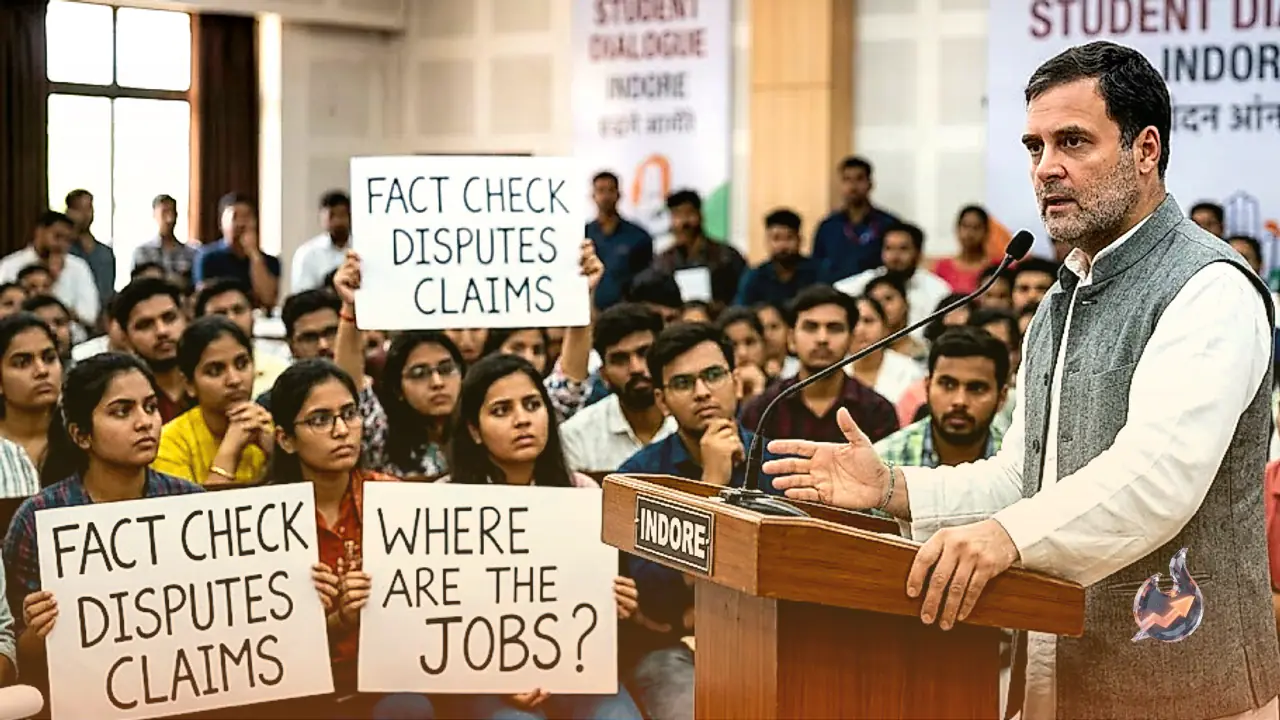

A sharp political debate has broken out following statements made by the Leader of the Opposition in the Lok Sabha, Rahul Gandhi, during the 'Chhatron Ki Goonj' interactive student session held in Indore, Madhya Pradesh. While the address focused on major grievances concerning young job-seekers and educational policies, an active handle on the social media platform X operating under the name 'Jhooth Ki Goonj' issued an extensive counter-analysis, scrutinizing five specific assertions regarding recruitment quotas, legal interventions, business deals, and attendee backgrounds.
Recruitment Quotas in MPPSC and the 87:13 Formula
The first significant dispute centered on state public service examinations. Rahul Gandhi alleged that recruitment drives conducted by the Madhya Pradesh Public Service Commission had kept 13 percent of vacancies on hold continuously over the preceding eight years. He asserted that this unresolved mechanism left approximately 4.87 lakh positions pending, stalling employment opportunities across the state.
Challenging this narrative, the fact-checking page presented administrative records indicating that the General Administration Department's 87:13 formula had not been operating for eight years. Instead, it was introduced on September 29, 2022, roughly four years ago. The issue originated during the Congress administration in 2019 following an expansion of other backward classes reservation to 27 percent. Recruitment was maintained for 87 percent of positions, meaning that only around 10,000 specific vacancies were trapped in the ensuing legal dispute rather than the claimed figure of 4.87 lakh.
The Timeline Behind the OBC Reservation Halt
The second contested claim involved the implementation of higher reservation quotas for backward communities. The speech stated that although the Congress government elevated OBC reservation from 14 percent to 27 percent in March 2019, the subsequent Bharatiya Janata Party government blocked its execution by citing pending courtroom deliberations.
However, the counter-examination pointed out that the suspension was not ordered by an incoming BJP administration. Rather, the Madhya Pradesh High Court had stepped in on March 19, 2019, while the Kamal Nath administration was actively in office. The critique highlighted that the notification was brought forth without sufficient legal preparation, leading judicial authorities to stay its application regarding higher education admissions. Subsequently, in 2021, the BJP administration moved to implement the enhanced quota across other government job hiring processes.
Investments by the Adani Group in Non-BJP States
Corporate contracts formed the core of the third allegation. Rahul Gandhi connected government tenders and financial windfalls secured by the Adani Group directly to patronage from the central government, alleging an institutional pipeline between public infrastructure contracts and ruling party funding.
The counter-arguments published on social media questioned this assertion by highlighting agreements enacted in states governed by opposition parties. If commercial ties with the conglomerate were purely the result of central favoritism, the critique asked why Congress-led administrations had also contracted significant infrastructure projects to the same business entity. For instance, the Congress government in Karnataka designated the Adani Group as the lowest bidder for a tunnel-road undertaking in Bengaluru. Similarly, the Congress dispensation in Telangana finalized formal Memorandums of Understanding valued at 12,400 crore rupees with the firm, alongside port operations operating in Kerala.
Dispute Over the Apolitical Nature of Student Speakers
The fourth controversy related to the authenticity and political neutrality of the attendees permitted to present student grievances from the stage. The event was framed as an earnest, non-partisan listening platform designed exclusively to amplify ordinary student voices without political interference.
Upon reviewing the background of speakers highlighted during the interaction, the counter-post demonstrated that Tanay Sharma, who addressed the assembly as a student, possessed active political ties. While enrolled at Makhanlal Chaturvedi National Journalism University, Sharma had previously served as a state spokesperson for the National Students' Union of India. Critics argued that presenting an individual with an established history within the party's student wing as an unaffiliated, ordinary student misrepresented the nature of the forum.
Expansion of Tribal Education and Eklavya Schools
The final debate examined education policies for indigenous communities and the administration of Eklavya Model Residential Schools. The opposition leader accused the central government under Narendra Modi of intentionally keeping tribal youth disconnected from standard educational opportunities to limit their independent civic participation.
Official progress metrics shared in response countered this narrative with institutional growth numbers. According to the data, the total count of operational Eklavya Model Residential Schools across India stood at 129 during the 2014-15 academic cycle. By August 2026, the network had grown significantly to 511 functional institutions. Furthermore, student enrollment within these specialized residential tribal schools climbed from 40,000 to approximately 1.5 lakh students, indicating expanded infrastructure and state-backed educational support.