






















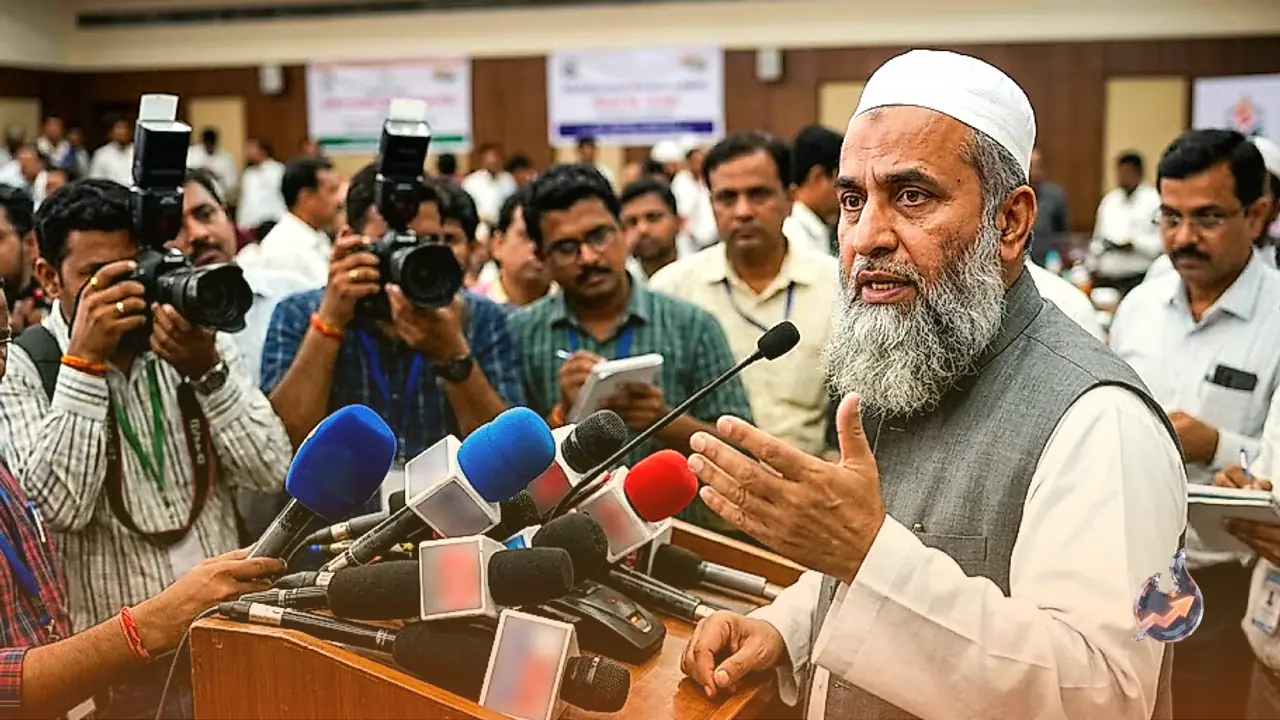

The implementation of the Maharashtra Freedom of Religion Act 2026 has sparked widespread legal and constitutional debates across the country. Expressing deep concern over the enactment of the new law, Maulana Mahmood Asad Madani, President of Jamiat Ulema-e-Hind, stated that several provisions of the legislation directly violate fundamental rights guaranteed to citizens. He emphasized that the law undermines freedom of conscience, religious liberty, personal privacy, and the right to live life according to individual choices. Reaffirming that India's core strength lies in its pluralistic religious and cultural identity, he argued that denying individuals the freedom to choose their faith renders the constitutional guarantees under Article 25 virtually meaningless.
Constitutional Guarantees under Article 25 at Stake
Highlighting the constitutional protections enshrined in Article 25, Maulana Madani noted that religious freedom is an essential cornerstone of Indian democracy. If an individual is restricted from choosing or practicing their religion of choice, the fundamental guarantee of religious freedom loses its substantive value. He asserted that the Constitution explicitly safeguards the right of every citizen to follow their conscience, and any legislative measure that restricts this personal liberty compromises the constitutional framework.
Adoption of Anti-Conversion Models from Other States
Maulana Madani observed that Maharashtra has structured its new anti-conversion legislation on models previously enacted in Uttar Pradesh, Gujarat, and Madhya Pradesh. He pointed out that Jamiat Ulema-e-Hind has already mounted legal challenges in the Supreme Court against the anti-conversion statutes of those states. According to him, these state laws rely on imprecise legal terminology that leaves significant scope for administrative misinterpretation and arbitrary enforcement.
Ambiguity Surrounding 'Allurement' and 'Fraudulent' Provisions
Critiquing the specific terminology used within the statute, Maulana Madani drew attention to terms such as 'allurement' and 'fraudulent'. He stated that the lack of clear and precise legal definitions for these concepts creates a serious risk where even peaceful religious propagation could be criminalized. In monotheistic faith traditions, spiritual teachings frequently reference salvation, liberation, or divine rewards in the afterlife. Under the broad language of the new law, conveying these core theological concepts risks being categorized as unlawful allurement, thereby directly curtailing the constitutional right to propagate religion.
State Oversight versus Personal Liberty and Privacy
Drawing from past experience in other states, Maulana Madani argued that such legislative frameworks have frequently led to the incarceration of numerous individuals under questionable circumstances. He questioned the rationale of granting the State constitutional authority to act as an arbiter or custodian of an individual's private conscience and religious choices. The State, he maintained, should not hold the power to dictate or audit personal faith decisions.
He further referenced concerns previously articulated by the Supreme Court regarding similar statutory requirements. Procedural mandates such as compulsory pre-conversion declarations, mandatory police inquiries, and the public disclosure of personal identity details impose an unwarranted and extraordinary burden on individual liberty and privacy.
Call for Comprehensive Judicial Scrutiny
In light of the broader impact of anti-conversion laws across multiple states, Maulana Madani appealed to the judiciary and democratic institutions to look beyond the stated legislative objectives. He urged courts to examine the entire statutory architecture, evaluate potential majoritarian motives underlying such legislation, and scrutinize documented instances of executive misuse. He called upon the judiciary to urgently address the ramifications of these laws on civil liberties.
Opposition Limited to Misuse, Not Legitimate Fraud Prevention
Clarifying the stance of Jamiat Ulema-e-Hind, Maulana Madani stressed that the organization does not oppose genuine statutory measures designed to prevent forced, coerced, or fraudulent religious conversions. If the true intent of a law is to curb deceit and coercion, there is no objection to that goal. However, he cautioned that legislation enacted under the banner of protecting religious freedom must not become a vehicle to suppress that very freedom or be weaponized against any specific religious community.