























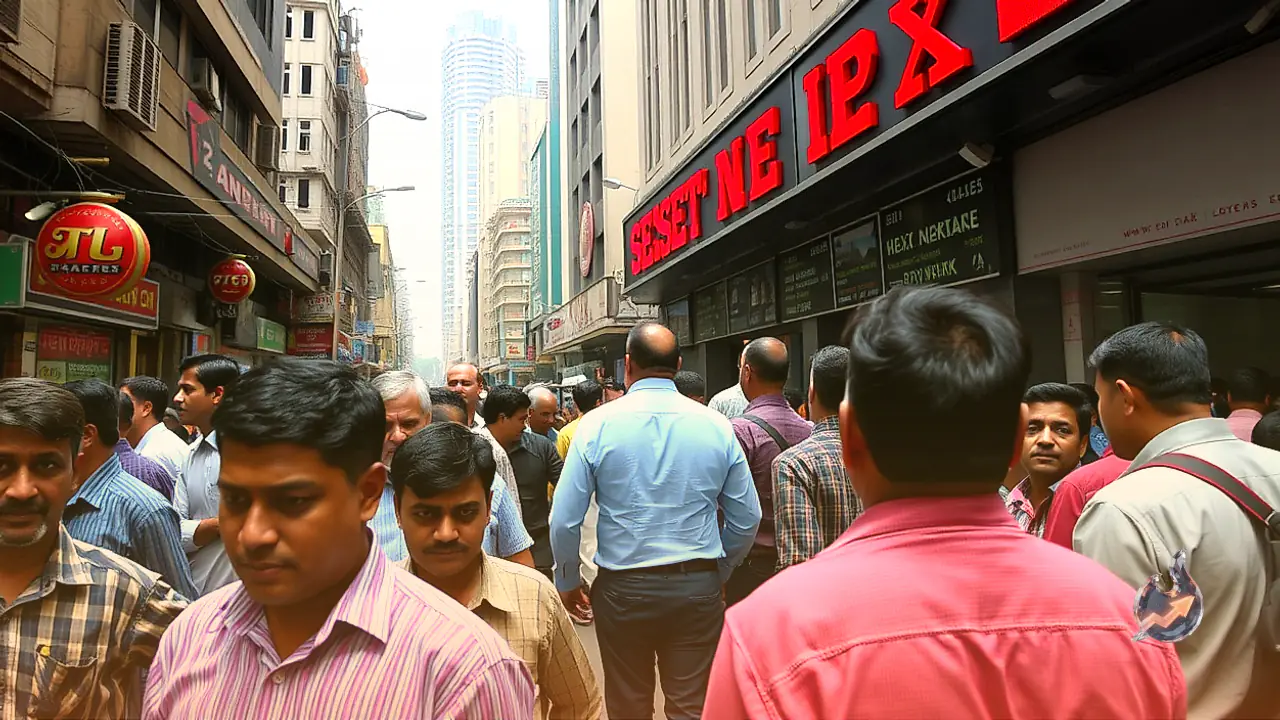

A severe bout of risk aversion swept through the Indian equity markets on Thursday, October 8, dragging the headline indices sharply lower as global headwinds converged with domestic monetary tightening concerns. Across the trading session, selling momentum remained relentless, leaving market participants with substantial portfolio drawdowns. By the closing bell, the benchmark Sensex had shed more than 1,000 points, wiping out approximately 10 lakh crore rupees in total investor wealth across listed counters.
Benchmark Indices Tumble Across Broad-Based Market Pressure
The headline indices concluded the session with substantial declines after enduring persistent downward drift. The BSE Sensex settled at 71,593.24, marking a drop of 1,045.46 points or 1.44 percent. Concurrently, the NSE Nifty dropped 371.25 points or 1.64 percent to end at 22,231.80. Market breadth tilted overwhelmingly in favour of declining counters. A total of 3,280 stocks ended lower, contrasted with merely 951 advances, while 180 issues closed unchanged. Broader markets offered no refuge from the carnage, with both midcap and smallcap gauges sliding by more than 2 percent.
Realty and Energy Bear the Brunt of Sectoral Selloff
Nearly all sectoral gauges finished in negative territory as selling pressure enveloped virtually every major segment. The Nifty Realty index endured the steepest setback, plunging 2.98 percent. Closely following, the Nifty Energy index recorded a drop of 2.87 percent. Significant downside was also evident in the Nifty Infra index, which slipped 2.66 percent, alongside declines in Nifty PSE (-2.47 percent), Nifty Pharma (-2.38 percent), and Nifty FMCG (-2.01 percent). In stark contrast to the surrounding weakness, only the Nifty IT index managed to cling to positive territory, closing marginally higher by 0.04 percent.
Stock Performance: Gainers Remain Scarce as Key Heavyweights Slide
Buying interest remained confined to a narrow pocket of resilient stocks throughout the trading hours. Modest advances were posted by Infosys, which added 0.50 percent, Tech Mahindra, up 0.34 percent, and Axis Bank, which advanced 0.20 percent. On the losing side, sharp pullbacks hit major corporate heavyweights. Adani Enterprises led the decliners with a slide of 5.36 percent, followed by JSW Steel with a 4.46 percent decline. Losses also mounted in ITC (-4.03 percent), Max Healthcare (-3.81 percent), IndiGo (-3.55 percent), and Shriram Finance (-3.24 percent).
Catalysts Fueling the Downward Spiral Across Equities
The intensified selling on October 8 stemmed from an intersection of domestic monetary moves and international macro pressures. The Reserve Bank of India enacted its first repo rate hike in three years, raising the benchmark rate to 5.50 percent and shifting its official stance to calibrated tightening, igniting concerns regarding prolonged elevated borrowing costs. Simultaneously, a sharp spike in US Treasury yields rattled equity investors, with the 30-year yield crossing 5.71 percent and the 10-year yield topping 5.3 percent, making fixed-income assets relatively more appealing. Compounding these factors, geopolitical tensions in the Middle East drove Brent crude beyond 102 dollars per barrel, stoking inflation risks and escalating input expense projections for Indian businesses.