























A routine household cleaning project in Michigan turned into a major emergency response when residents uncovered an authentic military relic dating back nearly eight decades in their cellar. While sorting through long-forgotten boxes and household clutter in their Kalamazoo residence, the family discovered an object that immediately appeared to be a military-grade hand grenade from the World War II era. Recognizing the potential peril associated with aged ordnance, the homeowners refrained from handling the device and immediately placed an emergency call to local authorities, setting off an extensive specialized security operation.
Vintage 1945 Ordnance Discovered Beneath Decades of Clutter
The alarming discovery took place in the Kalamazoo area of Michigan, where relatives were working through stored belongings accumulated over generations in the subterranean level of their home. Tucked away amid forgotten tools, dusty containers, and general debris, the heavily oxidized metal device was unmistakably a hand grenade produced around 1945, near the conclusion of the second global conflict. Decades of exposure to damp basement air had left the casing visibly corroded, making it impossible to determine its structural integrity or explosive potential simply by looking at it.
Ordnance manufactured during the second World War was engineered to unleash devastating destructive force across combat zones. When left neglected in private residences for roughly 80 years, such items present unpredictable hazards. The chemical components inside aged explosives can deteriorate over long periods, rendering them chemically volatile, unstable, and exceptionally sensitive to minor shocks, physical movements, or environmental temperature shifts. Rather than attempting to move the heavy, rusted metal cylinder, the residents demonstrated commendable caution by keeping clear and reaching out to county dispatchers.
Sheriff Deputies Secure Area and Request Specialized Bomb Squad
Deputies from the Van Buren County Sheriff Office responded rapidly to the residence following the emergency notification. Upon assessing the scene, patrol units established a strict security perimeter around the property, barring unauthorized entry to eliminate any potential danger to occupants and neighboring households. Given that the casing was identified as a 1945 combat weapon, officers recognized that standard protocol required specialized ordnance disposal intervention rather than ordinary police handling.
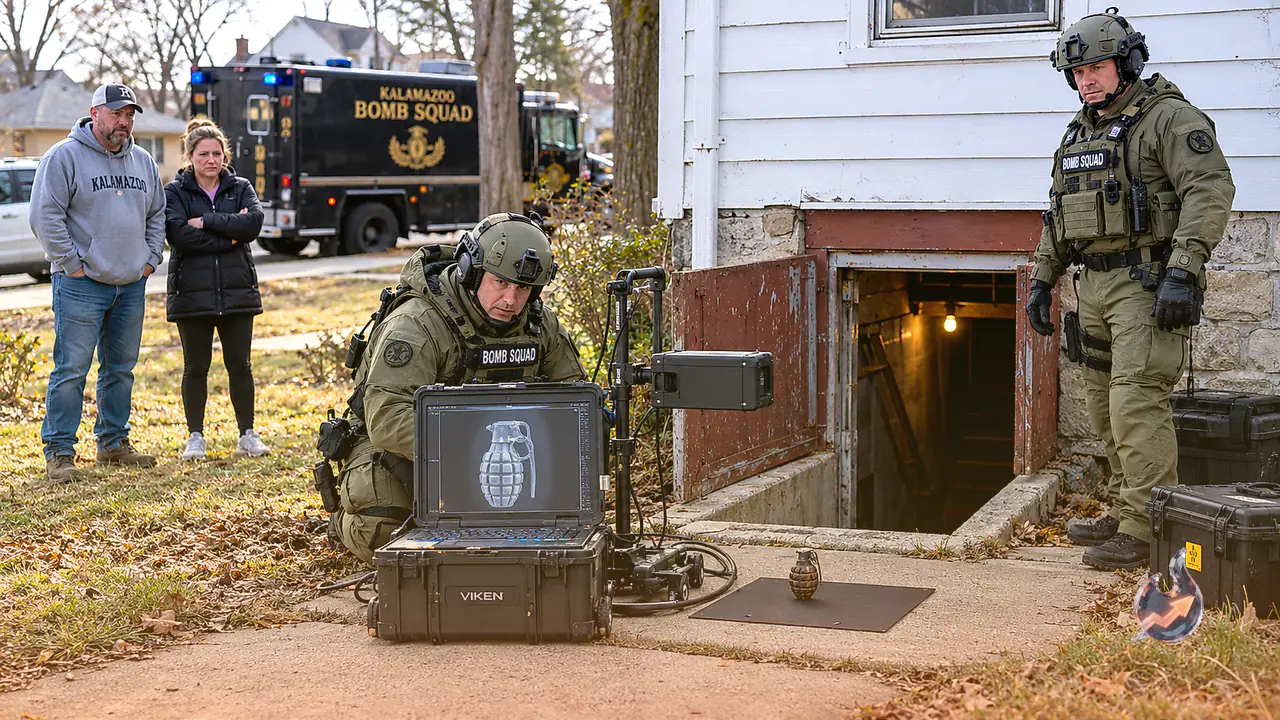
To safely evaluate the internal condition of the munition, the Kalamazoo Department of Public Safety Bomb Squad was dispatched to the address. Technicians arrived equipped with protective ballistic gear, remote sensors, and advanced containment assets. Moving or disturbing old ordnance without verifying its internal contents poses severe risks to first responders. Even a localized blast within an enclosed foundation can undermine structural supports and produce high-velocity shrapnel capable of causing extensive damage and casualties.
Portable Digital X-Ray Examination Reveals Decommissioned Core
Rather than risking physical detonation by manipulating the rusted casing, explosive ordnance disposal specialists deployed advanced portable X-ray diagnostic equipment. This specialized equipment permits bomb technicians to scan through dense metallic barriers from a protected standoff position, generating instantaneous high-resolution digital images of the device's internal layout. Technicians scrutinized the imagery to determine whether a functional fuze, primer cap, booster charge, or main explosive filling remained sealed within the cast-iron shell.
The radiological inspection provided immediate reassurance to both the emergency responders and the anxious family members. The internal imaging confirmed that the grenade contained zero energetic materials or detonating mechanisms. Historical military records and technical examinations demonstrated that the device had undergone formal decommissioning decades earlier, leaving it completely inert and hollow. The deceased grandfather had not kept an illegal or hazardous live explosive; instead, he had preserved an emptied military souvenir that had lost all lethal capability long before being stored away.
The Legacy of Wartime Relics in American Homes
While the sudden appearance of a combat munition in a modern neighborhood may seem extraordinary, military historians note that wartime souvenirs remain widespread across private homes throughout the country. Following victory in 1945, hundreds of thousands of returning service members retained decommissioned gear, non-functional shells, insignias, and deactivated weapons as physical tokens of their frontline service. Over time, as those veterans passed away, many of these historical artifacts remained sequestered in private storage spaces, completely forgotten by descendants.
Historical discoveries tied to that conflict continue to emerge in various forms worldwide. In another recent instance, neighbors of a late World War II veteran sorting through estate properties uncovered a remarkable collection of historical records linked to Stalag Luft 3, the notorious prisoner of war facility that inspired the iconic cinema classic The Great Escape. Concurrently, maritime researchers continue locating sunken naval vessels across deep ocean basins, while historical aviation restorers dedicate thousands of hours to locating, rebuilding, and returning genuine vintage military aircraft to active flight condition.
Official Protocols for Encountering Suspected Military Explosives
Following the successful resolution of the Kalamazoo incident, the Van Buren County Sheriff Office and regional emergency services published explicit safety directives for property owners, collectors, and antique enthusiasts. Authorities emphasized that no historical artifact should ever be assumed harmless based merely on its age, patina, or historical appearance. To prevent tragic accidents when clearing out old estates, barns, or storage units, public safety officials urge compliance with these mandatory steps
- Never manipulate or touch the object: If you spot a device resembling a grenade, shell, projectile, or blasting cap, resist any urge to lift, carry, tap, or shake it. Old chemical compounds become increasingly fragile over time.
- Evacuate the immediate vicinity: Withdraw to a safe standoff distance immediately and ensure that all other individuals, children, and domestic animals are directed away from the room or structure.
- Notify professional emergency services immediately: Contact your local police department, county sheriff, or emergency line without hesitation. Never attempt homebrew disposal methods such as submerging the device in water or burying it.
The Van Buren County Sheriff Office reinforced this caution, noting that even objects believed to be harmless commemorative memorabilia or spent training apparatus must be treated as lethal and live until a certified ordnance technician conducts a thorough evaluation. The measured handling of the situation in Michigan highlights how proper emergency notification ensures historical curiosity never turns into avoidable tragedy.