




















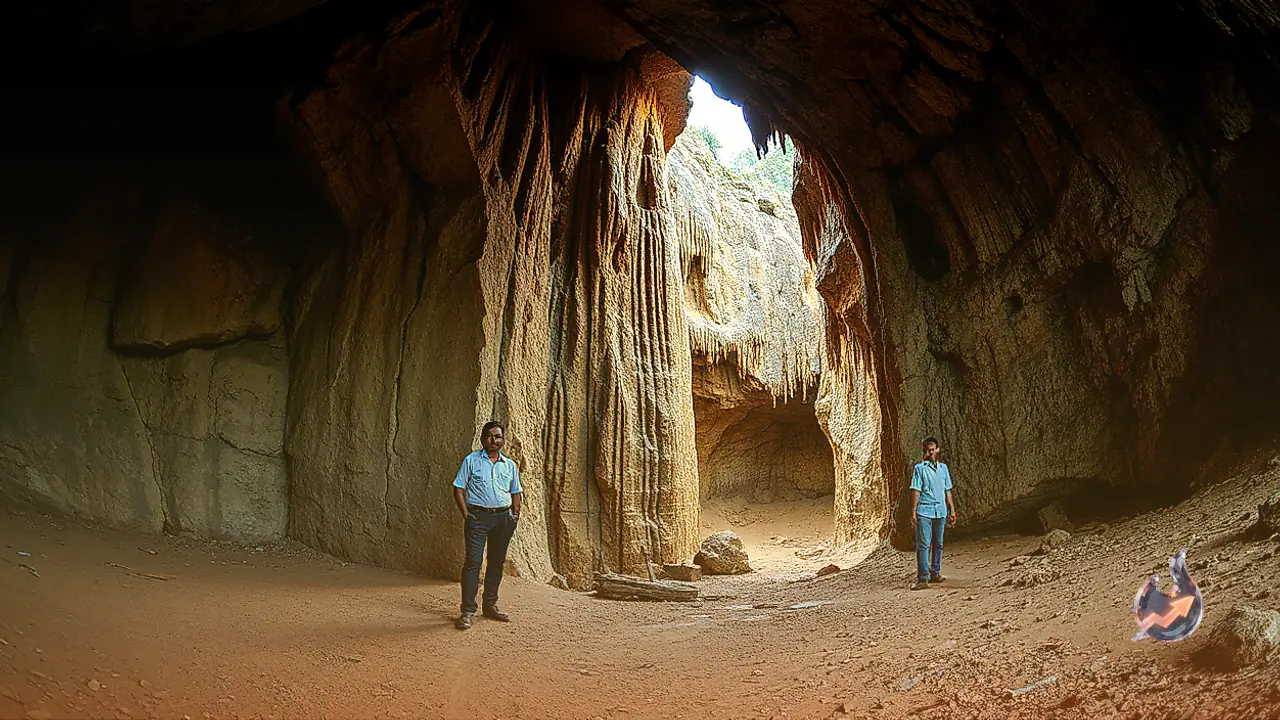

A mineral formation preserved deep within Meghalaya's Mawsmai Cave has provided scientists with a detailed window into the evolution of Northeast India's monsoon patterns over the past 6,000 years. Spanning a geological record of roughly 6,200 years, the investigation indicates that the Indian Summer Monsoon maintained immense strength during the early Holocene epoch before gradually weakening through the middle Holocene. The findings demonstrate that regional rainfall intensity in northeastern India was intricately linked to global oceanic circulation systems and shifts in solar output.
Mawsmai Cave Sample and Geological Investigation
To reconstruct prehistoric weather trends, researchers retrieved an 11-cm-long stalagmite from an interior chamber situated nearly 300 metres inside Mawsmai Cave. The cavern is located in Meghalaya's East Khasi Hills district, approximately 60 km south of the state capital, Shillong. The geological sample was recovered in an environment with ambient relative humidity exceeding 95 percent, preserving its pristine mineral layering. Stalagmites grow on cave floors as mineral-rich groundwater drips continuously from above, laying down chemical markers that chronicle environmental conditions over millennia.
The study, titled 'Deciphering Holocene monsoon dynamics in northeastern India', was published in the international research journal Palaeogeography, Palaeoclimatology, Palaeoecology. The investigative team was spearheaded by Yachna Verma and Anil K Gupta from IIT Kharagpur, alongside Prasanta Sanyal of IISER Kolkata, with contributions from co-researchers Priyantan Gupta, Som Dutt, Pankaj Kumar, and Abhijit Mukherjee. Field operations were supported by members of the Meghalayan Adventure Association, including B D Kharpan Daly, Ksan Kupar Mawlong, and Kyrmen Skhembha Rani. Following the recovery, IISER Kolkata provided specialized instrumentation for stable isotope measurement, while petrographic assessments were conducted at IIT Kharagpur.
Isotopic Evidence of Rainfall Shifts Across Millennia
By assessing stable oxygen isotope values alongside the petrographic and mineralogical properties of the stalagmite, the scientists mapped out prehistoric precipitation levels dating between 11,807 and 5,622 years ago. The Holocene represents Earth's current geological epoch, having started roughly 11,700 years ago following the close of the last glacial period.
The geochemical data established that monsoon strength was extraordinarily pronounced between 11,807 and 7,700 years ago. Depleted oxygen isotope concentrations during this early phase signify periods of intense, heavy rainfall across the northeastern terrain. In contrast, the subsequent period spanning 7,700 to 5,622 years ago displayed higher isotope readings, marking a prolonged transition toward milder, diminished monsoon precipitation. The authors noted that integrating detailed petrographic observations with conventional geochemical methodologies yielded refined precision for reconstructing the region's ancient environmental conditions.
Teleconnections to North Atlantic Currents and Solar Cycles
Beyond overarching millennial transitions, the geological archive highlighted multiple abrupt, shorter-term fluctuations in precipitation levels. These patterns revealed that northeastern India's rainfall regime was synchronized with climate dynamics operating on an intercontinental scale. The stalagmite profile tracked variations corresponding closely to documented North Atlantic cooling events, classified as Bond events 8, 7, 6, 5b, 5a, and 4. Scientists believe these anomalies point to shifts in the Atlantic Meridional Overturning Circulation, the vast ocean current conveyor belt responsible for carrying heat northward through the Atlantic Ocean.
Furthermore, spectral analysis revealed persistent climate oscillations recurring roughly every 110 and 118 years. These recurring periods mirror the Gleissberg solar cycle, which governs long-term changes in solar irradiance. The researchers concluded that prehistoric monsoon intensity was driven by the cumulative effects of solar variability, the Pacific Decadal Oscillation, dynamic ocean-atmosphere couplings, and thermal gradients between the Indian Ocean and the Tibetan Plateau. Given its distinctive topography and heightened sensitivity to climatic shifts, Northeast India serves as a key natural laboratory for deciphering the fundamental drivers of the Indian Summer Monsoon.