





















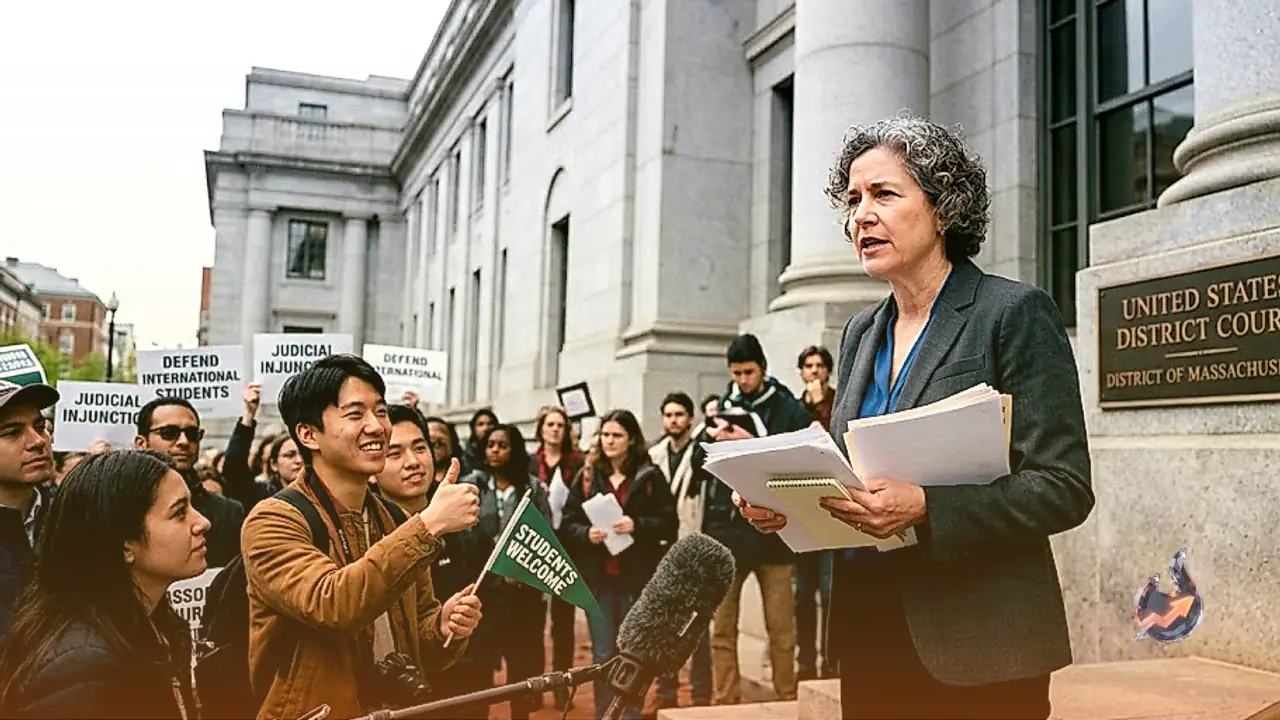

A federal court in Massachusetts intervened to protect international scholars and foreign media personnel from strict new stay limits across the United States. In a ruling delivered on Monday, the court blocked a Trump administration rule just twenty-four hours ahead of its planned Tuesday rollout. The decision brings immediate relief to thousands of overseas academic researchers, including a substantial cohort of scholars from India, while the underlying litigation continues to run its course.
Economic Risks and Rejection of Narrow Injunctions
Judge F Dennis Saylor IV issued a preliminary injunction with nationwide reach, warning that allowing the regulations to take effect would inflict severe and likely catastrophic damage on both universities and the broader domestic economy. The ruling firmly turned aside the federal government's request to restrict the relief solely to the specific institutional coalitions that had initiated the legal action.
The lawsuit brought together associations representing nearly 600 private and public academic entities. Judge Saylor observed that higher education in the country spans more than 5,000 separate institutions. The court reasoned that entering a selective or piecemeal order would fracture immigration administration by establishing parallel legal frameworks, creating persistent confusion and conflicting outcomes regarding which campuses and student bodies were protected.
Academic Realities Clash With Four-Year Caps
The regulatory measure was formally finalised in July, sweeping both student categories and exchange visitor visa classifications into its mandate. Under its core provisions, the vast majority of academic entrants faced an inflexible four-year cap on their initial legal stay. In parallel, foreign media credentials came under severe constraints, with general journalist visas restricted to an upper limit of 240 days and media representatives from China subjected to a tight 90-day ceiling.
The policy drew fierce pushback from university leaders and organised labour groups, who petitioned the judiciary to invalidate the measure entirely. Harvard President Alan M. Garber had publicly voiced reservations about the arbitrary timelines in July, describing the framework as odd. Garber pointed out that standard doctoral coursework and dissertation research routinely take at least six years to finish, making a four-year visa cliff ill-matched with the structural reality of advanced degrees.
Discretionary Extensions and Press Freedom Concerns
While the regulation nominally permitted non-immigrants to seek extensions, any grant was placed entirely at the unchecked discretion of Department of Homeland Security personnel. Crucially, the text denied applicants any formal administrative avenue to appeal if an extension request met with a rejection.
The Department of Homeland Security defended the restrictions as necessary operational mechanisms to curb visa abuse and eliminate overstays beyond authorized periods. However, Judge Saylor cautioned that such unfettered administrative authority invited systemic abuse. The court highlighted the conspicuous danger that foreign correspondents who published reporting critical of government policies, or of Department of Homeland Security officials specifically, would see their extension requests routinely denied.
Granting the preliminary injunction, the judge observed that the weak connection between the rule and its stated justifications raised legitimate questions about whether the measure was actually designed to protect borders and preserve national security, or whether it was intended to serve unstated objectives, such as expanding official leverage over the free press and higher learning institutions.