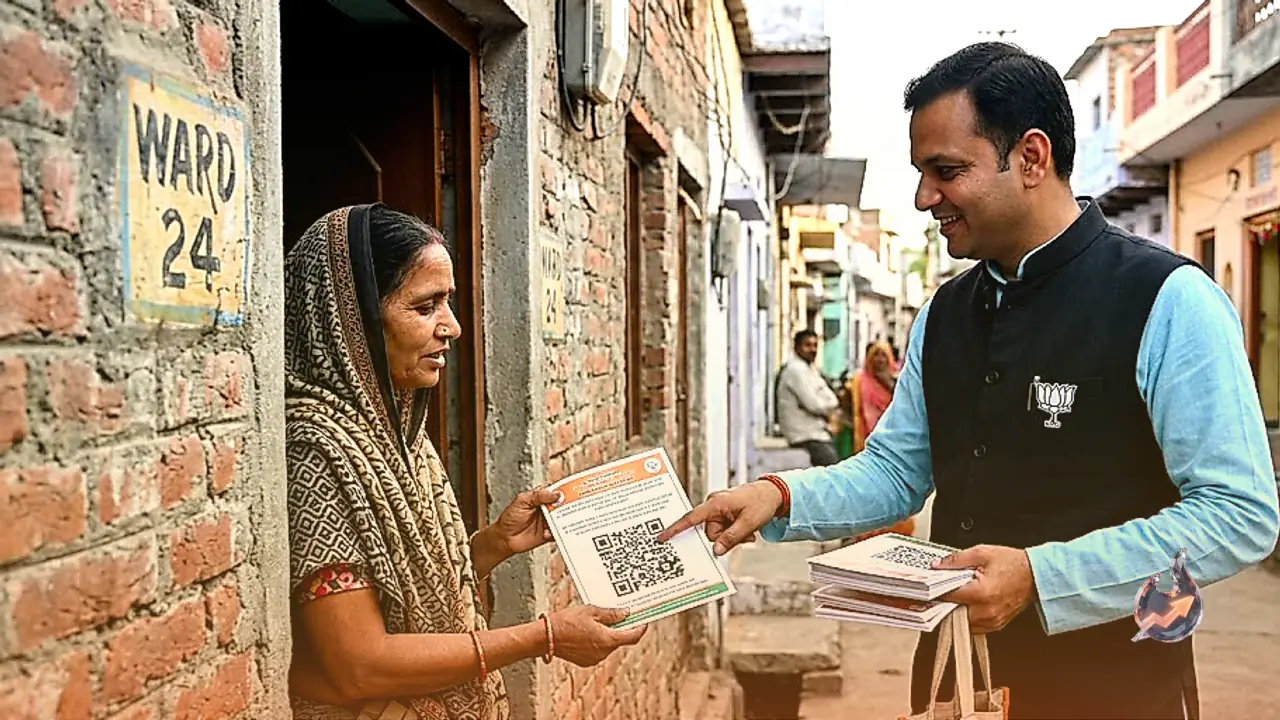
















Ahead of the upcoming local body elections in Banswara, Rajasthan, campaigning has hit its usual peak, with parties and candidates leaning on rallies, door-to-door canvassing and public meetings to win over voters. But BJP councillor candidate Mayank Jain, contesting from ward number 24, has taken a different route that has become the talk of the town. Instead of relying purely on face-to-face persuasion, Jain is going door to door handing out pamphlets printed with a special QR code that lets residents lodge a complaint instantly. He claims to be the first candidate among all 60 wards in Banswara to build a campaign around this kind of digital, tech-first outreach.
How the complaint QR code actually works
The mechanics behind the QR code are simple but effective. Any resident of the ward can scan the code printed on the pamphlet using an ordinary smartphone. The moment it's scanned, a digital form opens up, where the resident can enter their name, mobile number and a description of whatever problem they're facing. Alongside the text, they can also upload photos or videos related to the issue directly through the same form, whether it's a broken road, a water supply complaint, an electricity fault or a sanitation problem. Jain has assured voters that every complaint submitted this way goes straight to his personal dashboard, which he checks himself, and that he will make every effort to resolve each one within 48 hours of it being filed.
The idea traces back to the Digital India vision
According to Jain, the entire idea grew out of Prime Minister Narendra Modi's Digital India vision. His argument is that in an era where technology has already made everyday tasks like banking and government paperwork far simpler, there's no reason the same tools shouldn't be used to solve small, everyday problems at the ward level. He believes the approach offers two clear benefits: it cuts down the time it takes to both register and act on a complaint, and it keeps the entire process transparent, since a digital record shows exactly when a complaint came in and what was done about it.
A promise of permanent QR plates and a standing grievance office
Jain has been clear that this isn't a gimmick meant to disappear once voting ends. He has announced that if he wins the election, permanent QR code plates will be put up on every street, every neighbourhood lane and major public spot across the ward, so that any resident facing a problem can register it immediately, without having to wait or search for help. Beyond that, he has already set up a dedicated grievance redressal office to make things easier for people in the ward. Jain has promised that this office will stay open to the public continuously through his entire five-year term, win or lose.
Residents call the move a welcome change
The candidate's tech-driven campaign appears to have struck a chord with voters in the ward. Local resident Rahul Rathore praised the initiative, saying that resolving problems quickly through technology is genuinely commendable. He added that such a system narrows the distance between ordinary people and their elected representative, creating a more direct and transparent line of communication between the two. For now, Jain's digital campaign model continues to be a subject of curiosity and discussion, both within Banswara's political circles and among the wider public in the city.