



















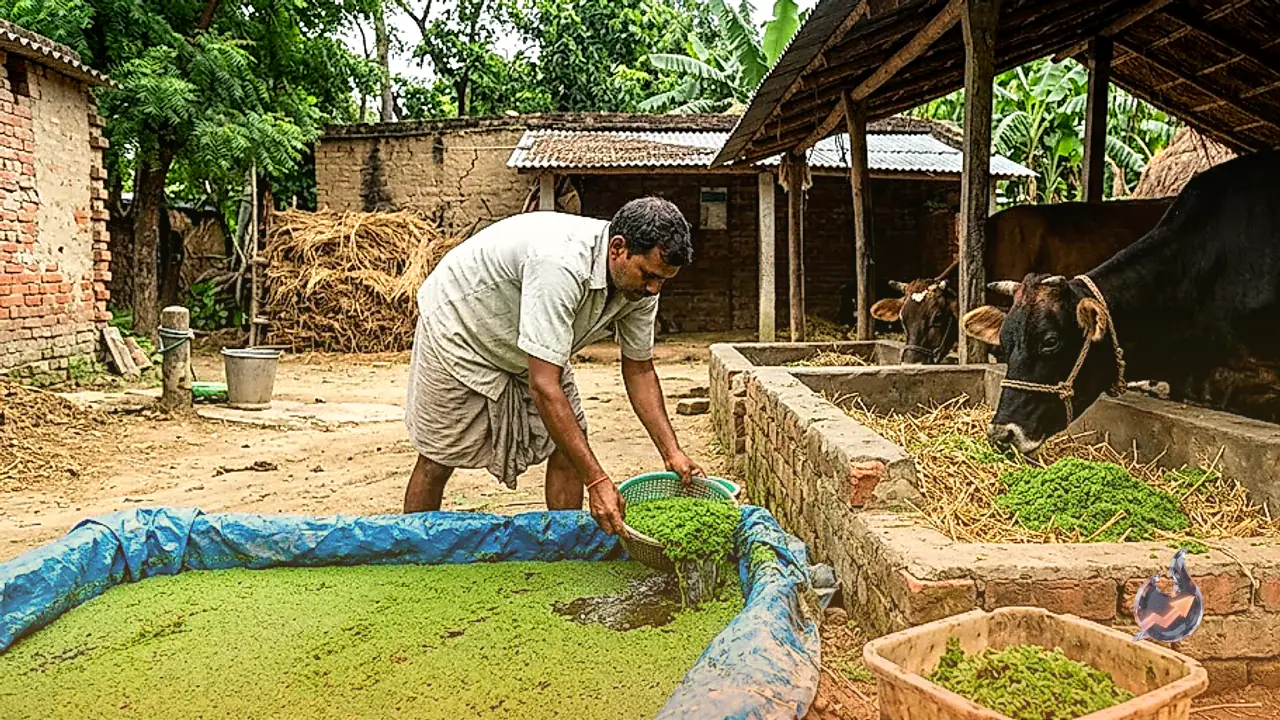

Across the rural belt of Lakhimpur Kheri district, farming families rely heavily on animal husbandry alongside crop cultivation to secure their household livelihood. A significant share of rural residents maintain cows and buffaloes as a steady income source. To generate viable returns from dairy farming, livestock owners must provide their animals with a balanced and nutrient-rich diet every day. Fresh green fodder remains an essential dietary pillar, particularly for milking animals. Whenever cattle experience a shortfall in green fodder or critical micronutrients, their overall physical health deteriorates and milk production declines. In this context, azolla has surfaced as a practical and economical supplement for rural producers. A distinct advantage of this aquatic crop is that it does not demand large fields or fertile agricultural ground, allowing growers to produce it readily in modest spaces adjacent to their homes.
Nutritional Value and Dietary Role of Azolla for Livestock
Maintaining dairy cattle health and consistent milk yields requires adequate nutrition that covers diverse metabolic requirements. Azolla is a free-floating aquatic fern that multiplies rapidly on water surfaces, packing high concentrations of protein and essential amino acids. In addition to essential vitamins, this bio-feed supplies indispensable minerals including calcium, phosphorus, and iron, all of which play key roles in sustaining bone strength and lactation. Because of this concentrated profile, livestock keepers increasingly integrate it into daily feeding routines for cows and buffaloes as a dietary booster.
Producers generally mix harvested azolla with dry roughage, routine green forage, and balanced concentrate feeds, elevating the nutrient density of every meal. Agricultural experts emphasize, however, that azolla is not designed to replace an animal's entire daily diet. Dairy cattle continue to require sufficient dry straw, traditional green fodder, clean drinking water, and formulated nutritional feeds according to their stage of lactation and physical body requirements.
Reducing Market Dependency Through Simple Household Production
One major economic benefit of growing azolla is the direct reduction in external expenditure for supplementary green feeds. Instead of continually purchasing costly feed additives from commercial vendors, dairy farmers can sustain household-level production with basic care. This advantage particularly benefits marginal and small-scale livestock keepers who manage small herds on tight operational budgets and cannot routinely afford high-priced packaged supplements.
Optimal Environmental Conditions and Cultivation Guidelines
Cultivating azolla effectively demands unpolluted water and suitable ambient weather conditions. The cultivation site should be shielded from intense, direct solar radiation, as excessive heat, strong sunlight, and poor water quality severely retard the fern's vegetative growth. Routine observation and water management remain essential throughout the farming cycle.
To establish production, farmers fill wide shallow containers, plastic basins, or ground pits with fresh water before introducing an initial starter culture of the fern. Ongoing maintenance involves regulating water volume and adding appropriate organic nutrients as needed. Maintaining sanitation across the culture basin is critical to prevent unwanted debris, dirt, and biological contaminants from entering the water. Before offering azolla to cattle, farmers must thoroughly rinse the harvested fern with clean water. Any harvest exhibiting foul odors, decay, or contamination must be discarded immediately rather than fed to livestock.
Potential Support for Dairy Productivity and Herd Well-Being
Milk yield in dairy animals is governed by multiple interconnected variables, including genetic breed, animal age, baseline health, lactation stage, and nutritional adequacy. Integrating a nutrient-rich supplement like azolla into daily cattle rations helps cover minor dietary deficits that often limit milk output. Dairy keepers should introduce this supplementary feed gradually into existing meal routines while carefully observing livestock appetite, digestion, and performance. Consulting a qualified veterinarian or animal nutrition professional provides guidance on appropriate portion sizes tailored to each animal's specific physiological stage.
Veterinary Insights from Dr. Honey Saxena
Detailing the science behind this aquatic feed, veterinary officer Dr. Honey Saxena explained that azolla is a floating aquatic fern rich in dietary protein and essential micronutrients. Since it requires minimal physical space and low financial input, smallholder farmers can comfortably cultivate it as a supplementary feed for their cattle. Dr. Honey Saxena noted that the plant contains high-quality protein, essential amino acids, vitamin A, vitamin B-12, along with critical minerals such as calcium, phosphorus, and iron. He pointed out that feeding azolla within a well-balanced ration enhances nutritional intake and supports sustained milk production in dairy livestock. He advised farmers to cultivate azolla exclusively in clean water and verify freshness prior to feeding. He further stressed that livestock should never rely solely on a single feed type, underlining that a balanced ratio of dry fodder, fresh green roughage, and balanced nutrients is essential for lasting animal health.