
















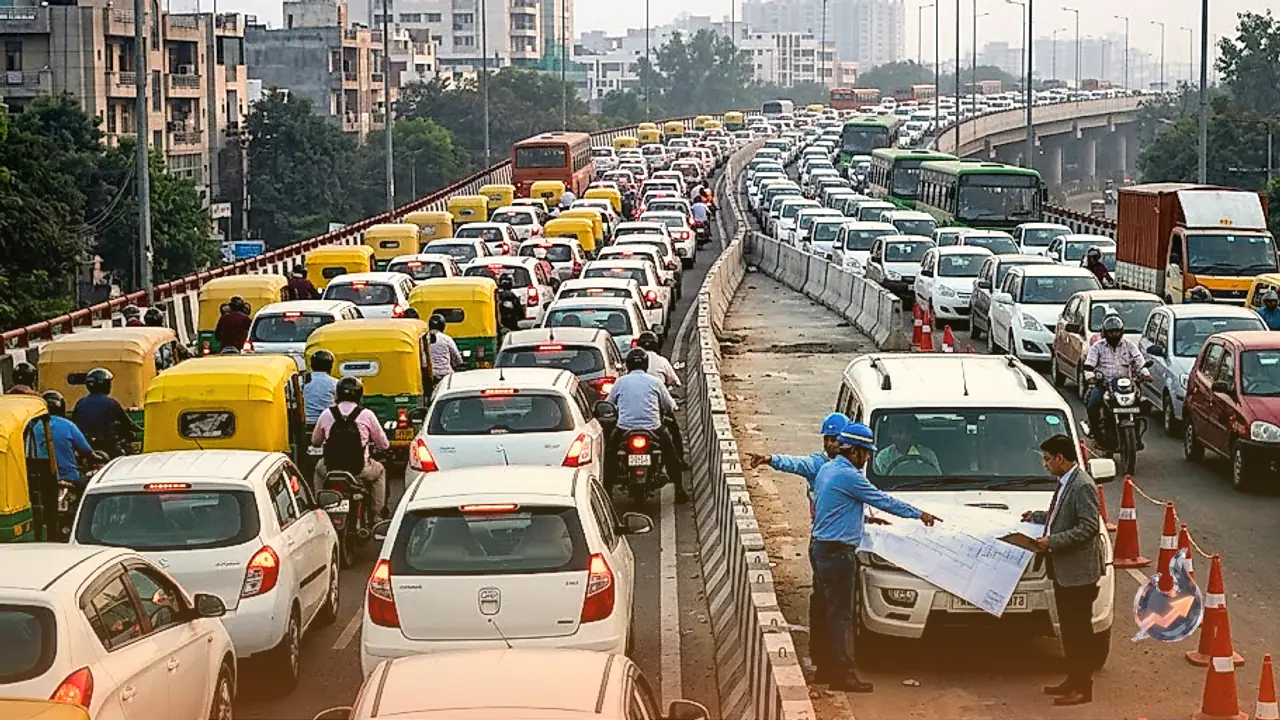

Commuters navigating the newly commissioned Barapullah Phase-3 corridor in Delhi are facing intense gridlock instead of the expected seamless connectivity between east and south parts of the capital. High vehicular influx following its opening has triggered bottlenecks across several stretches, leaving drivers stranded for long periods. In response to mounting public inconvenience, the administration has initiated structural and operational interventions designed to restore smoother traffic movement across the corridor.
Extra Lane and Ring Road U-Turn Proposed at Sarai Kale Khan
Under the preliminary relief blueprint, authorities propose dismantling the footpath along the ITO-bound carriageway near Sarai Kale Khan to carve out an additional traffic lane. Broadening this specific bottleneck will provide expanded road space for moving vehicles, effectively diluting the current congestion that builds up during peak travel windows.
Engineers are also assessing the technical feasibility of introducing a dedicated U-turn on the Ring Road directly opposite the Gurdwara. Establishing this turn is intended to eliminate the long and cumbersome detours that motorists residing in nearby neighborhoods currently face when heading toward central destinations.
Convenience for Siddhartha Extension and Commuters Heading to AIIMS
The proposed U-turn promises direct dividends for residents commuting from the Siddhartha Extension area, giving them unhindered entry onto the older Barapullah alignment. It is also expected to significantly ease movement for motorists traveling onward to Lajpat Nagar, INA, and AIIMS.
Due to the current gap in direct route continuity, hundreds of drivers are forced onto long diversions every day, consuming fuel and swelling traffic queues on surrounding arteries. The new turnaround point will curtail these unnecessary loops while discouraging the dangerous practice of wrong-side driving that frequently stalls traffic flows in the vicinity.
Consultant Agency to Map Entire Corridor and Traffic Merging Points
PWD Minister Parvesh Sahib Singh stated that isolated structural alterations or elevated tweaks alone will not offer an enduring remedy to the congestion dilemma. To formulate a lasting strategy, an independent consultant agency will be commissioned to conduct a comprehensive assessment of the entire corridor.
The agency will systematically examine vehicular distribution, lane channelization, merging junctions, and route-specific volume patterns. Based on these findings, authorities will implement an actionable mix of immediate bottleneck adjustments and sustainable long-term traffic engineering solutions.
Scrutiny over Project Timeline and ₹640 Crore Arbitration Payout
The PWD Minister also raised critical concerns regarding the execution delays and financial management surrounding the Barapullah infrastructure venture. He noted that arbitration awards resulted in an extra payment of approximately ₹640 crore to the project contractor, even as the completion schedule suffered prolonged setbacks.
The government maintains that administrative and financial inquiries will proceed separately, but daily commuters must not suffer chronic travel delays while past issues are reviewed. As a result, the primary focus remains firmly on expanding physical carriageway capacity and streamlining the corridor's integrated transit network.