















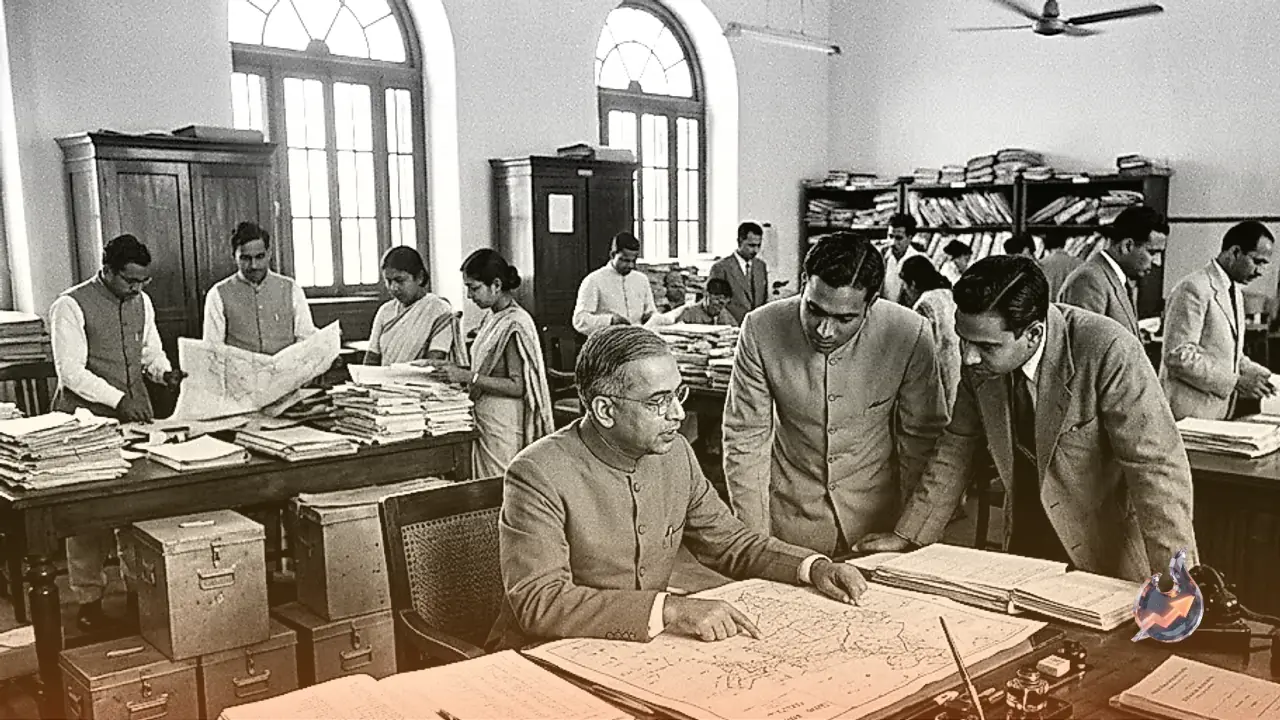

With India's Chief Election Commissioner Gyanesh Kumar currently at the center of political controversies, attention has turned back to the foundational origins of the nation's democratic machinery. When India gained independence from British colonial rule, the newly liberated country faced the daunting task of electing its first representative government. There was neither prior domestic experience in organizing an exercise of such scale nor any historical precedent anywhere in the world for conducting universal suffrage across such a vast population. Stepping into this unprecedented administrative landscape was Sukumar Sen, who laid the ground rules for modern Indian elections.
Academic Excellence and the Newton Scholarship
Sukumar Sen was born on January 2, 1898. He pursued his education at Presidency College in Kolkata and subsequently attended University College London. At Presidency College, he earned his graduation degree in mathematics. His remarkable talent and scholarly discipline in the subject earned him the prestigious Isaac Newton Scholarship, reflecting an analytical rigor that would later define his meticulous approach to public administration.
Civil Service Career and Appointment to the Election Commission
In 1922, Sen entered the Indian Civil Service (ICS), serving in several key administrative positions during the period of British rule. Following independence, he took on the responsibility of Chief Secretary of West Bengal. After the Election Commission came into existence, he formally assumed charge as India's first Chief Election Commissioner on March 21, 1950.
His name was recommended to Prime Minister Jawaharlal Nehru by the then Chief Minister of West Bengal, Bidhan Chandra Roy. Roy viewed him as the ideal candidate precisely because his mathematical background combined with a reputation as a stern, unyielding administrator capable of making firm and thoroughly impartial decisions. Under Sen's stewardship, India successfully executed its mammoth first general elections in 1951-52, followed by the second general elections in 1957.
Conducting Sudan's First Polls and National Recognition
Sen's organizational prowess extended beyond the Indian subcontinent. In 1953, he was appointed Chairman of the international election commission in Sudan, where he oversaw the smooth execution of that African nation's inaugural general elections.
In recognition of his foundational contribution to building India's democratic electoral architecture, the Government of India conferred upon him the Padma Bhushan in 1954. Sen concluded his tenure and retired as Chief Election Commissioner on December 19, 1958. He passed away in 1963, leaving behind an electoral framework that continues to anchor the country's democracy.