


















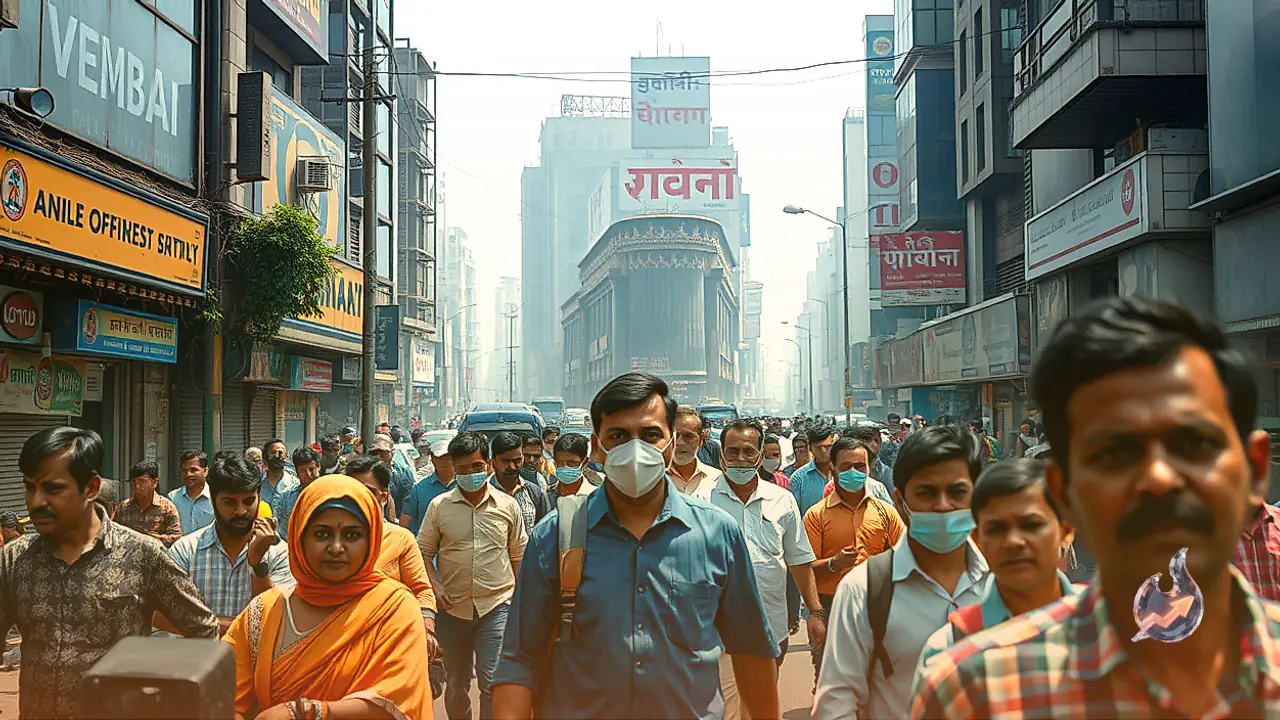

A sigh of relief might cross the minds of residents in the national capital as a fresh update emerges, though the broader reality remains deeply concerning. Ahead of the notorious toxic spell typically arriving in November, the dubious crown of being the most polluted city, which traditionally burdens Delhi year after year, has now shifted to Mumbai. According to the latest rankings released by the American agency IQAir, the country is witnessing its financial capital outrank Delhi to claim the position of the most polluted city in India, while also securing the fifth spot among major cities across the globe.
National Standings and Global Rankings
Despite Mumbai taking over the unwanted lead in this index, Delhi's standing on the chart offers very little room for celebration. The national capital remains in a precarious position, sitting immediately below Mumbai as the sixth most polluted city worldwide. This comprehensive global index evaluated a total of 122 cities from around the world, highlighting the severe air quality struggles persisting across several major Indian urban centers.
Among the top ten most polluted cities globally on this list, three are located in India alone. While Mumbai claims the fifth position and Delhi follows closely at sixth, another major metropolitan city, Kolkata, secures the tenth spot with an air quality index reading of 124. Consequently, Mumbai has recorded the worst air quality among all Indian cities in this assessment, marking a notable shift in urban pollution patterns.
The primary driver behind Mumbai overtaking Delhi in this ranking is its air quality index, which has remained persistently within the unhealthy category. Data released recently recorded Mumbai's air quality index at 152, placing it firmly in the unhealthy tier. Unlike Delhi, where the dominant pollutants are typically particulate matter like PM2.5 or PM10, Mumbai is experiencing ground-level ozone as its primary pollutant.
Monsoon Deficits and Weather Impacts
The most significant blow to Mumbai's air purity has stemmed from a severe monsoon deficit. Rainfall during the monsoon season fell short this year, and the seasonal showers concluded much earlier than usual. Compounding this issue, the city has experienced prolonged spells of high temperatures and lingering humidity. These combined meteorological conditions have heavily exacerbated the pollution levels.
This month has recorded three of the hottest days in Mumbai over at least the past decade, with maximum temperatures soaring four to five degrees Celsius above normal for multiple consecutive days. Atmospheric scientist Gufran Beeg, affiliated with the National Institute of Advanced Studies and the Indian Science Institute, connected these prevailing conditions to climate patterns akin to El Nino, elevated temperatures, and a massive drop in wind speeds.
He explained that sluggish winds and warm, humid weather conditions effectively trap the air, preventing pollutants from dispersing upward and causing them to accumulate near the ground surface. El Nino refers to the warming of sea surface temperatures across the central and eastern tropical Pacific Ocean, which heavily influences weather patterns worldwide. Ground-level ozone differs fundamentally from the ozone layer located in the upper atmosphere, which shields the Earth from harmful ultraviolet radiation. Instead, near-surface ozone is created when nitrogen oxides and volatile organic compounds react under direct sunlight, a chemical process that accelerates during hot and sunny weather.
Discrepancies in Official Data and Local Conditions
The figures published in the IQAir rankings present a notable contrast to the data provided by the Central Pollution Control Board. The dashboard managed by the Central Pollution Control Board displays Mumbai's city-level air quality index at 98, categorizing it under the satisfactory tier, whereas Delhi's reading on the same platform appears higher.
Station-level data from the Central Pollution Control Board reveals that pollution severity varies drastically across different neighborhoods within Mumbai. Out of the 23 active monitoring stations operating across the city, 12 locations recorded satisfactory air quality levels. However, specific pockets are suffering from severe air degradation, with Devanagari recording an air quality index of 156, the Bandra Kurla Complex hitting 145, and the Khindipada area in Bhandup registering 129. These specific locations identified particulate matter PM2.5 and PM10 as their primary pollutants.
The variance between the figures provided by the two platforms stems from differences in monitoring networks, calculation methodologies, averaging timeframes, and data collection sources. City-wide averages and localized station readings naturally reflect different aspects of the environment.
Municipal Action and Waste Burning Concerns
An official from the Maharashtra Pollution Control Board noted that pollution generated from burning garbage or plastic is never confined to a single spot. The official explained that when waste is burned in areas like Devanagari, the resulting polluted air drifts across neighboring localities. Unhealthy air quality indices are being registered in adjacent residential and commercial zones such as Chembur and Kurla, underscoring the widespread impact of burning waste and plastic on surrounding neighborhoods.
In response to these conditions, the Brihanmumbai Municipal Corporation has ordered inspections across pollution hotspots spanning all 26 administrative wards. The municipal administration is preparing to identify the exact sources of pollution and initiate strict enforcement actions. Experts emphasize that the combination of intense heat, reduced rainfall, and weak winds has severely degraded Mumbai's air quality, prompting advisories for citizens to monitor air conditions closely and exercise necessary precautions.