






















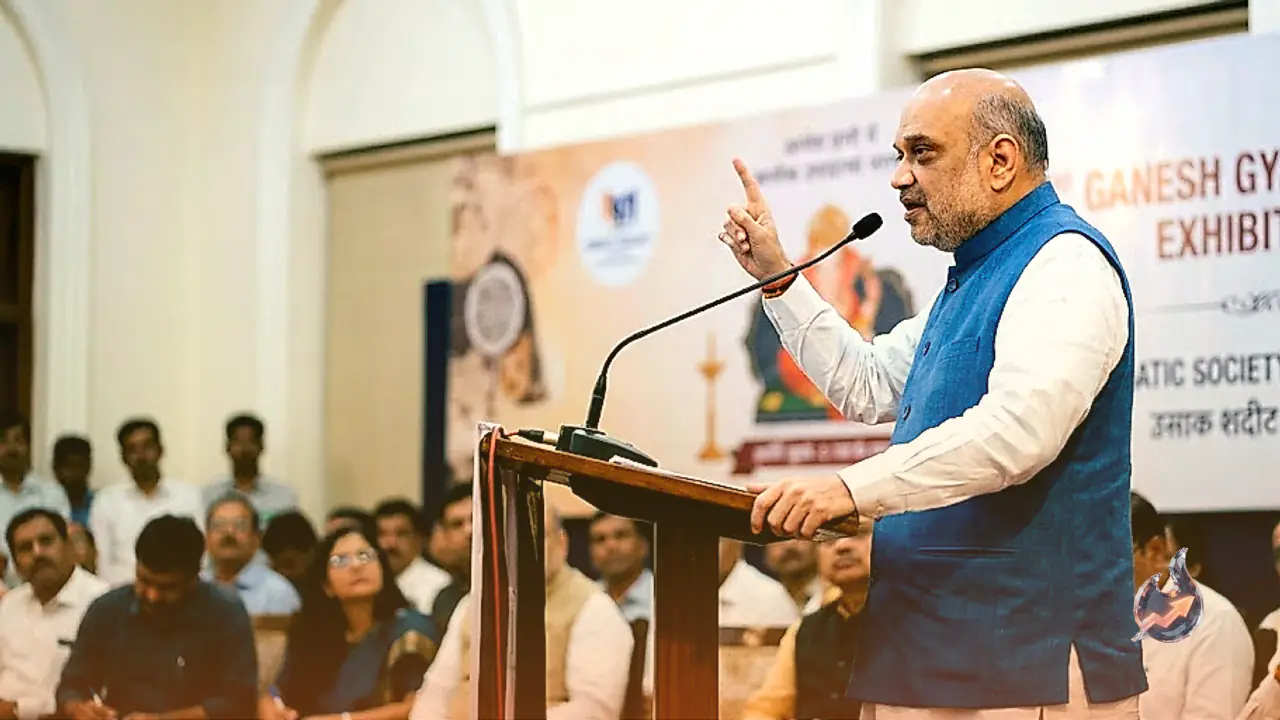

Union Home Minister Amit Shah inaugurated the Ganesh Gyanarthi exhibition at the historic Asiatic Society premises during his official visit to Mumbai. Addressing an assembly of scholars, historians, and citizens, he clarified that he attended the gathering not merely in his official capacity as a cabinet minister, but as an active campaigner committed to advancing India's thousands of years old intellectual and cultural traditions. He expressed strong confidence that the Asiatic Society of Mumbai will serve as a vital medium for disseminating India's rich heritage of wisdom across the entire country.
Preserving Language, Culture, and Historical Memory
Emphasizing the vital connection between cultural preservation and national longevity, the Home Minister remarked that any nation failing to protect its native language, traditions, history, values, and archives faces rapid decline regardless of its material power. Conversely, a society that zealously guards its linguistic structure, historical records, and cultural roots can never be permanently subjugated, even after centuries of foreign occupation. India's long historical journey stands as a living testament to this civilizational resilience.
Reflecting on past attempts to destroy India's intellectual storehouses, he specifically cited the destruction of Nalanda. He noted, "They can burn down the library of Nalanda, but no one can destroy the knowledge enshrined in people's minds and hearts through memory and oral tradition." He explained that while foreign invaders repeatedly tried to annihilate the profound wisdom that once guided the world, they could never erase the knowledge deeply embedded within the collective consciousness of the Indian people.
Indian Ethos in Defeat and Victory
Elaborating on the core philosophy of Indian civilization, the Home Minister observed that Indian traditions teach patience during times of adversity. When faced with defeat, the nation maintains composure and pushes forward with renewed determination. On the other hand, when victorious, Indian ethos does not seek to obliterate the history or memories of the conquered. Instead, it makes deliberate efforts to assimilate those memories respectfully into its broader cultural tapestry without destroying their identity.
Decoupling Knowledge from Ideology and Power
Addressing the future role of the Asiatic Society, Amit Shah stressed that true knowledge must never be held hostage by any single political or social ideology. Knowledge itself constitutes an independent ideology, and attempting to confine it within restrictive frameworks alters its foundational meaning. True learning requires an environment of complete intellectual freedom. He urged that the immense archival wealth stored within the Asiatic Society be harnessed for building a strong nation and promoting global welfare.
He recalled how colonial administrators had tied academic research to state power to consolidate British governance over India. He advocated separating state power from academic pursuits, establishing a governance framework informed by authentic knowledge. The Asiatic Society, he suggested, should lead efforts to shape governance models grounded in true scholarship.
Deconstructing Colonial Concepts of 'Indology'
The Home Minister offered a critical analysis of the term 'Indology', stating that understanding its historical context is essential to evaluating institutions like the Asiatic Society. During the colonial era, Indology was constructed by combining diverse academic fields, including numismatics, epigraphy, anthropology, history, archaeology, linguistics, philosophy, literature, theology, and grammar.
However, he clarified that colonial Indology was never intended to serve universal welfare, unlike traditional Indian knowledge systems. Instead, British administrators studied Indian societal structures and cultural nuances primarily to devise effective mechanisms for maintaining long-term control over the local population.
A Three-Point Roadmap for Asiatic Society's Future
To maximize the reach and impact of the Asiatic Society's resources, the Home Minister outlined a clear three-point vision
- Engaging Scholars: Attract leading researchers and intellectuals who can expand the horizons of academic scholarship at the institution.
- Digital Library Network: Utilize modern electronic platforms to interconnect libraries nationwide, enabling seamless digital access to rare archives.
- Preserving Local Manuscripts: Collect and preserve ancient manuscripts scattered across rural Maharashtra, bringing their insights to light through the 'Bharatam Manuscript' initiative.


