















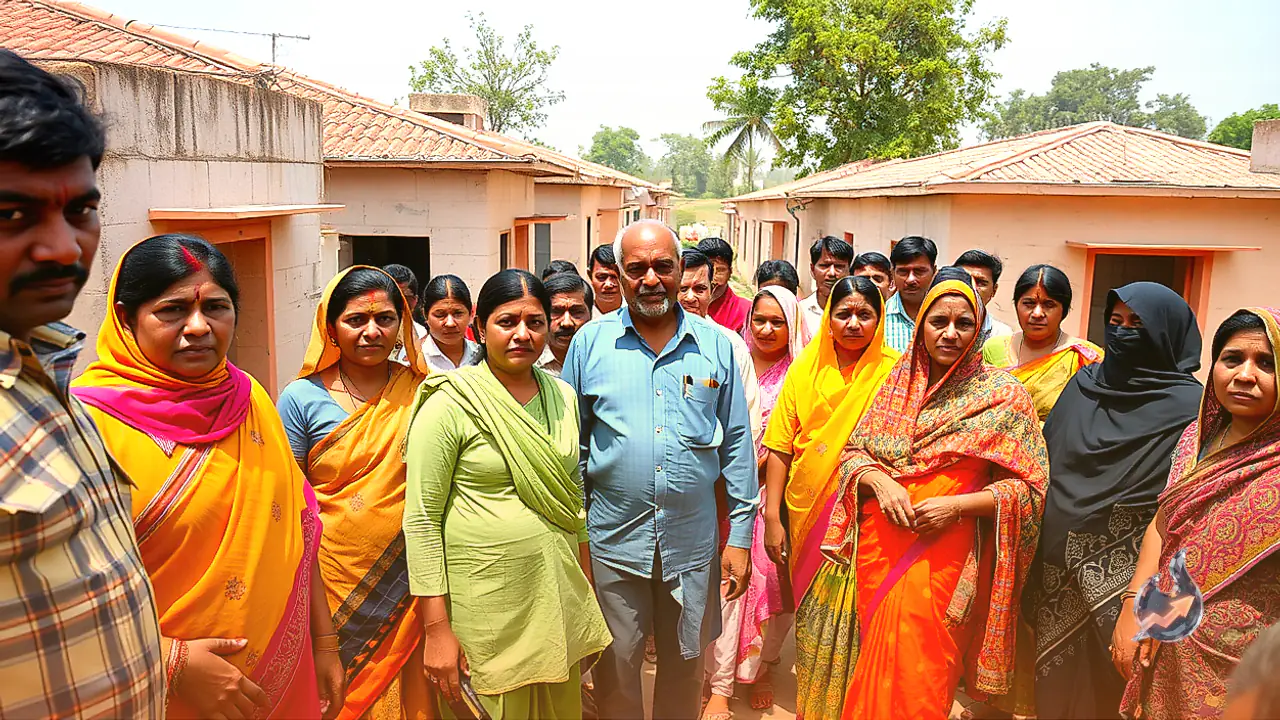

Rural households living in makeshift huts and dilapidated mud structures across Azamgarh district are moving closer to securing permanent brick-and-mortar homes. Under the Pradhan Mantri Awas Yojana (Gramin), a formal target of 12,052 houses has been approved across all 1,810 gram panchayats for the ongoing financial year. Administrative approvals are progressing at a rapid pace to ensure that the initial installment of government financial assistance reaches the registered bank accounts of selected beneficiaries within the next 15 days. The local administration is coordinating efforts to have all 12,052 sanctioned houses fully constructed before the upcoming Diwali festival, allowing eligible families to move into safe residential structures in time for the celebrations.
Ground Verification Weeds Out Ineligible Claimants Across 1810 Panchayats
The current selection follows a rigorous two-year field verification initiative conducted across rural parts of the district to eliminate discrepancies. Project Director Sachidanand stated that ground teams carried out on-site inspections covering 1,65,217 households across the 1,810 gram panchayats. Claimants who failed to meet official criteria or were found ineligible were struck off the rolls. Following this thorough audit, approximately 1,12,000 eligible beneficiaries remain on the permanent waiting list. These verified families will be granted housing support in a phased sequence based on strict priority rankings, beginning with the current cohort.
Disbursement Structure: Three Tranches Alongside MGNREGA and Sanitation Aid
The welfare scheme is exclusively earmarked for houseless citizens and families residing in kutcha dwellings. To ensure accountability and steady construction progress, the designated financial assistance is released in three distinct phases directly linked to structural milestones.
- First Installment: An opening grant of ₹40,000 is transferred to fund groundwork, trench excavation, and plinth foundation.
- Second Installment: Once the foundation and structural walls are firmly established, a substantial sum of ₹70,000 is credited to facilitate roof casting.
- Final Installment: After the roof slab is laid, a concluding sum of ₹10,000 is released to finance plastering, doors, and floor finishing.
Apart from the core grant of ₹1,20,000 for construction, beneficiaries receive unskilled labor wage support equivalent to 90 man-days under the MGNREGA program. Furthermore, households lacking private sanitation facilities are allotted an additional ₹12,000 grant specifically to erect an attached toilet.
No Fresh Applications Needed as Automated AI Rankings Eliminate Discretion
Addressing common misconceptions regarding registration, authorities clarified that villagers do not need to submit any fresh online or physical applications. Field data gathered during the door-to-door survey, including verified annual income, housing material status, and household demographic details, is already integrated into the national database. The central government system uses automated computing tools and AI algorithms to establish baseline seniority lists without subjective human intervention. Sanctions for Scheduled Caste (SC), Scheduled Tribe (ST), and General category beneficiaries are awarded strictly according to these automated merit tiers as tranches unlock.