





















A remarkable new arrival in the Sagar district of Madhya Pradesh is drawing large crowds and widespread fascination. The attraction is not an ordinary animal, but a highly rare Punganur cow, an indigenous breed native to Andhra Pradesh. Known across the country for its astonishingly short stature, massive price tag, and highly medicinal milk, this miniature cow has become the center of attention. Housed at the under construction ISKCON temple complex in Sagar, the presence of this tiny bovine is renewing public interest in the conservation of native Indian cattle breeds and their deep religious significance.
Deep Ties to Tirupati Balaji and Spiritual Significance
Historically, cows have held a position of profound religious and social importance in India. Currently, the country is home to more than fifty two distinct indigenous cattle breeds. Among these, the Punganur breed from Andhra Pradesh stands out as one of the rarest and most revered. Its spiritual significance is highlighted by the fact that the sacred Abhishek of Lord Venkateswara at the world famous Tirupati Balaji temple is performed exclusively using the milk of the Punganur cow. Because this milk is incredibly rich in fat and essential nutrients, it commands a premium price even for regular consumption. When required for religious ceremonies and sacred rituals, its value multiplies significantly due to its purity and divine association.
Meet Rati Manjari and Balram: The Center of Attraction
The specific pair brought from Andhra Pradesh to the ISKCON temple in Sagar is leaving visitors amazed by their tiny dimensions. A fully developed Punganur cow reaches a maximum height of just under three feet. The pair at the temple features a beautiful light reddish brown coat. Temple caretakers have affectionately named the young female calf Rati Manjari, while her male companion goes by the name Balram. Balram stands exactly three feet tall. Rati Manjari is currently twelve months old. According to the temple management, she will reach maturity and begin yielding milk when she hits two years and three months of age. Despite their incredibly small size, both animals are fully developed and completely healthy.
Minimal Diet and Perfect for Urban Farming
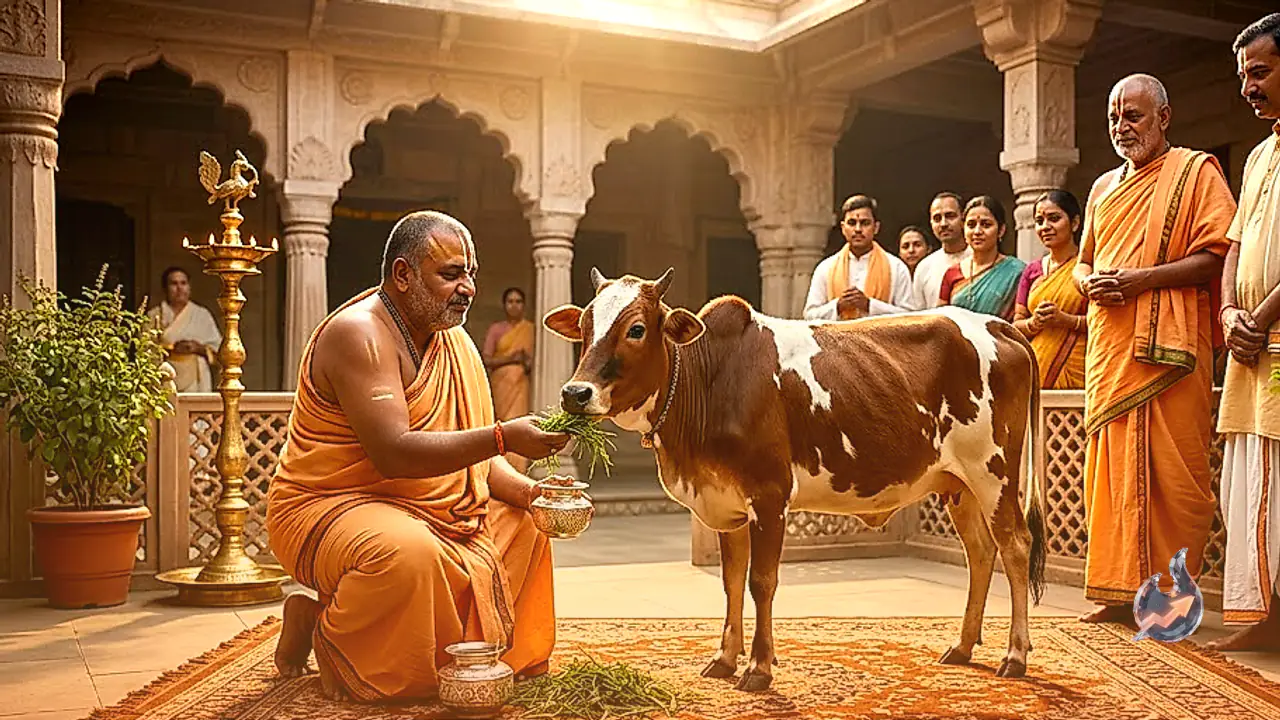
Gauri Das Maharaj, who is closely associated with the temple, detailed the numerous unique qualities of this ancient South Indian breed. He pointed out that the most remarkable feature of the Punganur cow is how easily it can be reared in large metropolitan cities. Unlike standard breeds, they do not require sprawling farmlands or massive sheds. Their compact size means they take up very little space and thrive comfortably within limited resources. Their daily dietary requirement is remarkably minimal. Throughout the entire day, a Punganur cow consumes only four kilograms of dry fodder, one kilogram of green feed, and a small quantity of flour mixture. Furthermore, they possess an incredibly calm and gentle temperament. Anyone from young children to elderly family members can safely care for them. Despite their critically low population in India today, these resilient animals have the unique ability to adapt flawlessly to any climate across the nation.
Astonishing Prices and Highly Valued Milk
The financial aspects surrounding this breed are equally staggering. Gauri Das Maharaj noted that a high quality, purebred, or pregnant Punganur cow costs anywhere from 300,000 rupees to over 1,000,000 rupees in the market. Even a young female calf commands a price ranging from 40,000 rupees to 100,000 rupees. A primary reason for this astronomical valuation is their limited milk production, which caps out at just 1.5 to 2 liters per day. Because the yield is so low and the milk is packed with fat and medicinal properties, it sells for 1,000 to 1,500 rupees per liter in large urban centers.
The Grand ISKCON Temple and Conservation Vision
There is a much larger purpose behind bringing these animals to the city. A magnificent ISKCON temple is being constructed in Sagar at a massive cost of 50 crore rupees. A grand goshala will be established within this complex with a focus far beyond mere milk production. The core objective is to actively conserve indigenous cattle breeds from every state in India. By bringing these rare breeds together under one roof, the temple management aims to educate the public, raise awareness about conservation, and reconnect modern society with India's ancient heritage of animal husbandry.