


















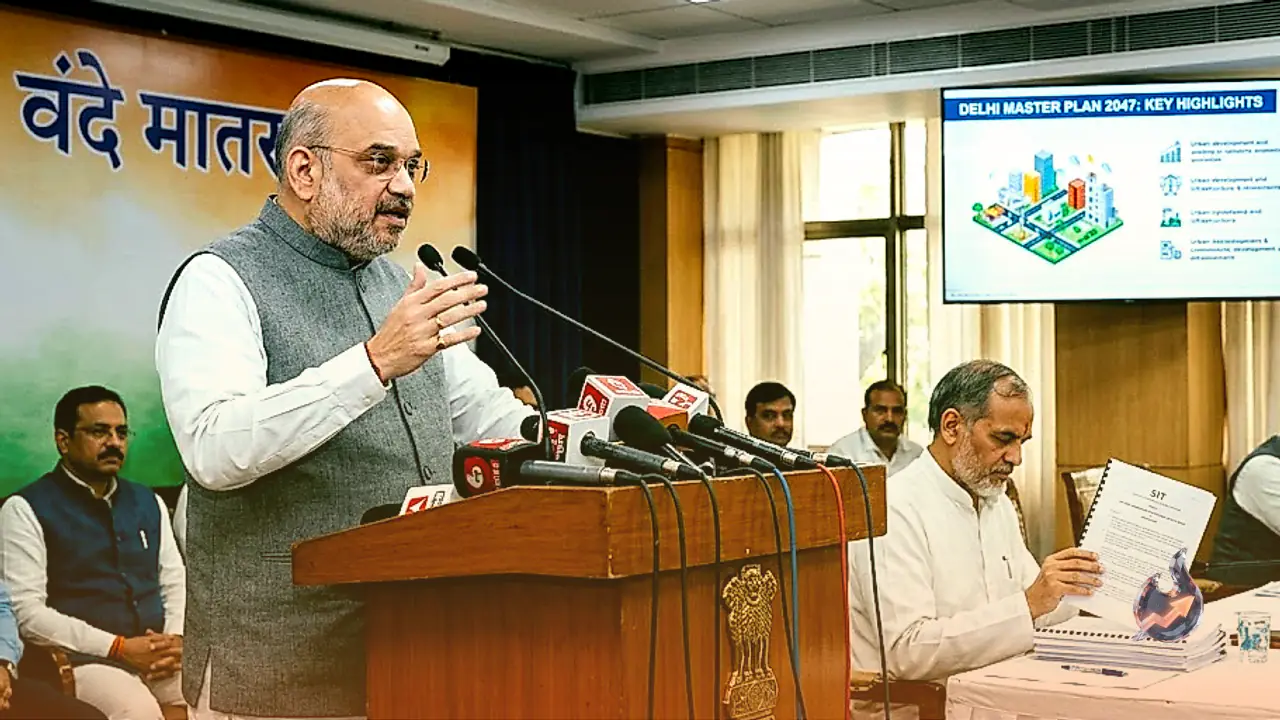

A fresh political confrontation has erupted in the country over the national song Vande Mataram. Home Minister Amit Shah criticized the Congress party, accusing it of engaging in appeasement politics and demonstrating an anti-national mindset. Amit Shah stated that by refusing to sing the full national song, which served as an iconic anthem during India's freedom struggle, the Congress party has exposed its true stance to the public. The controversy intensified after the Congress Working Committee passed a formal resolution mandating that only the first two stanzas of Vande Mataram will be sung at official party events, despite a 2026 parliamentary law that strictly prohibits dishonoring the national song.
National Song Controversy and Historical Context
On the final day of the previous parliamentary session, all Congress lawmakers, including Telangana Chief Minister Revanth Reddy and Himachal Pradesh Chief Minister Sukhbir Sukhu, stood to sing the complete Vande Mataram in compliance with the law. However, friction arose after Sonia Gandhi expressed displeasure over singing the full song at the Congress headquarters. The party now maintains that it is upholding its 1937 decision to sing only the first two verses, thereby adhering to an 89-year-old resolution while ignoring the updated 2026 statutory framework.
The debate stems from electoral sensitivities surrounding the lyrics. The final three stanzas of Vande Mataram depict Mother India in the imagery of goddesses Durga and Lakshmi. In 1937, the Muslim League opposed these stanzas, leading to the party's initial compromise. Highlighting this historical precedent, Amit Shah asserted that the party continues to prioritize vote-bank considerations over national traditions.
Ayodhya Ram Mandir Donation Theft Investigation and Champat Rai's Letter
Following the submission of the Special Investigation Team (SIT) final report regarding the theft of donation funds at the Ram Lalla temple in Ayodhya, former trust general secretary Champat Rai released a detailed 9-page letter. Although the document refrained from commenting directly on the theft investigation, it provided a comprehensive account of temple operations, construction milestones, and financial governance. Rai specified that no checkbooks were ever issued for the trust's three primary bank accounts, with all disbursements executed digitally to ensure transparency. Furthermore, internal audits are conducted regularly by independent external firms.
Rai emphasized that temple visits, worship, aarti, and prasad remain completely free for all devotees, with no religious fees collected. The letter attributed key structural and architectural decisions primarily to Nripendra Mishra. Over the past fortnight, Champat Rai and Anil Mishra actively conducted visits across religious establishments in Ayodhya to engage with local spiritual leaders. Since the SIT probe focused exclusively on identifying cash theft from donation boxes rather than management oversights, Rai maintains that administrative processes operated with full integrity.
Delhi Master Plan 2047 Framework and Demographic Challenges
Union Housing Minister Manohar Lal Khattar presented the Delhi Master Plan 2047, addressing the long-term urban infrastructure of the national capital. Official projections indicate that Delhi's population will reach 32 million by 2047, representing an influx of 8 million residents over the next two decades. To accommodate this expansion, the government plans to construct 4 million new residential flats.
Under the proposed framework, building height restrictions will be relaxed across most urban zones, excluding areas adjacent to the airport and Lutyens' Delhi. This policy change will enable vertical construction, allowing 50-year-old structures to be redeveloped into modern high-rise complexes. Additionally, informal settlement areas will be transformed into multi-story residential buildings to rehouse slum dwellers.
Urban planning analysts note that expanding housing stock and transit networks may not fully address core capacity limits. Initially planned for a population of 7 to 8 million, Delhi currently houses approximately 25 million people. Subsidized utilities and employment opportunities continue to draw migrants from across India. Nearby satellite cities such as Gurgaon and Noida are similarly experiencing severe urban congestion, underscoring the broader challenge of managing regional migration alongside infrastructure growth.