





















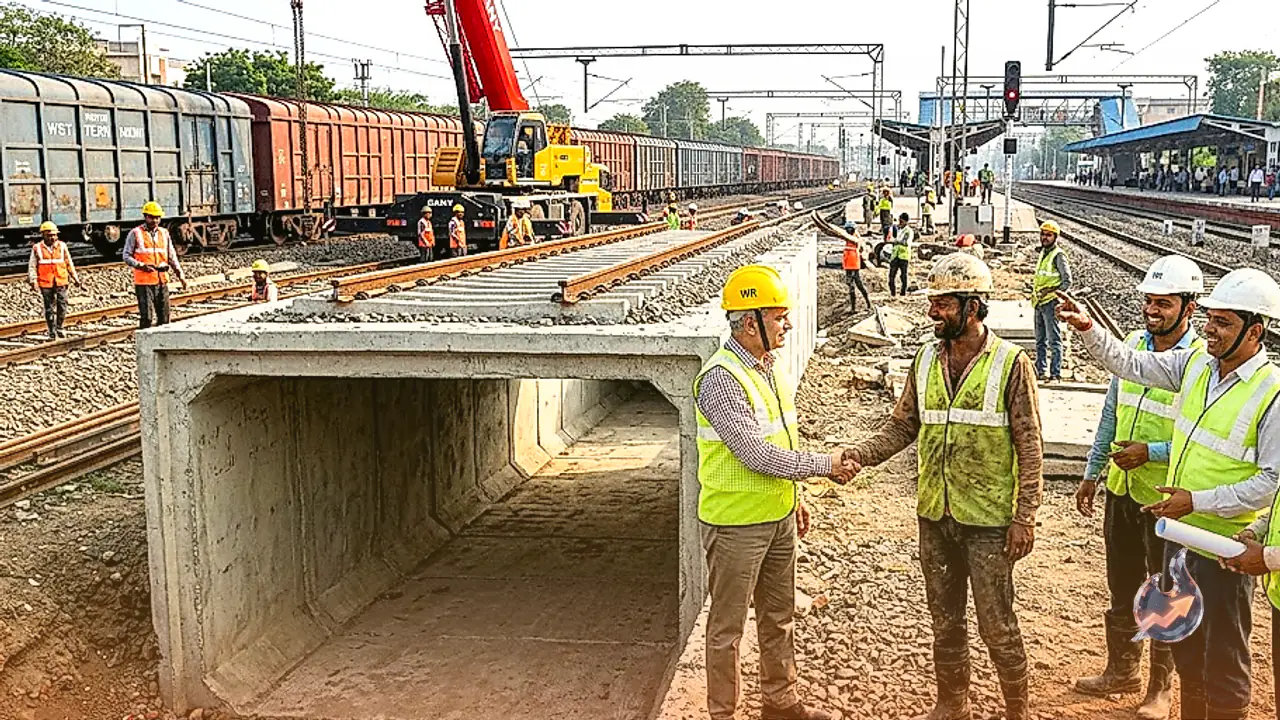

In a remarkable demonstration of civil engineering efficiency and rapid project execution, Western Railway has successfully constructed a 21-meter-long precast Reinforced Cement Concrete (RCC) pedestrian subway in the Vastrapur locality of Ahmedabad, Gujarat. The entire installation was accomplished in a remarkably short window of just 7 hours and 15 minutes during an overnight railway block. Originally, railway authorities had scheduled an 8-hour traffic block to complete the complex structural operation. However, due to meticulous planning, advanced machinery deployment, and precise team coordination, the engineering crew wrapped up the entire process 45 minutes ahead of the allotted deadline. This milestone represents the first pedestrian subway in Ahmedabad built entirely using factory-fabricated precast concrete components, setting a new benchmark for urban railway infrastructure projects across the region.
Strategic Night Block and Preparatory Earthwork Operations
To minimize inconvenience to passenger traffic and avoid disruptions to regular train schedules running through the busy Ahmedabad network, Western Railway planned the installation as a single overnight block. The 8-hour window began late at night when train movements were minimal. As soon as the block was formally granted by railway traffic controllers, heavy construction equipment, including heavy JCB excavators and specialized rail-bound machinery, moved onto the site.
The initial phase required the swift dismantling and clearing of the existing railway tracks, sleepers, and ballast at the targeted location in Vastrapur. Once the upper track structure was cleared away, excavation crews used JCB diggers to excavate a massive trench approximately 1.5 meters deep beneath the track level. This deep foundation trench was necessary to establish a stable, perfectly level sub-grade capable of carrying the heavy load of both the subway structure and the continuous dynamic forces exerted by passing trains. Immediately following excavation, workers laid a heavy-duty 1.5-meter concrete base slab across the pit floor, creating a rigid foundation platform to receive the heavy modular subway blocks.
Precast Concrete Engineering and Modular Box Assembly
The rapid timeline of the Vastrapur subway project was made possible through the use of factory-manufactured precast RCC technology. Rather than pouring concrete directly on site—a traditional method requiring weeks of formwork installation, concrete pouring, and extended curing times—the structural components were pre-fabricated in a controlled factory setting. This off-site manufacturing approach ensured high quality control, consistent material standards, and superior concrete strength.
For the subway barrel, high-grade M50 precast RCC box units were transported directly to the Vastrapur site prior to the night block. Once the 1.5-meter base slab was set, powerful cranes lifted and positioned the heavy M50 precast RCC box modules side-by-side on top of the base. The individual box units were systematically aligned to construct a continuous 21-meter-long underground subway barrel.
To guarantee maximum structural stability, long-term durability, and resistance against constant train vibrations, engineers applied advanced post-tensioning techniques. High-strength steel tendons running through the precast modules were tensioned, compressing the individual RCC box sections tightly together into a single monolithic structure. Following the post-tensioning process, specialized waterproofing treatments were applied over the outer joints and surface of the subway structure. This advanced waterproofing barrier protects the subway barrel against groundwater infiltration, monsoon rain runoff, and long-term soil moisture damage.
Load-Bearing Verification and Railway Track Restoration
Immediately after completing the structural assembly, post-tensioning, and waterproofing of the 21-meter precast subway, railway engineers conducted rigorous safety and load-bearing evaluations. Before restoring regular train traffic over the newly installed subway roof, heavy railway service machines and heavy locomotives were run directly over the structure. This stress test verified structural integrity, ensuring that the subway could withstand immense static and dynamic operational loads without any measurable settlement or structural deformation.
Once the load tests confirmed full structural stability, track laying teams worked rapidly to replace the railway ballast, re-lay the sleepers, and re-install the steel rails across the subway roof. The entire sequence—from initial track removal to final track restoration and load testing—was completed in 7 hours and 15 minutes. Commercial train movement resumed safely over the line immediately after the block was lifted. Western Railway officially commended its engineering personnel and work crews, highlighting the project as an exemplary model of fast, precise, and high-quality railway engineering.
Urban Safety Benefits and Public Transit Infrastructure Impact
The completion of the precast pedestrian subway addresses a long-standing public safety concern for residents living in and around the Vastrapur area of Ahmedabad. Previously, pedestrians in the neighborhood frequently crossed the active railway tracks on foot, creating severe safety risks and increasing the likelihood of fatal accidents or unauthorized trespassing incidents. The new underground subway offers a secure, well-ventilated, and convenient pedestrian route, completely separating foot traffic from active rail lines.
The Divisional Railway Manager (DRM) of Ahmedabad praised the achievement on social media, describing it as a landmark example of rapid urban construction. Railway officials emphasized that adopting precast RCC technology significantly reduces site-level construction duration, eliminating the need for prolonged speed restrictions or multi-day train cancellations. By completing the Vastrapur subway within a single overnight block of 7 hours and 15 minutes—45 minutes ahead of schedule—Western Railway demonstrated how modern engineering techniques can enhance public safety while preserving rail network efficiency.