





















Although the 2027 Uttar Pradesh assembly elections are still some time away, the political rivalry between the state's two dominant figures, Chief Minister Yogi Adityanath and Samajwadi Party chief Akhilesh Yadav, has already escalated significantly. Addressing the Bharatiya Janata Party's Shakti Kendra convention in Meerut, the Chief Minister invoked Babur and Bajrangi to launch a sharp offensive against the opposition. Within hours, the Samajwadi Party responded in kind by putting up a prominent hoarding outside its Lucknow headquarters depicting Akhilesh Yadav bowing in reverence before Lord Hanuman. This swift back-and-forth indicates that religious and historical symbols will occupy center stage in the forthcoming electoral battle.
Chief Minister Addresses Youth and Party Workers in Meerut
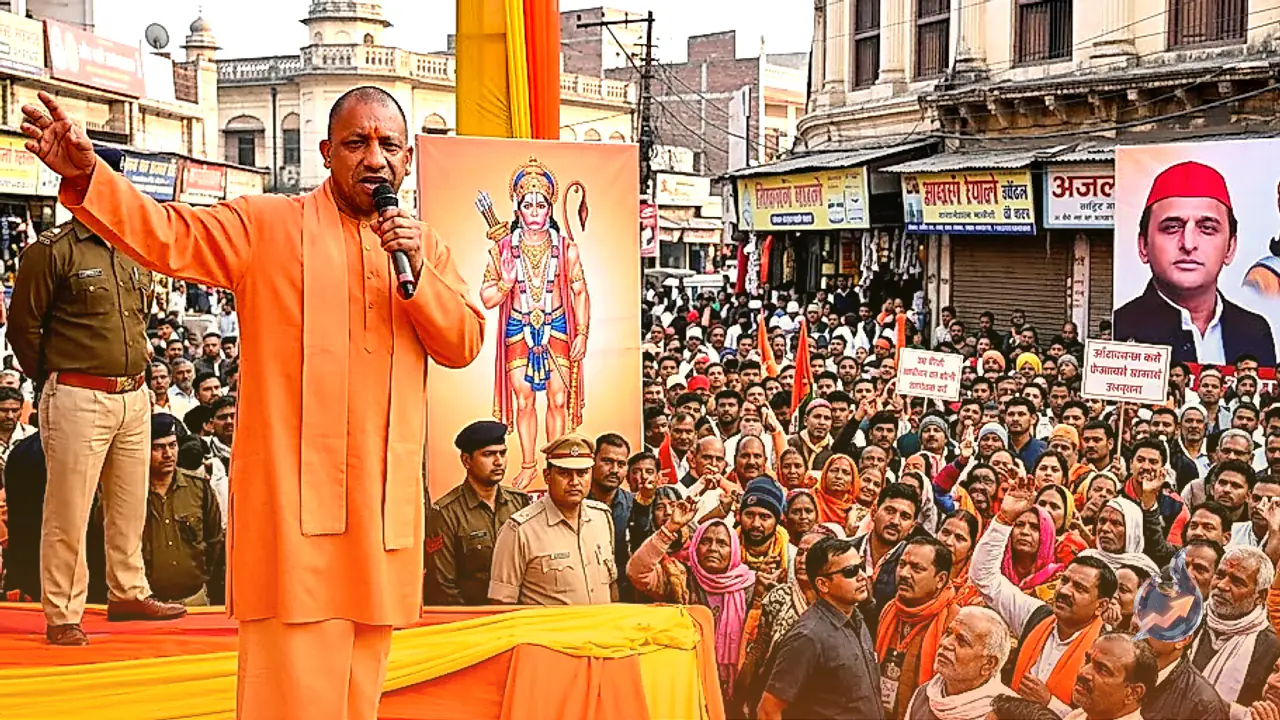
Speaking to party workers and youth at Subharti University in Meerut on Monday, Chief Minister Yogi Adityanath mounted a blistering attack on both the Samajwadi Party and the Congress. He accused the opposition of harboring resentment toward the name of Lord Ram, arguing that previous administrations made a habit of disparaging India's Sanatan heritage. Drawing historical comparisons, the Chief Minister remarked that rival parties experienced the same unease and irritation upon hearing the name of Shri Ram as Babur once did.
Delivering his remarks in a stern tone, Yogi Adityanath declared:
"Only the devotees of Bajrangi can give a fitting reply to the followers of Babur."He went on to hold the policies of the previous Samajwadi Party government responsible for disrupting development initiatives and placing restrictions on cultural and religious observances such as the Kanwar Yatra and Janmashtami celebrations. The address signaled a deliberate effort to rally party cadres around issues of cultural preservation.
Samajwadi Party Unveils 'Vijay Bhavah 2027' Hoarding in Lucknow
Shortly after the Meerut speech, a large hoarding appeared outside the Samajwadi Party state headquarters in Lucknow, quickly becoming a focal point of political discussion. The poster features Akhilesh Yadav standing with folded hands in complete surrender and devotion before Lord Hanuman. Emblazoned across the banner in bold lettering is the slogan 'Vijay Bhavah 2027'.
Through this prominent visual display, Samajwadi Party workers sought to communicate that Lord Hanuman's blessings rest firmly with Akhilesh Yadav and his party. The move serves as an explicit pushback against the assertion that the Bharatiya Janata Party holds an exclusive claim over Sanatan faith and veneration of Hindu deities. By adopting this stance, the opposition aims to shield itself from being boxed in by its rival's ideological rhetoric.
The Underlying Strategy Behind Historical and Faith-Based Symbols
Caste-based alliances and slogans have long defined electoral contests in Uttar Pradesh, but the sudden reliance on religious and historical iconography by both major camps ahead of 2027 points to deep strategic calculation. The BJP seeks to anchor the political narrative around cultural identity, heritage protection, and ideological polarization, whereas the Samajwadi Party is working to keep its broad coalition intact.
In the 2024 Lok Sabha elections, Akhilesh Yadav's PDA framework, representing backward classes, Dalits, and minorities, made significant inroads into the BJP's traditional voter base. Party planners in the BJP recognize that if the SP-Congress combine succeeds in fragmenting Hindu voters along caste lines, the ruling party could encounter serious electoral headwinds. Shifting the public contest toward a sharp confrontation between cultural preservation and appeasement simplifies the consolidation of Hindu votes under a unified banner.
Soft Hindutva Countering Claims of Exclusive Patronage
In response, Akhilesh Yadav has pursued a calculated posture of soft Hindutva combined with an all-inclusive public outreach. The Samajwadi Party leadership has consistently sought to dismantle the narrative that projects the BJP as the sole protector of Hindu tradition. This approach is not entirely new; the party previously associated itself with the construction of temples dedicated to Lord Parshuram and related community gatherings.
The recent hoarding depicting reverence toward Lord Hanuman represents an effort to show that the party neither avoids religious symbols nor restricts its appeal to a solitary demographic. While both parties continue to trade accusations over unemployment, recruitment exam controversies, and economic progress, the injection of Babur and Hanuman into daily political discourse demonstrates that governance indicators alone will not decide the 2027 contest.
The Race to Set the Political Agenda
Recent months have witnessed an intense contest to dictate the political narrative in Uttar Pradesh. A few months ago, Akhilesh Yadav frequently pushed the ruling party onto the defensive by raising allegations concerning donation irregularities at the Ram temple in Ayodhya. However, over the past two to three months, Chief Minister Yogi Adityanath has altered the dynamic by focusing on younger Gen-Z voters and announcing administrative drives, including one lakh government job recruitments.
These policy announcements have provided momentum against the opposition's PDA coalition messaging. Within this broader battlefield, Yogi Adityanath's invocation of Bajrangi functions as an energizer for the BJP's core base, while Akhilesh Yadav's visible devotion before Lord Hanuman represents a calculated bid by the Samajwadi Party to repel allegations of being anti-Hindu.