





















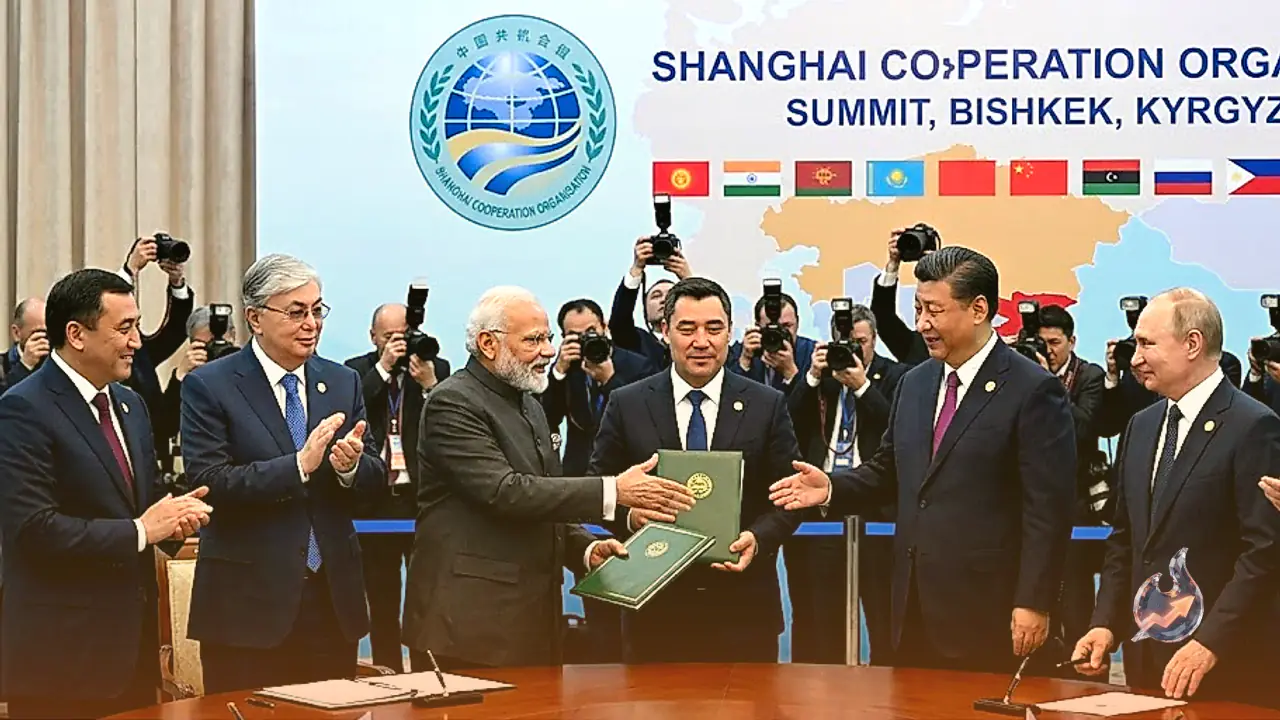

The Shanghai Cooperation Organisation (SCO) Bishkek summit concluded with the release of a comprehensive declaration that establishes a strong, unified stance against terrorism. All member states, including China, formally signed and endorsed the declaration, reinforcing India's long-standing policy advocating zero tolerance toward terrorism. According to the Ministry of External Affairs (MEA), member countries reiterated their firm commitment to combating terrorism, separatism, and extremism. The Bishkek declaration strictly condemned all manifestations of terrorism and emphasized that maintaining double standards in the fight against terror is entirely unacceptable.
Core Highlights and Outcomes of the Bishkek Declaration
The summit declaration explicitly stated that utilizing terrorist, separatist, and extremist groups to advance self-serving objectives cannot be tolerated under any circumstances. Member countries condemned terrorism in all its forms and called for collective regional action under the central role of the United Nations to curb the cross-border movement of terrorists and eliminate terror organizations. The MEA noted that this phrasing aligns directly with India's long-standing national security priorities. Highlighting 13 key outcomes of the Bishkek summit, the MEA drew specific attention to the regulations governing the Universal Center, which aims to strengthen regional coordination against terrorism and organized crime.
PM Narendra Modi Issues Direct Warning to State Sponsors of Terror
During the summit proceedings, Prime Minister Narendra Modi delivered an uncompromising address in the presence of Pakistan Prime Minister Shehbaz Sharif and Chinese President Xi Jinping. PM Modi stated that nations must act decisively to dismantle the entire infrastructure of terrorism, including terror financing, recruitment channels, radicalization efforts, and safe havens. He stressed that there can be no justification or double standards when confronting terror threats. Sending a clear signal to countries using terrorism as an instrument of state policy, PM Modi asserted that terrorism can never be treated as anyone's strategic asset.
Contrast Between the 2025 Standoff and the 2026 Consensus
The current consensus marks a significant shift from the events of 2025. Following the Pahalgam terror attack in April 2025, India faced a difficult struggle to get the incident acknowledged during the SCO Defense Ministers' meeting held in Qingdao. Defense Minister Rajnath Singh famously refused to sign the joint agreement because it failed to mention terrorism or reference the Pahalgam attack. Later, at the Tianjin summit, the SCO eventually issued a statement condemning the Pahalgam attack and calling for the perpetrators to be brought to justice.
Mounting Diplomatic Pressure on Islamabad
By 2026, the complete alignment of all SCO member states, including China, with India's anti-terror position sends an unmistakable message to Islamabad. Pakistan has long relied on cross-border terrorism as a strategic tool against India while attempting to shift focus by pointing to events in Balochistan as external conspiracies. The unanimous agreement at the SCO undermines Islamabad's recurring strategy of using Chinese backing to dilute anti-terror language in international forums. China's participation in this anti-terror commitment significantly increases diplomatic pressure on Pakistan, demonstrating a growing regional consensus that forces Islamabad to alter its conduct, even as it prepares to assume the upcoming SCO chairmanship.