





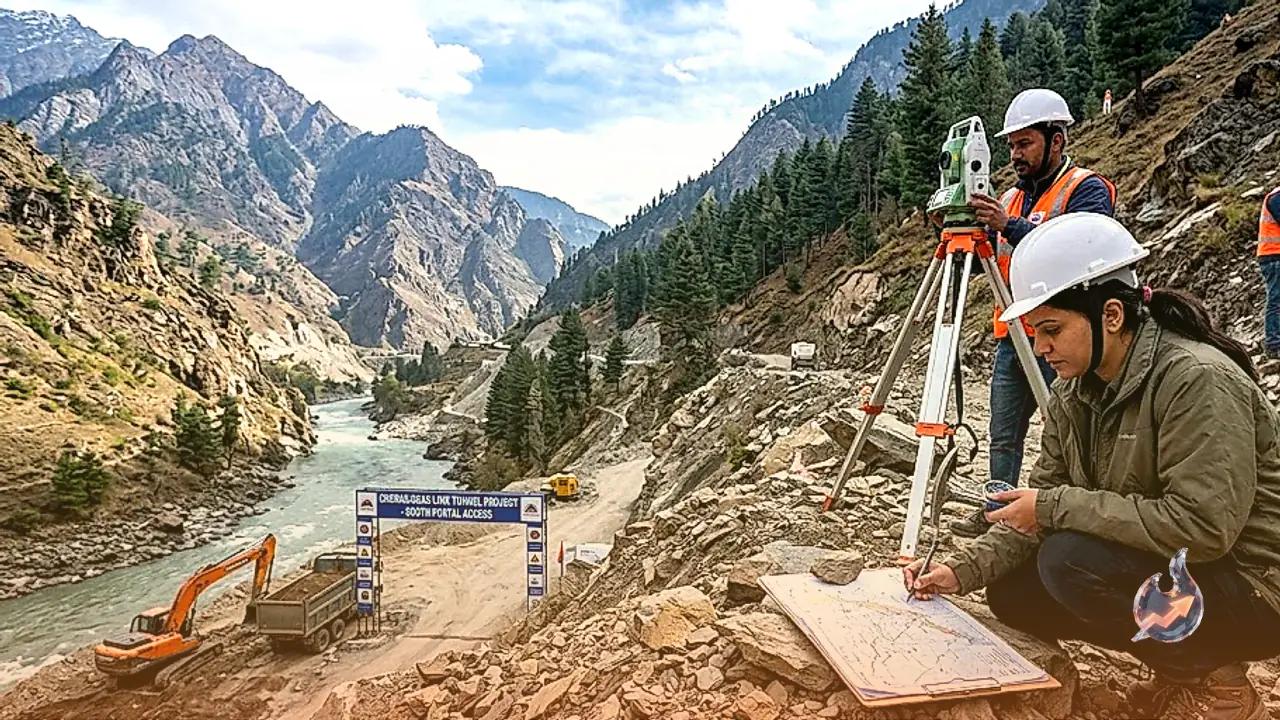


















Following the terror strike in Pahalgam, India made the significant move of suspending the Indus Waters Treaty, a step that has triggered profound restlessness within Islamabad. While Pakistan has consistently raised grievances across international diplomatic forums concerning cross-border river flows, its appeals have largely failed to generate external traction. Beyond general water sharing disputes, acute anxiety has emerged across Pakistan's establishment over the proposed 8.7-kilometer Chenab-Beas link tunnel, an infrastructure endeavor designed to route water from the Chenab system into the Beas river basin. Islamabad fears that this venture marks the practical onset of diverting western river allocations into eastern river channels, though the full technical reality involves nuanced hydrological details.
Project Blueprint and Technical Scope
In the elevated landscapes of Himachal Pradesh's Lahaul-Spiti district, the Chandra river serves as the principal feeder stream of the Chenab. Under this strategic diversion initiative, the government plans to erect a barrage structure near Koksar. Through this diversion barrage, regulated volumes of river discharge will be directed into the Beas basin via an 8.7-kilometer underground tunnel.
A critical milestone for this infrastructure project materialized in July of this year, when central authorities directed agencies to fast-track pre-feasibility surveys, detailed engineering designs, and comprehensive geographic mapping. The cessation of routine bilateral commissioner meetings and regular hydrological data transmission under the suspended treaty mechanism has enabled administrative authorities to dramatically accelerate early execution phases. This mid-year progress immediately prompted sharp reactions across Pakistan's Ministry of Water Resources and domestic media, reflecting heightened apprehension that construction activity was moving rapidly toward physical implementation on the ground.
Hydrological Realities versus Islamabad's Underlying Apprehension
Official circles in Pakistan contend that India intends to divert approximately 1.9 million acre-feet (MAF) of water annually from the Chenab river through the planned tunnel route. Conversely, multiple independent water experts assess that the actual quantum redirected through this mountain pass could remain substantially below that projection.
Evaluating the project through hydrological figures addresses whether a 1.9 MAF diversion would indeed deplete the Chenab river. The Chenab carries an average cumulative annual flow exceeding 36 MAF. Consequently, 1.9 MAF represents only a modest portion of the river's overall volumetric discharge, confirming that immediate physical drying is not a factual prospect. Pakistan's fundamental anxiety lies instead in the administrative and operational precedent being created. In the entire operational history of the Indus Waters Treaty, this marks the first instance where waters originating from the western rivers—assigned primarily for downstream Pakistani utilization—are being systematically diverted into the eastern river network managed entirely by India. The Pakistani leadership remains concerned that if an 8.7-kilometer conduit successfully channels an initial fraction of water, identical engineering designs and transport corridors could subsequently facilitate larger-scale diversions across the river system.
Dissolution of Historical Legal Obstacles
Historically, whenever upstream infrastructure or hydroelectric works were initiated along the Chenab or Jhelum rivers, Pakistan routinely mounted formal objections before the Permanent Indus Commission. By repeatedly demanding neutral expert interventions or pursuing arbitration at the Permanent Court of Arbitration, downstream objections frequently entangled Indian power and storage projects in decades of administrative gridlock.
With treaty operations currently suspended, the mechanism of sharing real-time hydrological data has been discontinued. Deprived of treaty-mandated consultation channels, Pakistan can no longer leverage procedural technicalities to delay construction timelines. As a consequence, foundational initiatives like the Chenab-Beas diversion tunnel are advancing steadily without the recurring impediment of bilateral legal disputes.
Pakistan's Structural Water Crisis and Geopolitical Outreach
The intensifying water stress across Pakistan's agricultural heartland cannot be attributed solely to upstream developments, given that internal structural deficiencies remain widespread and unaddressed
- Extensive Distribution Losses: Deteriorating, unlined canal networks suffer from rampant seepage and structural breaches, causing millions of liters of usable river water to be squandered before reaching agricultural fields.
- Severe Reservoir Siltation: Massive reservoirs including Tarbela and Mangla have accumulated substantial silt deposits over decades of operation, drastically curtailing their active water retention capacity.
- Intense Inter-Provincial Friction: Protracted political disputes between key provinces, notably Punjab and Sindh, have blocked essential water storage schemes, leaving major undertakings such as the proposed Kalabagh Dam stalled for roughly 60 years.
Instead of overhauling its domestic conservation mechanisms, Pakistan frequently seeks international mediation, recently attempting to draw China into its diplomatic posturing. Strategists in Islamabad argue that just as India occupies an upper riparian location relative to Pakistan, China sits in an upper riparian posture relative to India. On this basis, Pakistan has floated expectations that Beijing might constrain downstream river volumes entering India, while simultaneously urging third-party intervention from the United States or the World Bank. However, hydrological realities reveal that the predominant share of the Brahmaputra river's volume accumulates inside Indian territory via intensive monsoon rainfall and domestic tributaries, rendering potential upstream manipulation significantly less impactful.
Strategic Safeguards and Diplomatic Clarity
The Chenab-Beas link tunnel underscores India's advancing engineering capabilities and deliberate water security management. Realizing this high-altitude project will require focused operational vigilance across two vital domains
- Physical Infrastructure and Cyber Protection: Given the vulnerable terrain, the tunnel, Koksar diversion barrage, and affiliated control centers will require robust defenses against potential drone incursions, sabotage, and sophisticated cyber interference.
- Principled Diplomatic Engagement: New Delhi must continue to articulate internationally that utilization of domestic river flows constitutes a sovereign and lawful exercise within national borders, making it clear that civil engineering and resource planning will not remain hostage to cross-border security threats.
Although the 8.7-kilometer tunnel channels a measured fraction of the total Chenab river flow, its geopolitical signal is substantial. It demonstrates a firm decoupling of vital resource development from the shadow of cross-border terrorism. Rather than relying on familiar rhetoric, obstructionism, or external mediation, Islamabad faces the reality that lasting stability depends on addressing cross-border militant infrastructure, as this vital link tunnel establishes a transformative chapter in regional water management.