





















Political intensity has hit its peak in the Bankipur assembly constituency located in Patna, Bihar, ahead of the upcoming by-election. Although the official deadline for public campaigning has drawn to a close, political debates continue to rage across street corners and digital platforms alike. All eyes are now fixed on the polling scheduled for July 30, followed by the decisive vote counting on August 3. In this high-stakes contest, the ruling Bharatiya Janata Party is striving to defend its long-held bastion, while Prashant Kishor's Jan Suraaj and the Rashtriya Janata Dal are attempting to reshape local electoral equations. While the final outcome will only become clear once the electronic voting machines are unsealed on August 3, a newly circulated video has injected a fresh narrative into the election campaign.
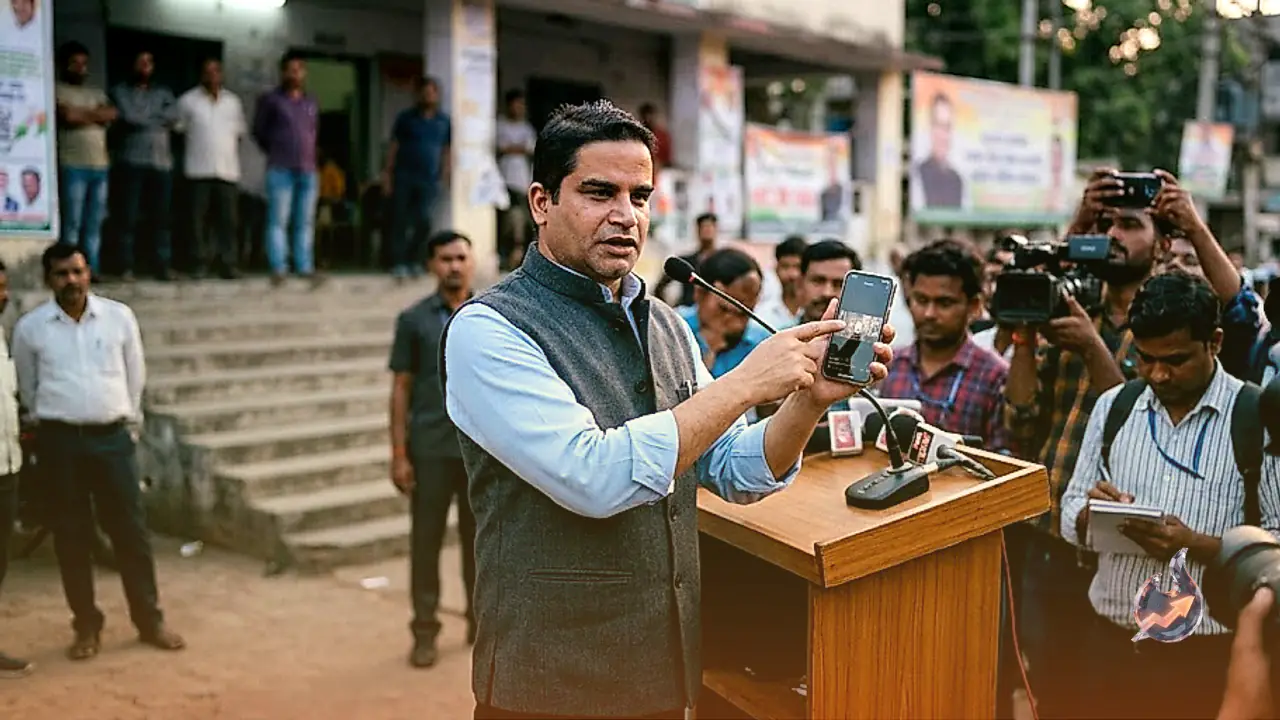
Shared on Jan Suraaj's official social media handles across Facebook and Instagram, the video features strategist-turned-politician Prashant Kishor reflecting on former Prime Minister Dr. Manmohan Singh's electoral defeat in South Delhi. By highlighting how an eminent economist lost in one of the nation's most affluent parliamentary constituencies, Prashant Kishor has directly questioned deeply entrenched assumptions regarding voter literacy, economic status, and political behavior. As the countdown to the Bankipur by-poll voting narrows, this video has generated widespread discussion across Bihar's political landscape. Understanding why Prashant Kishor resurrected this decades-old election result requires a closer examination of his underlying message to Bankipur's electorate.
The Myth of Educated Voter Superiority
In the video circulated during the Bankipur by-poll campaign, Prashant Kishor launched a direct critique against the widespread societal belief that formal education automatically yields a more rational or progressive voter. Prashant Kishor urged citizens not to harbor the misconception that educated individuals inherently make better voting choices. He stressed that a person's academic credentials or wealth offer no guarantee that they will rise above narrow caste and religious considerations when stepping inside the polling booth.
Prashant Kishor pointed out that political analysts and commentators frequently accuse poor, less-educated, or rural voters of falling prey to identity politics based on caste and religion. However, drawing from his extensive experience in electoral campaign management, he argued that reality often presents the exact opposite picture. In many instances, highly educated and financially secure citizens actively perpetuate caste-based and communal divisions, letting those very biases dictate their voting decisions. Despite rising literacy rates, the failure of formal education to eliminate identity-driven voting remains a persistent flaw in modern democratic practice.
The South Delhi Contest and Dr. Manmohan Singh's Electoral Loss
To substantiate his perspective with historical evidence, Prashant Kishor cited the solitary direct Lok Sabha election contested by former Prime Minister Dr. Manmohan Singh. He reminded viewers that Dr. Manmohan Singh contested this election not from a remote or economically backward rural area, but from the South Delhi Lok Sabha constituency. South Delhi was widely regarded as one of the most enlightened, prosperous, and highly educated urban constituencies in India, populated by prominent professionals, corporate executives, and affluent residents.
Prashant Kishor highlighted that Dr. Manmohan Singh was indisputably the nation's premier economist with an unblemished public record, credited with steering India's landmark economic reforms. Nevertheless, when the voters of South Delhi exercised their mandate, they rejected the distinguished economist and elected Bharatiya Janata Party candidate Vijay Kumar Malhotra to Parliament instead. Prashant Kishor argued that if academic qualifications and high living standards were truly the primary indicators of prudent voting, a leader of Dr. Manmohan Singh's caliber would never have suffered defeat in such a constituency. This outcome demonstrates that educated urban electors are equally prone to voting along party and ideological lines rather than merit alone.
The Hypothetical Supaul Parallel and Regional Stereotypes
Elaborating further, Prashant Kishor challenged the regional biases often directed toward Bihar by urban elites and national commentators. He presented a hypothetical scenario, suggesting that if Dr. Manmohan Singh had contested and lost an election from a rural constituency in Bihar such as Supaul, critics nationwide would have immediately blamed the state's literacy rate. Observers would have summarily dismissed the electorate as uneducated and incapable of appreciating a world-class economist's vision.
However, when Dr. Manmohan Singh lost in South Delhi, one of the nation's wealthiest and most educated urban centers, those same commentators refrained from drawing similar conclusions about urban literacy. Prashant Kishor questioned whether wealthy and educated voters can always be trusted to make optimal democratic decisions. He asserted there is no definitive correlation ensuring that an educated voter will be less casteist or less communal. On the contrary, individuals who perceive themselves as highly informed often place significant emphasis on caste calculations during elections.
Double Standards in Caste Politics and Jan Suraaj's Vision
Addressing the broader socio-political dynamic, Prashant Kishor spoke candidly about the double standards prevalent among political leaders and voters alike. He observed that many individuals deliver grand speeches against caste discrimination on public platforms, yet prioritize caste considerations in their private lives and political decisions. While poorer citizens often vote based on tangible daily necessities such as employment, inflation, and healthcare, educated voters frequently get bogged down in intricate caste arithmetic.
The Jan Suraaj founder appealed to the public to move beyond passive consumption of political speeches and adopt principled principles in their personal conduct. He stressed that genuine democratic transformation requires a fundamental shift in daily behavior alongside political awareness. Words alone cannot reform the political system unless voters demand accountability and practice what they preach.
Electoral Accountability and the Path Ahead for Bankipur
In the concluding segment of the video, Prashant Kishor expressed a pragmatic view regarding election outcomes and Jan Suraaj's organizational mission. He acknowledged that winning and losing are inherent aspects of any democratic contest, but maintained that political work must be conducted with absolute integrity and clear intent. Jan Suraaj is actively engaging with voters in Bankipur to foster long-term political consciousness rather than relying on short-term electoral gimmicks.
He emphasized that the ultimate choice rests entirely with the electorate when voting takes place on July 30, leading up to the official result declaration on August 3. Jan Suraaj remains committed to accepting the public's verdict with humility. Prashant Kishor reiterated his call for citizens to look beyond political rhetoric and exercise their voting power responsibly. As Bankipur prepares to vote, this viral reflection on voter psychology has added a thought-provoking dimension to the final stretch of the campaign.