





















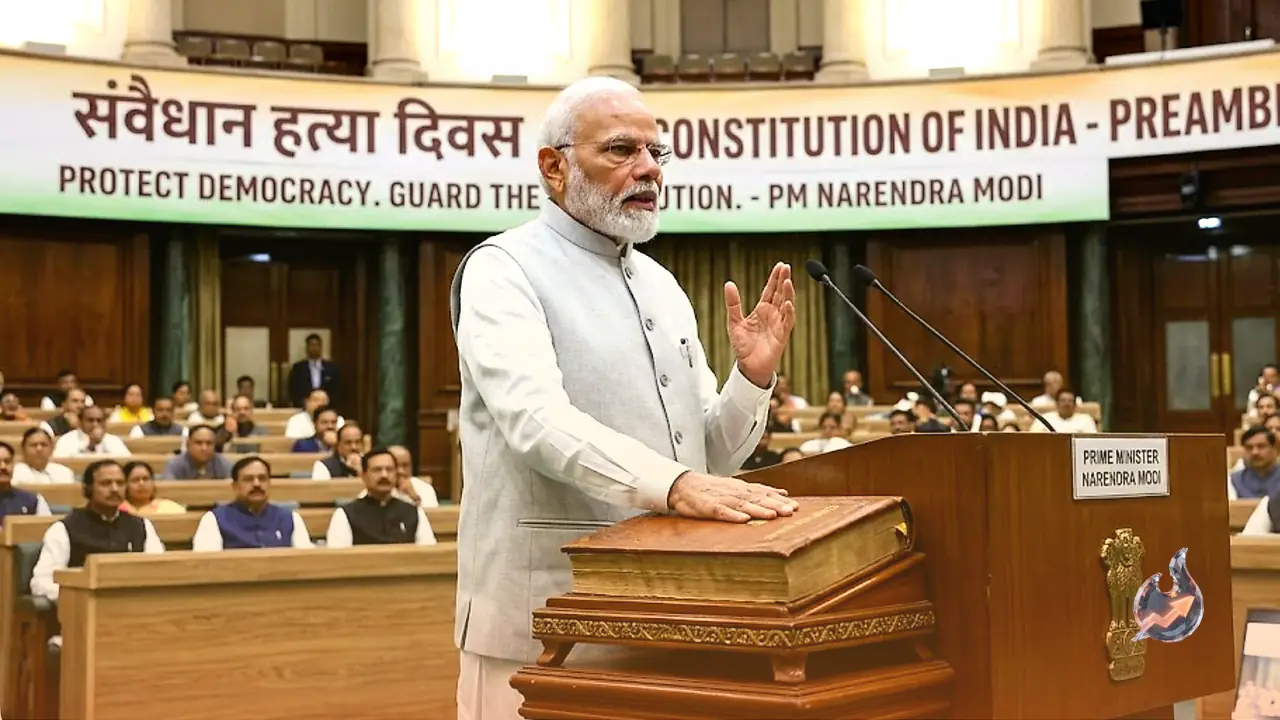

On the occasion of Samvidhan Hatya Diwas, Prime Minister Narendra Modi described the Emergency as a period when Indian democracy was brutally crushed, calling it one of the darkest chapters in the country's history. He said the day serves as a reminder of that grim era while also inspiring the nation to build an India committed to the ideals of justice, liberty, equality and fraternity.
In a post on the social media platform X on Thursday, Modi paid tribute to all those who firmly safeguarded democratic values during the Emergency, which he counted among the darkest periods India has seen.
'A direct attack on the Constitution'
The Prime Minister termed the Emergency a direct assault on the Constitution. He wrote that civil liberties were stripped away during that time, freedom of expression was muzzled, political leaders, journalists and social workers were jailed, and the very institutions that form the foundation of democracy came under attack.
At the same time, Modi noted that the era brought out the extraordinary courage of countless ordinary citizens, people who refused to stay silent and held firm to the ideals enshrined in the Constitution.
A symbol for 140 crore Indians
In his post, Modi described the Constitution as a symbol of the aspirations, rights and duties of 140 crore Indians. He said the country reaffirms its collective commitment to protecting constitutional values. Drawing inspiration from the spirit of the Constitution, he added, an India would be built that remains forever committed to justice, liberty, equality and fraternity.
A salute to those who resisted
In a separate post, the Prime Minister said Samvidhan Hatya Diwas reminds the nation of the dark period when Indian democracy was badly trampled. Calling it a source of inspiration to always stand firm in defence of democracy, the Constitution and citizens' rights, he offered a respectful salute to all the figures who opposed the Emergency.
A Sanskrit verse on freedom
To mark the day, Modi also shared a Sanskrit subhashitam that read, 'Swatantryat sukhamapnoti swatantryallabhate param. Swatantryannirvritim gachchet swatantryat paramam padam.' Explaining its meaning, he said it is through freedom that a person attains happiness, through freedom that one reaches the highest achievement, through freedom that one finds a state of calm, and through freedom that one attains the supreme position.