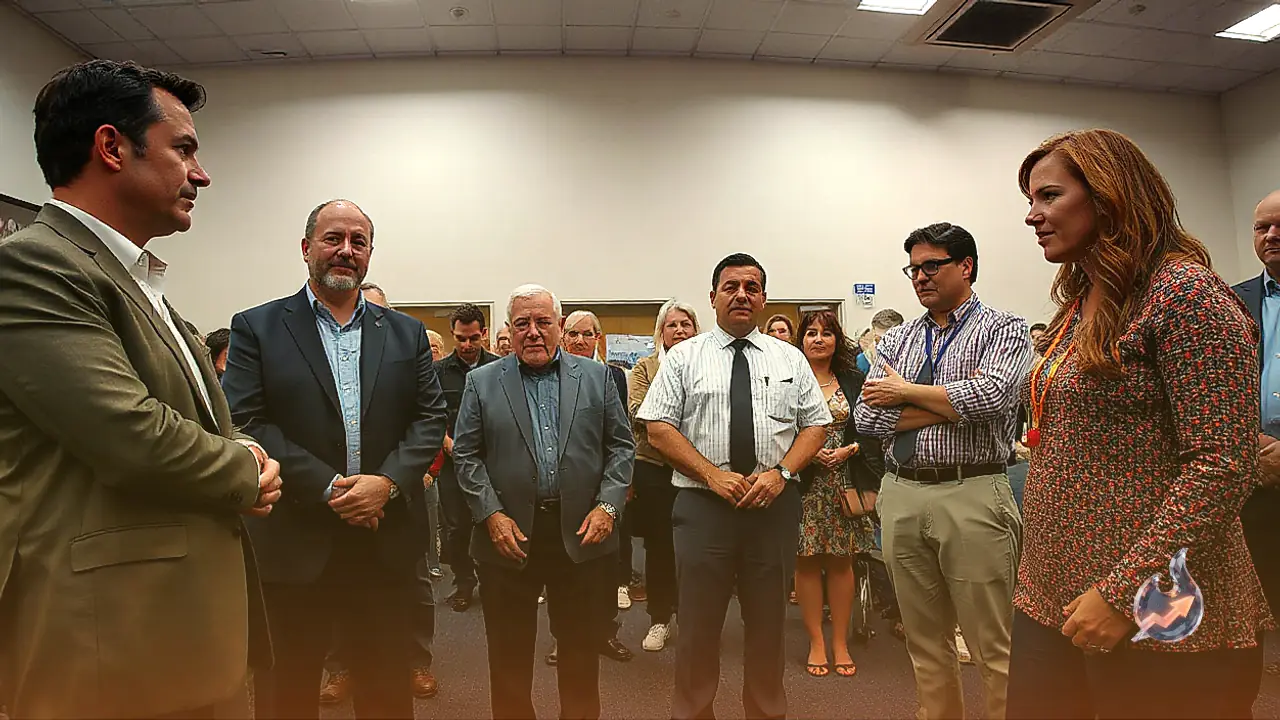

























Following the conclusion of the congressional midterm elections, the tech sector's premier political operation is facing a sobering reality. After assembling an immense political vehicle with roughly $100 million in financial commitments, the network known as Leading the Future concluded the election cycle holding slightly above $20 million in reserve. While the organisation points to an array of victorious candidates spanning both major parties, a closer examination reveals that the overwhelming bulk of funding flowed toward non-competitive races. In the contested districts where the coalition attempted to demonstrate political muscle, its ambitions largely failed to materialize.
A Billionaire-Backed Coalition Built for Political Power
When the coalition made its public debut in August 2025, its stated mission centered on pushing back against legal restrictions that could slow technological development. That vision attracted substantial funding from some of the most influential figures in Silicon Valley. Key financial supporters included Andreessen Horowitz, Palantir co-founder Joe Lonsdale, and Greg Brockman of OpenAI, alongside seasoned political strategists tasked with running the apparatus.
The organization was structured as a comprehensive political umbrella intended to operate with agility throughout the 2026 midterms and future campaign cycles. Its components combined 501(c)(4) advocacy entities with state and federal super PACs serving both sides of the aisle. The American Mission arm concentrated its capital on Republican candidates, while Think Big handled resources for Democratic contenders. This parallel framework and overlapping leadership structure drew immediate parallels to Fairshake, the crypto sector's massive campaign network that wielded significant sway during the 2024 elections.
Primary Aggression Followed by General Election Retreat
In its initial phase, the coalition attempted to deter lawmakers from enacting regulatory boundaries around software models. Sacha Haworth, serving as executive director of the Tech Oversight Project, stated that the group intended to intimidate lawmakers into backing away from safety oversight. When contacted regarding these operations, Leading the Future declined to offer remarks.
During the previous autumn, the network directed substantial funding against Democrat Alex Bores in New York's 12th congressional district. Bores, a former Palantir engineer serving in the state legislature, anchored his platform on machine learning safeguards. The group poured millions into negative advertising against him. Haworth observed that the super PAC sought to make an example of Bores to frighten other candidates. However, the aggressive push turned the primary into a national referendum on regulatory oversight, elevating Bores' visibility. Public First, an advocacy entity with financial backing from Anthropic, committed $15 million to bolster Bores. While Bores ultimately finished second in the primary, the victory went to Micah Lasher, who similarly campaigned on industry accountability and strict safeguards.
Across the primary phase, the organization spent roughly $26 million on independent political expenditures. As the contest transitioned into the general election, however, that momentum sharply deteriorated. The network expended only around $10 million during the final stretch, directing nearly all of it to uncompetitive districts. Its fundraising pipeline dried up in tandem, recording zero dollars in contributions through both the second and third quarters.
Shifting Public Sentiment and Decisive Swing Race Losses
This tactical withdrawal coincided with internal and external polling indicating broad public skepticism regarding Big Tech influence in the federal government. An exit poll conducted by NBC revealed that 56 percent of participating voters viewed machine learning systems and computing infrastructure centers as a major consideration in their ballot choices. Haworth characterized the pivot toward safe incumbents as an effort to purchase standing with arriving legislators.
Brad Carson, co-founder of Public First Action, described the midterm outcomes as a significant achievement for legislative oversight, noting that voters across party lines sent an unmistakable message against attempts to weaken industry rules. In the high-stakes races where the tech network gambled, outcomes proved uniformly difficult. A flagship contest took place in South Carolina, where the group supported Darline Graham, sister of the late senator Lindsey Graham, who was seeking a full term. Graham gained the tag Data Center Darline from Democratic rival Annie Andrews due to her promotion of industrial facility expansion. American Mission contributed over $2 million toward Graham's bid, yet she garnered only 46.5 percent of the vote, suffering defeat in a state that had not sent a Democrat to the Senate since 1998.
House Battles and Brewing Congressional Scrutiny
In other contested House districts, the network relied on American Mission to support Republican hopefuls, with one notable exception. Through Think Big, it financed the re-election bid of Florida Democratic representative Jared Moskowitz. Moskowitz prevailed by a margin of 13,000 votes over challenger Scott Singer, who previously served as mayor of Boca Raton.
In North Carolina's 1st congressional district, American Mission endorsed Republican Laurie Buckhout, a retired Army colonel who served as assistant secretary of defense focusing on cyber policy under president Donald Trump in 2025. Conversely, Guardrails Alliance, a group aligned with the technology safety movement, backed Democratic incumbent Don Davis, who had previously co-sponsored legislation curbing tax breaks for computing facilities. Davis retained the seat.
Montana's 1st congressional district saw the coalition fund Aaron Flint, a combat veteran, conservative commentator, and former state director for Republican representative Ryan Zinke. Flint conceded his race to Democratic opponent Sam Forstag, a wildland firefighter backed by prominent progressive leaders including Alexandra Ocasio-Cortez. Forstag campaigned vigorously for strict federal regulation of artificial intelligence. While the Associated Press had not formally projected the outcome at that juncture, Flint conceded.
In state-level politics, American Mission Florida collected $3 million to advance Republican gubernatorial candidate Byron Donalds. While Donalds and opponent David Jolly adopted nuanced views on safety protocols, they clashed over infrastructure, with Donalds opposing moratoria on computing facilities. In the aftermath of the vote, technology firms face heightened scrutiny in Washington, ending an era of broad latitude under Trump's second administration. Democratic lawmakers plan congressional inquiries into company executives, underscored by Senator Ron Wyden posting a one-word alert on X pledging subpoenas.