























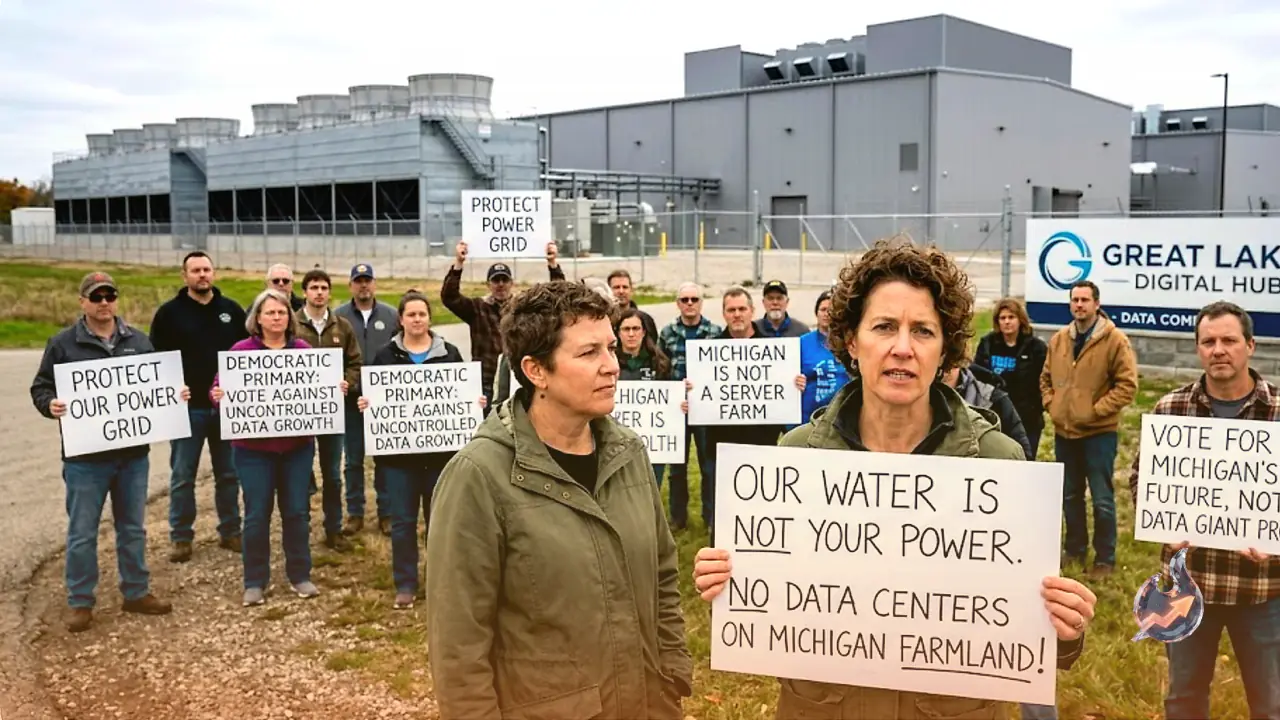

Lawrence, who is running for the Democratic primary in Michigan’s 7th district, is finding that data center opposition has become a potent rallying cry for his campaign. The candidate, who has received an endorsement from Senator Bernie Sanders, is being positioned as someone who will demand accountability from big tech and AI firms. According to internal polling from Data for Progress, more than 40 percent of likely Democratic primary voters in the district indicated they would be much more likely to support a candidate who opposes data center construction.
This sentiment is even stronger among younger voters; nearly 80 percent of those under 45 expressed a preference for candidates who challenge these developments. Lawrence notes that data centers were not his expected campaign focal point, but voters started organically approaching him at town halls after he launched his candidacy last summer. According to Lawrence, residents feel deeply disrespected by the companies and local officials who are pushing these projects into their communities without genuine consultation.
Legal Hurdles and Political Fallout
Clean-energy database Cleanview reports that at least 11 data centers are currently planned for Michigan. While persistent local pushback in two townships within the 7th district has successfully stalled at least two projects, developers have discovered ways to bypass such opposition elsewhere. For instance, when a township in the 6th district voted to reject an Oracle data center, the firm responded with a lawsuit. Facing an expensive court battle, the town eventually allowed the development to proceed.
The political stakes were highlighted when Michigan Governor Gretchen Whitmer attended the opening of an Oracle data center earlier this month, where she was seen smiling alongside OpenAI’s Sam Altman while praising the $16 billion investment. California-based Democratic strategist Cooper Teboe contends that any candidate ignoring the toxic nature of these data centers is unlikely to win. Christy McGillivray, executive director of the democracy reform group Voters Not Politicians, described the Governor’s appearance as a major misstep, suggesting it could potentially harm the Democratic party at large.
The Connection to Renewable Energy Resistance
During his campaign, Lawrence has encountered protesters who hold vastly different political views but share a common opposition to large-scale industrial projects, including solar and wind farms. Michigan has become a hub for such resistance; a 2025 review identified it as the state with the highest number of local restrictions on renewable energy. Between 2011 and 2024, over 60 local governments passed ordinances or moratoriums, effectively stalling at least 28 projects across the state.
Governor Whitmer signed legislation in 2023 allowing renewable energy developers to bypass local ordinances, making it easier for large developers to site projects on rural land. This sparked a wave of lawsuits from dozens of townships, particularly in the 7th district, where officials expressed concerns that renewable developments threaten to degrade fertile soil. While Lawrence maintains that he supports renewable energy, he argues that the intense reaction to data centers mirrors the public's frustration with renewable projects. He believes the core issue is that citizens do not feel they have control over their community's future. As Teboe puts it, many tech executives fail to realize that while they see these facilities as symbols of progress, local residents view them as unwelcome intrusions into their backyards.