



















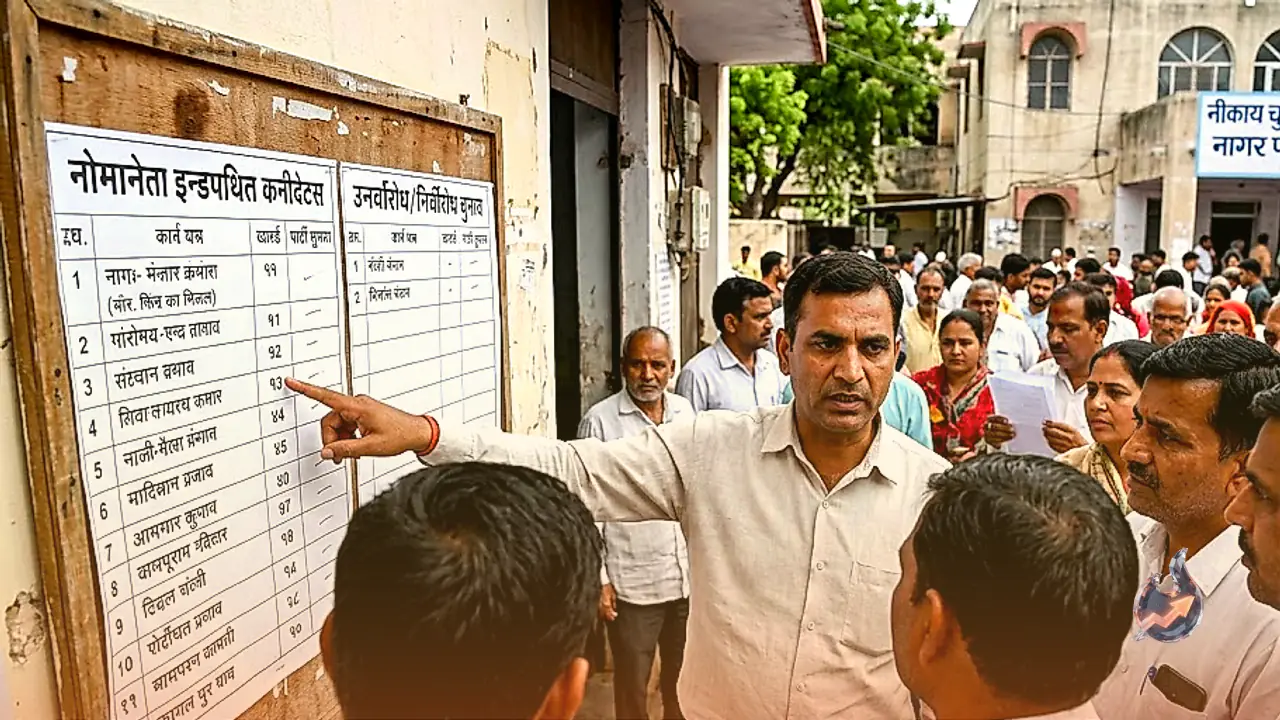

A surprising political scenario has emerged in the ongoing local body elections across 309 urban local bodies in Rajasthan, where polling is scheduled for 10,245 wards. While thousands of party workers lobbied fiercely for official tickets, both major political parties appear to have surrendered strategic ground in nearly 25 percent of the total wards. According to election data, there are approximately 2,550 wards state-wide where either the Bharatiya Janata Party (BJP) or the Congress failed to field an officially authorized candidate. Leaving such a substantial number of seats uncontested has sent shockwaves through local cadre and shifted the campaign dynamics significantly across multiple municipalities.
Seat Breakdown: Dissecting the Party Numbers
Data from the State Election Commission reveals that the Congress party did not field candidates in nearly 1,500 wards, representing roughly 14 percent of the total 10,245 wards up for contest. On the other hand, the Bharatiya Janata Party left around 1,050 wards vacant, accounting for nearly 10 percent of the total seats. With major national parties pulling out of the fray across these 2,550 wards, local contests in these segments have effectively turned into battles between independent candidates, smaller regional groupings, or single-party dominated fights. Political observers note that failing to field symbol-backed candidates on one-fourth of the state's civic seats highlights organizational gaps within both traditional party powerhouses.
Internal Disputes, Demographic Factors, and B-Form Delays
Insiders and political analysts point to a mix of strategic calculations and organizational lapses behind the vacancy of these seats. Sources within the BJP indicated that the party opted out of nearly 10 percent of the seats primarily because those areas were heavily Muslim-majority pockets or places where the party lacked a solid organizational foundation. Key locations where ticket consensus eluded the BJP due to fear of rebellion or complex local demographics include Makrana, Dataramgarh, Hindaun City, Ramgarh-Shekhawati, Deeg, and Nagaur. Conversely, Congress suffered a 14 percent deficit largely due to fierce internal factionalism that persisted until the last minute, coupled with delays in the issuance of official B-Forms. Consequently, several prospective candidates missed the filing deadline because they could not secure their allocation slips in time.
Rise of Independents and Massive Scrutiny Rejections
The absence of official nominees from major parties is set to benefit local independent contenders and smaller political outfits. In these 2,550 uncontested wards, party politics will take a backseat, giving way to personal reputation, accessibility, and hyper-local infrastructure issues. Furthermore, post-election board formations in several municipal councils and corporations will likely hinge entirely on the support of these independent candidates. Meanwhile, administrative scrutiny of nominations conducted late into the night by the State Election Commission led to significant disqualifications. Out of a total of 69,939 nomination papers submitted across Rajasthan, election officials rejected 7,854 forms due to technical errors, incomplete documentation, and statutory shortcomings.
Withdrawal Deadline and Campaign Timeline
With the scrutiny phase concluded, focus across all 309 urban bodies has now shifted to the candidate withdrawal phase. Candidates whose papers were validated are actively engaged in persuading rebel candidates to pull out of the race to prevent vote division. The deadline for candidates to formally withdraw their nominations is set for 3:00 PM on September 3, immediately after which the final list of contesting candidates will be published. On September 4, the Election Commission will allocate election symbols to all eligible candidates, marking the official kickoff for high-decibel ward-level campaigning across all 309 municipal bodies.