



















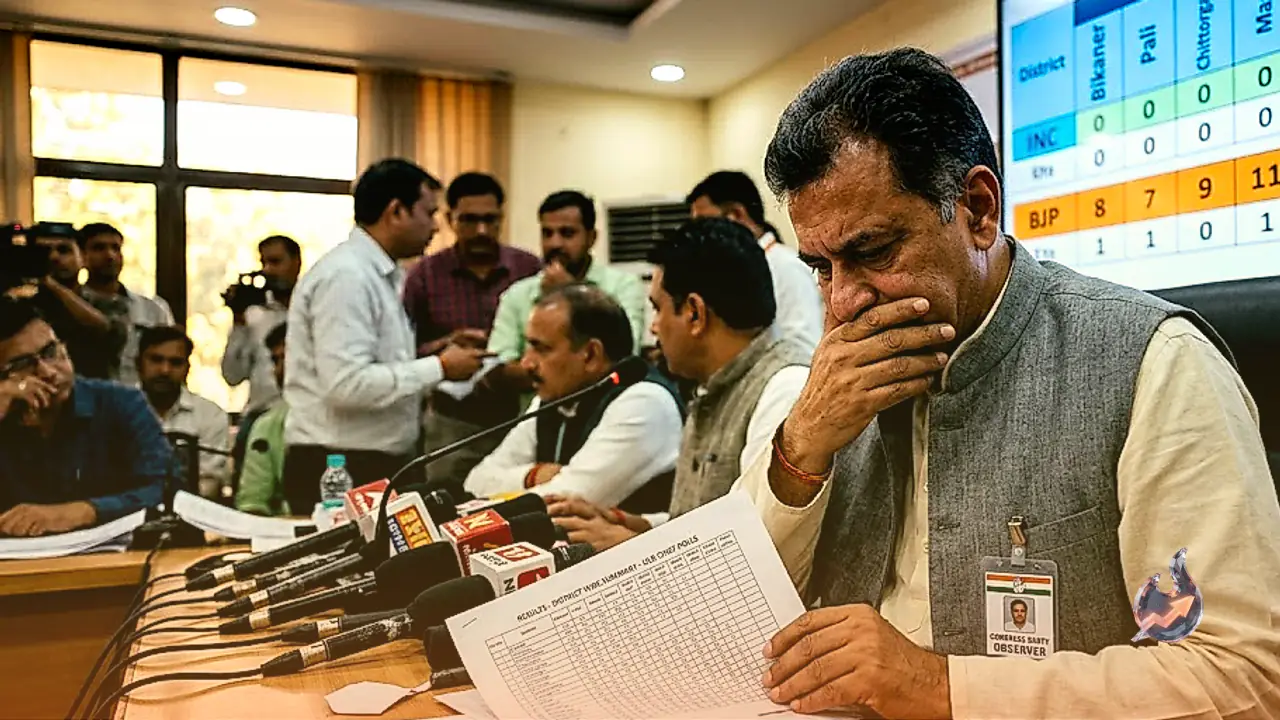

The results of the urban local body chief elections across Rajasthan have dealt a major political blow to the Congress party. In the run-up to the municipal and panchayat polls, the party had rolled out its ambitious Sangathan Srijan campaign to fortify its grassroots presence from the bottom tier to the top leadership. However, the ground reality during the election of civic body heads showed little trace of that organizational groundwork. While Congress appeared competitive during the initial councillor elections, its ranks fractured significantly when the race for local body chiefs unfolded. The final tallies left the party completely shut out in nine districts, while in another six districts, it managed to win only a solitary civic body.
Complete Washout in Nine Crucial Districts
The election outcomes declared on Monday revealed a sweeping loss for Congress across multiple geographic zones of the state. In nine districts comprising dozens of local bodies, the party failed to form even a single board. This clean sweep against the party occurred in the western districts of Barmer, Balotra, Phalodi, and Pali, as well as the eastern districts of Bharatpur and Deeg. Beyond these regions, Congress drew a blank in Kota within the Hadoti belt, the tribal-majority district of Dungarpur, and Beawar adjacent to Ajmer. In all these administrative areas, the opposition failed to secure any municipal chairmanship or mayoral seat.
Restricted to a Single Civic Body Across Six Districts
Alongside the nine districts where it won nothing, Congress achieved only marginal success in half a dozen other districts. The party was confined to just one local body board each in Ajmer, Banswara, Jaisalmer, Jalore, Pratapgarh, and Sirohi. The scale of the defeat caused visible concern within the party apparatus. Congress leaders reacted sharply to the outcome, accusing the ruling Bharatiya Janata Party of misusing state power to capture civic bodies. Rajasthan Pradesh Congress Committee president Govind Singh Dotasra, Leader of Opposition Tikaram Jully, and former Chief Minister Ashok Gehlot alleged that the Bhajan Lal administration disregarded public mandate and manipulated local authority elections.
Internal Discord and Flawed Floor Management
Political observers point to several organizational missteps behind the poor showing, foremost being weak floor management and tactical miscalculations. Congress struggled to formulate a coherent post-councillor strategy, leaving it unable to win over independent councillors or protect its own elected representatives from cross-voting and defection. The mayoral contest in Ajmer Municipal Corporation highlighted these vulnerabilities, where extensive efforts to install a Congress mayor collapsed during voting due to council divisions. Furthermore, simmering dissatisfaction over ticket distribution during the initial phases resurfaced during the leadership voting. Several rebels who won independently actively worked against local party leaders, eroding the official nominees' prospects.
BJP's Coordinated Enclosure and Grassroots Capitalization
In contrast, the BJP implemented a disciplined enclosure strategy that shielded its elected members from counter-poaching. The ruling party mobilized senior leaders and regional managers to secure majorities across as many civic boards as possible. Congress lagged behind in organizational unity, as persistent factional rivalries prevented its leadership from mounting a unified campaign. Consequently, the anticipated momentum from the Sangathan Srijan campaign failed to materialize at both the ward level and during executive elections. The BJP leveraged its governmental initiatives under the Bhajan Lal administration and tighter cadre coordination to capitalize on the opposition's internal rifts.