


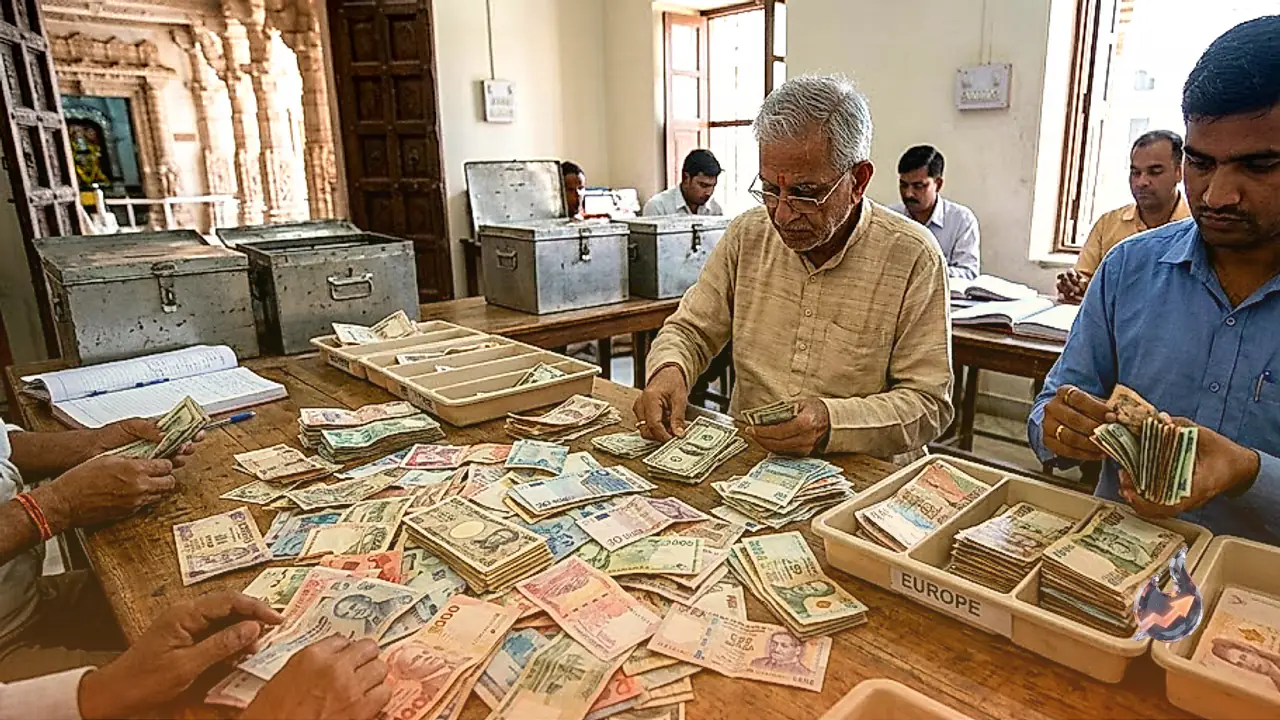
















The renowned Sanwaliya Seth Temple located in Chittorgarh serves as a profound spiritual anchor for countless devotees, extending its pull far beyond national boundaries. The sheer scale of global reverence for the deity becomes evident through the diverse foreign currencies regularly recovered from the temple donation boxes during routine counting processes.
Over the preceding eight months, collection drives inside the temple sanctum yielded paper money and coins originating from roughly sixty different countries. This widespread contribution includes tender from the United States, the United Arab Emirates, Kuwait, Australia, Canada, alongside various Gulf and European territories, underscoring the expanding international footprint and deep-seated faith associated with the shrine.
Major Foreign Currencies Collected Over Eight Months
The United States contributed the largest single-country share during this timeframe, accounting for 45,351 dollars in total offerings. Contributions also arrived in substantial quantities from numerous Muslim-majority and Gulf nations, reinforcing the far-reaching appeal of the site.
Additional currencies retrieved from the vaults include legal tender from Oman, Bahrain, Qatar, Saudi Arabia, Pakistan, and Bangladesh. Specific counting sessions highlighted distinct surges, such as 21,127 US dollars recovered in a single tally on April 16, and 8,955 UAE dirhams found during the August 11 count. Furthermore, calculations from February and March brought to light 463,500 Iranian rials and 229,000 Vietnamese dong.
Conversion Through Authorized Banks and Fund Utilization
According to Chief Executive Officer Dinesh Chandra Dhakad, all foreign currencies gathered within the premises undergo official conversion into Indian rupees through banking channels authorized by the Reserve Bank of India.
The total evaluated value of all foreign banknotes retrieved from the vaults stands at 62,800 US dollars.
Based on prevailing exchange rates, this accumulated foreign tender translates to roughly 59 lakh rupees in Indian currency. Temple authorities channel these financial resources directly toward infrastructural development, administrative upkeep, and various ongoing social and religious welfare initiatives.