




















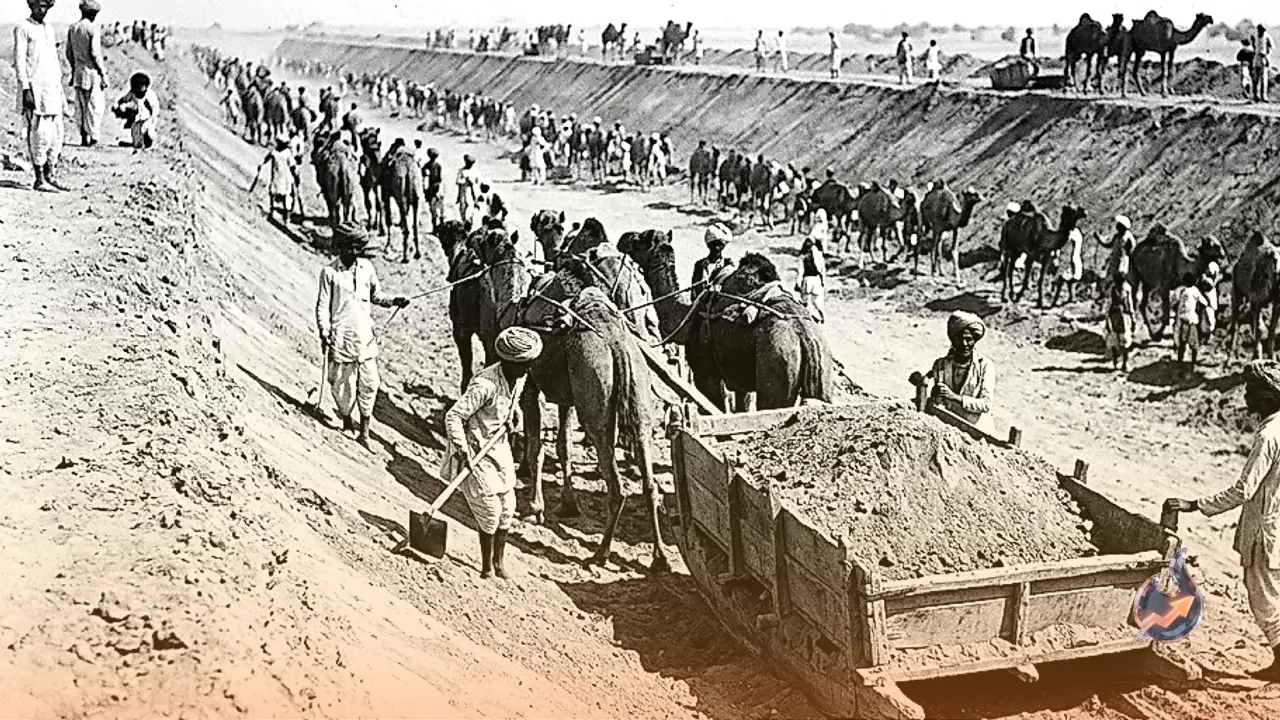

Camels have long been revered as the iconic ships of the desert in Rajasthan, but their indispensable contribution to one of Northern India's greatest engineering feats remains a lesser known chapter of history. Between 1920 and 1927, when the historic Gang Canal was excavated to transform the arid expanses of Western Rajasthan, modern heavy machinery like excavators and dump trucks did not exist. Instead, thousands of dedicated laborers alongside thousands of camels and camel carts formed the backbone of this monumental undertaking. The massive task of transporting tons of excavated soil across rolling sand dunes fell primarily on camel carts, a vital role preserved today in rare archival photographs and historical records.
The Devastating Chhappaniya Famine of 1899
The creation of the Gang Canal was far more than an ordinary irrigation canal project; it was a visionary initiative designed to provide permanent immunity against the recurring droughts that plagued Western Rajasthan. In 1899-1900, the region suffered one of the most catastrophe-laden droughts in Indian history, locally remembered as the Chhappaniya Famine because it occurred in Vikram Samvat 1956. In official colonial records, the British administration documented this tragedy as the 'Great Indian Famine'.
The absolute failure of monsoon rains completely destroyed standing crops across the landscape. Tragic scenes unfolded as thousands of starving villagers succumbed to acute hunger and thirst, while a massive number of cattle perished due to lack of fodder and water. The sheer scale of devastation devastated the local economy and underscored the urgent need for a long term water management strategy.
Maharaja Ganga Singh's Visionary Water Solution
Witnessing the terrible human suffering caused by the famine, Maharaja Ganga Singh, the ruler of the then princely state of Bikaner, recognized that temporary relief distribution could never solve the underlying crisis. He firmly believed that Western Rajasthan required a permanent irrigation infrastructure to secure its future. Guided by this foresight, he conceptualized a bold plan to divert surplus waters from the Sutlej River in Punjab across hundreds of kilometers into the desert sands of Rajasthan.
Recognizing the immense socio-economic benefit of the proposal, the British government endorsed Maharaja Ganga Singh's ambitious plan and granted official approval for the Gang Canal project. This set the stage for one of the most transformative civil engineering efforts in pre-independence India.
The Pivotal Role of Camels in Arid Terrain
Construction officially commenced in 1920 across challenging desert terrain. Deprived of modern equipment such as JCB diggers or motor trucks, workers relied entirely on manual tools like pickaxes and shovels to dig out the canal bed.
Clearing sand and heavy soil under extreme weather conditions presented formidable logistics challenges. Camels proved to be the most resilient and reliable transportation network in the soft sand. Labourers loaded excavated earth onto camel carts, which effortlessly hauled the heavy material across sand dunes where wheeled motorized vehicles would have stalled. Thousands of camels remained actively deployed on the canal line for seven consecutive years, working tirelessly to carve out the canal's course.
Agricultural Revolution in Sri Ganganagar
After seven years of grueling manual labor, the Gang Canal was completed in 1927, successfully delivering Sutlej water to the desert soil of Western Rajasthan. The arrival of river water triggered a dramatic ecological and economic revival in Sri Ganganagar and surrounding districts. Arid wasteland was rapidly converted into flourishing agricultural land.
Farmer yields of cash crops such as wheat, cotton, and mustard skyrocketed, dramatically improving agrarian livelihoods and accelerating regional socio-economic development. In subsequent decades, the canal network was expanded further to benefit adjacent areas of Rajasthan. According to Dr. Nitin Goyal, Senior Research Officer at the Rajasthan Prachya Vidya Pratishthan, the Gang Canal stands today as an enduring monument to the vision of Maharaja Ganga Singh, the sweat of thousands of workers, and the indispensable service rendered by camels.