




















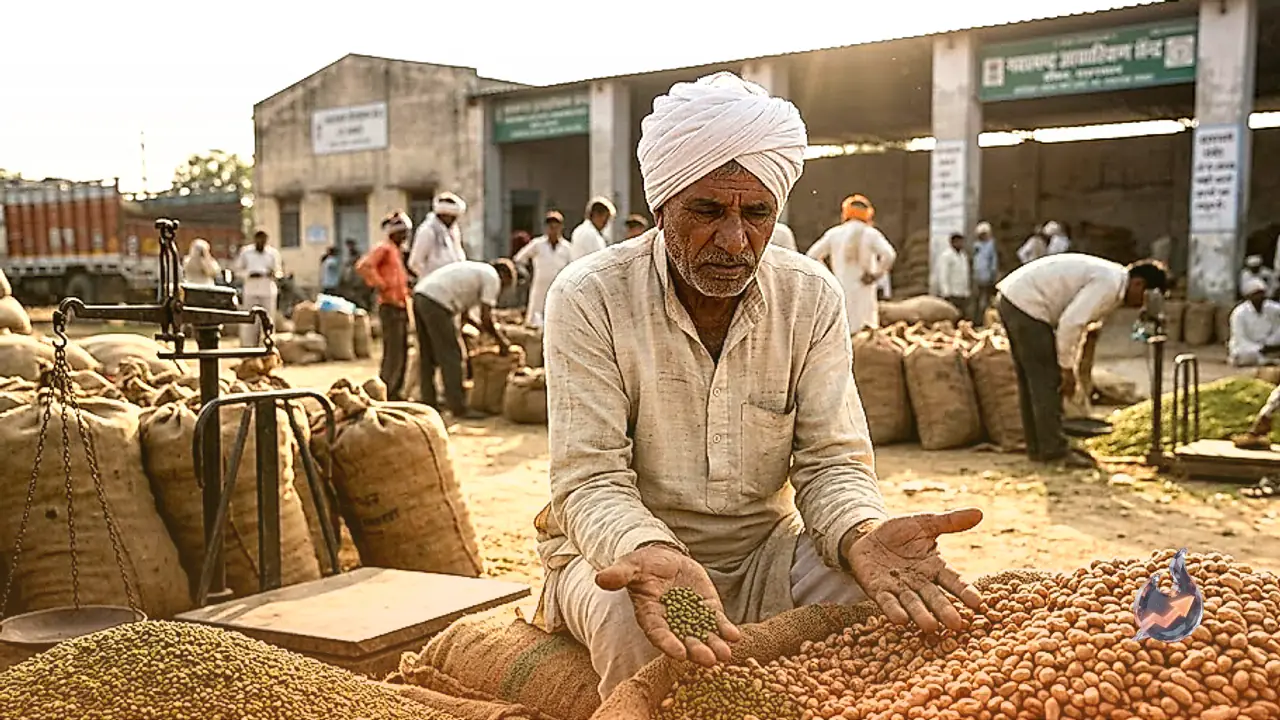

Ahead of the upcoming commercial procurement window for Kharif produce, the central government has officially announced revised Minimum Support Price rates, setting off mixed reactions across agrarian belts in Sikar district. Under the fresh pricing schedule, the guaranteed procurement rate for moong has been fixed at 8,780 rupees per quintal, while the rate for groundnut stands at 7,517 rupees per quintal. When evaluated against the previous marketing season, the upward revision translates into an increment of barely 11 rupees per quintal for moong growers, whereas groundnut cultivators have received a hike of 254 rupees per quintal. To facilitate orderly intake of arriving crops, cooperative authorities have simultaneously expanded procurement infrastructure throughout the district.
Marginal Increment in Moong and Groundnut Thresholds
During the preceding agricultural season, public procurement agencies offered farmers 8,769 rupees per quintal for moong consignments. The latest revision adds a nominal 11 rupees to that baseline, settling the benchmark at 8,780 rupees per quintal, representing the narrowest upward change across the entire seasonal basket. In contrast, the support price for groundnut was pegged at 7,263 rupees per quintal last year, which has now been raised by 254 rupees to reach 7,517 rupees per quintal. Agricultural producers point out that such minute adjustments fall drastically short of balancing soaring operating expenditures, including spiraling costs of certified seeds, chemical fertilizers, crop protection inputs, irrigation electricity, tractor fuel, and rising rural field labor.
Wider Revisions Across Other Major Kharif Staples
The latest price chart cleared by policymakers extends beyond moong and groundnut to incorporate critical coarse cereals and pulses such as bajra, tur, and urad. The procurement rate for bajra has moved from 2,775 rupees to 2,900 rupees per quintal, reflecting an increase of 125 rupees. Among primary pulses, tur has witnessed a notable enhancement of 450 rupees per quintal, raising its official rate to 8,450 rupees, while urad has received an addition of 400 rupees to settle at 8,200 rupees per quintal. These figures highlight clear disparities in price adjustments across varieties, leaving moong cultivators at the absolute bottom of the incremental spectrum.
Implications for Mandi Trade and Competitive Bidding
A declared support price does far more than set public purchase values; it fundamentally alters the pricing dynamics and inventory flows within open physical mandis. Grain trader Subhash Bubna points out that whenever the official support rate remains higher than spot wholesale quotes and public purchase centers function efficiently, farmers actively route their harvest to designated state yards. Such diverted deliveries reduce spot arrivals in commercial wholesale yards, prompting heightened bidding competition among private merchants and processors seeking adequate physical supplies, which can subsequently push open market quotations upward.
Conversely, should private buyers in open mandis offer rates comparable to or slightly above the state threshold, cultivators generally favor private transactions to avoid bureaucratic queuing and deferred settlements. An unhindered influx of crop volume into regular mandis can ease purchasing urgency among merchants, thereby exerting downward pressure on prevailing cash rates. Consequently, the ultimate financial return realized by farmers depends less on declared theoretical support levels and far more on the actual interplay between mandi demand and public procurement intensity during peak harvest weeks.
Procurement Framework Ready Across 19 Centers in Sikar
In anticipation of physical arrivals, the cooperative department has finalized the operational network for moong and groundnut procurement across Sikar district. Authorities have increased the total number of operational collection points from 17 to 19 this season to ease transit burdens for regional farmers. The central yard of the Sikar Krishi Upaj Mandi Samiti, alongside facilities at Dhod and Gothra Bhukran, will handle major intake volumes. In Dantaramgarh tehsil, operations have been assigned to the Dantaramgarh Purchase and Sale Cooperative Society, Palsana Mandi, and KVSS Dantaramgarh, while farmers in Laxmangarh and Fatehpur will access their respective local cooperative societies.
In the Khandela territory, facilities have been established at Khandela and Tapiplya GSS. The Shrimadhopur zone features the primary mandi yard in addition to centers at Bharni, Nathusar, Kanchanpur, Sihodi, Garh Taknet, and Simarla Jagir. Furthermore, within the Neem Ka Thana area, intake will proceed through the local Purchase and Sale Cooperative Society along with Patan and Chala GSS locations. With the physical directory of 19 centers formally established, the cooperative administration is scheduled to publish the detailed procurement calendar shortly.